

Global investment banks (IBs) predict that the listing of China's largest DRAM company, Changxin Memory Technologies (CXMT), is unlikely to shift the global memory semiconductor (hereinafter "memory") market landscape in the short term. This is because a technology gap of at least two to three years persists compared to leading firms, and recent gains in market share are largely attributed to windfall benefits from tight memory supply. However, CXMT's expansion of production capacity and diversification of its customer base are identified as key long-term variables that could reshape the competitive dynamics of the memory market.
According to industry sources on the 28th, global IB UBS stated in a report issued earlier this month that "despite CXMT's growth, the memory market structure centered on Samsung Electronics, SK Hynix, and Micron will not be shaken in the short term." The analysis notes that even with CXMT's aggressive expansion of production capacity, significant gaps remain compared to the existing three major memory companies in process technology, product mix, and supply of high-value-added products such as HBM (high-bandwidth memory).
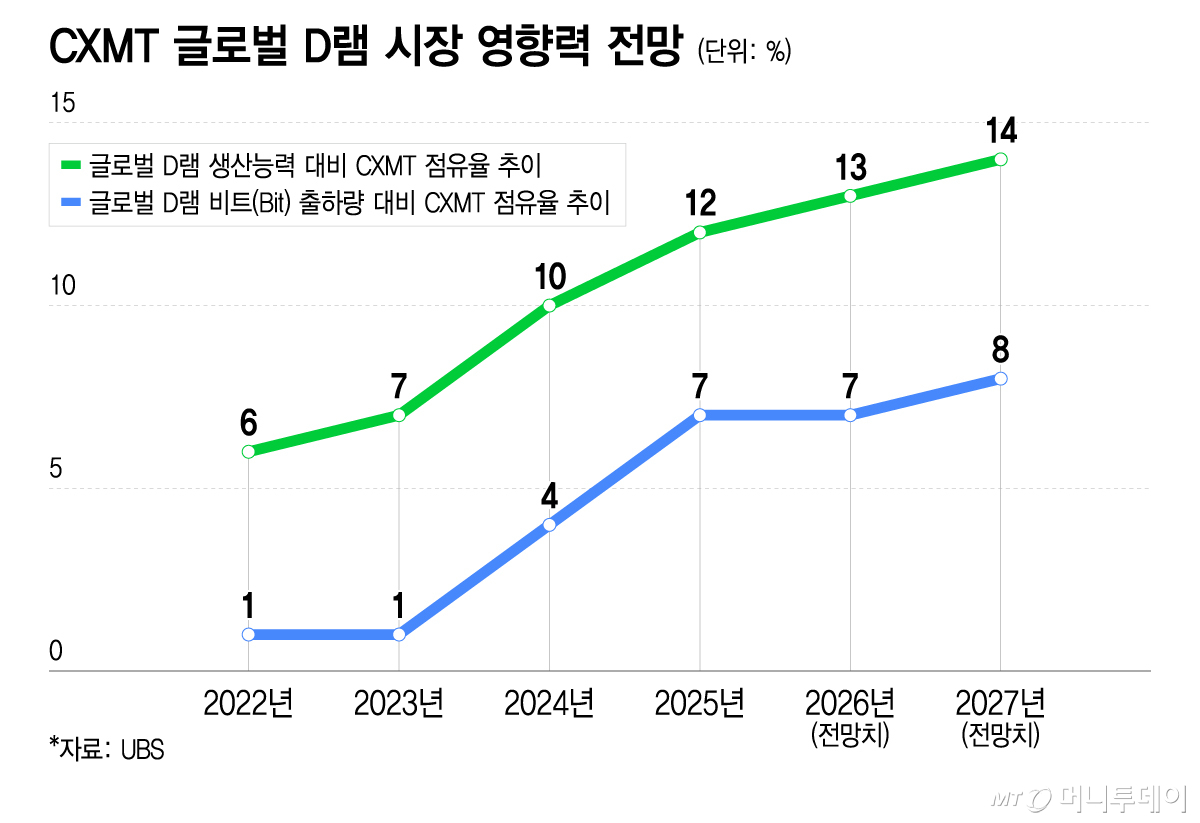
UBS expects CXMT's share of global DRAM production capacity to steadily increase from 12% last year to 13% this year and 14% next year. However, in terms of actual market supply measured by global DRAM bit shipment volume, its market share is projected to remain at 7% last year, 7% this year, and 8% next year. The assessment indicates that despite capacity expansion, market supply growth will be limited due to low yields and constraints in producing high-value-added products like HBM.
Another global IB, Jefferies, explained that CXMT's technology lags behind global leaders by 1.5 to two generations. While CXMT shipped samples of HBM3 (fourth generation) last year, Samsung Electronics and SK Hynix have already released samples of HBM4E (seventh generation) this year. Micron is also expected to ship HBM4E samples in the second half of this year.
According to market research firm Counterpoint Research, CXMT's global DRAM market share based on revenue expanded more than twofold from 3% in the first quarter of last year to 8% in the first quarter of this year within just one year. Some argue that this growth cannot be explained solely by technological competitiveness. Although AI-driven investment has surged memory demand, the production capacity of the three major memory companies could not keep pace, allowing CXMT to reap windfall benefits from tight memory supply.
Securing room for aggressive investment could become a variable. On the 27th (local time), CXMT raised 66.6 billion yuan (approximately 14.5 trillion won) through its listing on the STAR Market in Shanghai, exceeding its initial target of 29.5 billion yuan by more than double. CXMT plans to allocate these newly secured funds to retrofitting its existing Yangsan line, advancing memory technology, and R&D (research and development). Monthly wafer production capacity (thin wafers used to make semiconductor chips) is expected to expand from approximately 320,000 units this year to 420,000 units next year.
Concerns also arise that CXMT's market influence could grow further if its customer base expands. Following Chinese IT companies such as Huawei and Alibaba, global PC manufacturers HP and Dell Technologies have adopted CXMT's DRAM to diversify their supply chains amid a sharp rise in memory prices. Apple is also reported to have recently requested approval from officials of the Donald Trump administration to enable the use of CXMT memory in its products sold outside the United States.
A semiconductor industry official stated, "Even if production capacity expands, there will be limits to increasing market influence unless yields and quality are supported." The official added, "Conversely, if a stable Yangsan system is established, it could significantly impact the medium- to long-term competitive landscape of the three major memory companies."

 in INDUSTRY

