

Samsung Electronics once again shattered its record for the largest quarterly performance, buoyed by an unprecedented boom in memory semiconductors (hereinafter "memory"). Driven by expanded sales of high-value-added products such as HBM4 (6th-generation high-bandwidth memory), the semiconductor business alone recorded an operating profit of 89.2 trillion won. In contrast, the finished goods business turned to a historic first loss due to rising production costs.
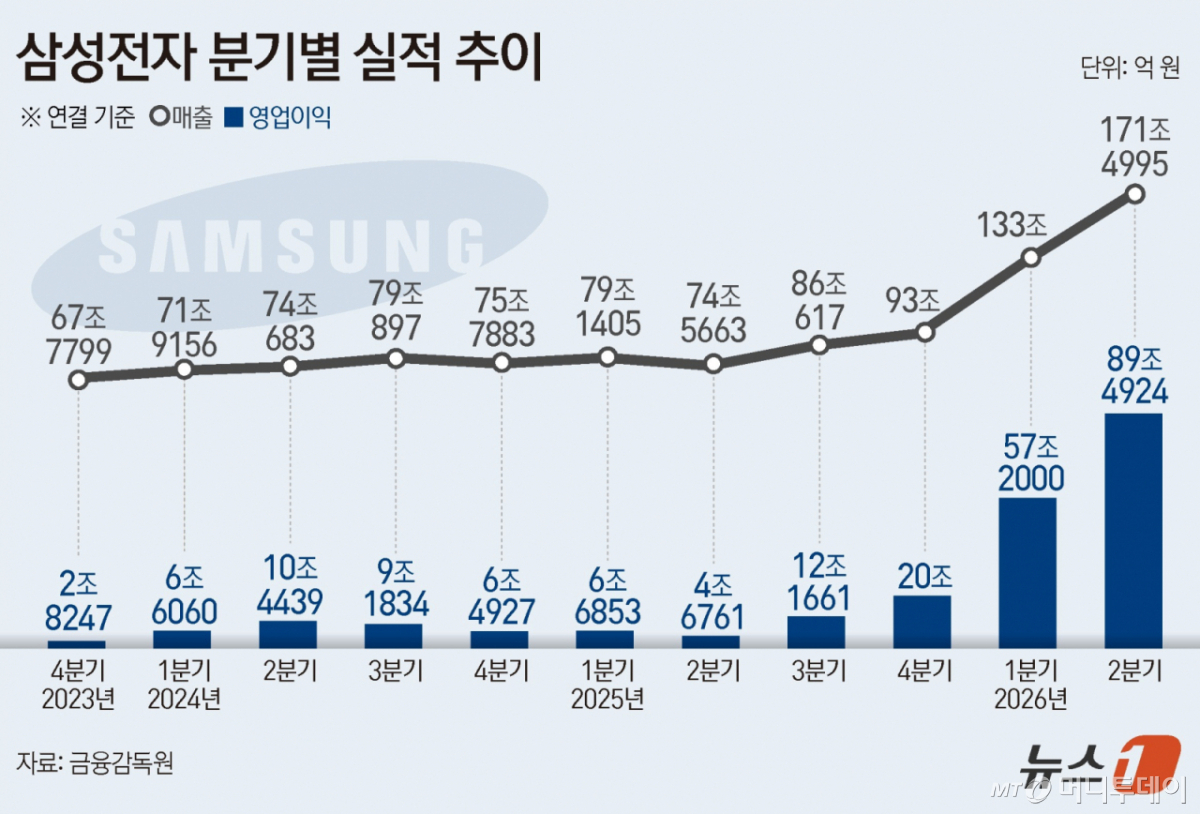
Samsung Electronics announced on the 30th that its consolidated sales for the second quarter of 2026 reached 171.5 trillion won, with operating profit hitting 89.5 trillion won. Sales rose by 130% and operating profit surged by 1,814% compared to the same period last year. Both figures represent all-time highs. Notably, the operating profit significantly exceeded the combined total of approximately 50 trillion won from all 704 KOSPI-listed companies excluding Samsung Electronics in the first quarter of last year. Net income per share was recorded at 18,490 won for both common and preferred shares, marking a 52% increase from the previous quarter. This reflects profitability at the highest level among global technology companies.
By business segment, the DS (Device Solutions) division, responsible for semiconductors, posted another record-breaking quarterly performance following the previous quarter, driven by strong sales of DRAM and NAND. The DS segment's operating profit reached 89.2 trillion won on sales of 127.5 trillion won. Semiconductor demand is expected to remain robust in the second half of the year. In contrast, the DX (Device Experience) division, centered on finished goods, saw sales increase by 130% compared to the previous year due to expanded sales of premium and AI products, but incurred an operating loss of 80 billion won due to rising component costs.
The memory business effectively shouldered all operating profits. With the spread of agentic AI, demand for server-grade products surged, achieving record quarterly results. Samsung also expanded shipments of HBM4 produced at its Yangsan facility, marking a first in the industry. Additionally, it shipped samples of HBM4E (7th-generation) to customers worldwide for the first time, further strengthening its technological competitiveness.
System LSI achieved its highest-ever sales in the first half of the year despite overall demand weakness, driven by expanded sales of mobile SoCs (system-on-chip) and sensors. Foundry operations saw improved performance, with sales increasing due to rising demand for products centered on HBM base dies and U.S. customers. Samsung Electronics' HBM4 utilizes its proprietary 4-nanometer (nm) process (1 nm = one-billionth of a meter). As HBM4 volumes expand, foundry utilization rates are expected to rise accordingly.
The operating profit margin for the entire DS segment stands at 70%. The memory business division's operating profit margin is estimated to approach 80%, placing it among the world's highest alongside SK Hynix, which reported a 76.3% margin the previous day, and Micron (80.4%).
However, the DX segment was hit directly by rising costs. The MX (Mobile Experience) division, responsible for smartphone operations, saw sales rise compared to the previous year due to strong sales of flagship products centered on the Galaxy S26 series and favorable performance of the A series. However, increased cost burdens led to a loss exceeding 70 billion won.
The VD (Video Display) division, responsible for TV operations, and the Home Appliances division both recorded losses of approximately 10 billion won. The VD division improved both sales and profitability compared to the same period last year due to proactive responses to major sports events like the World Cup and the launch of new products. The Home Appliances division saw sales increase from the previous quarter thanks to peak-season demand for air conditioners, but profitability declined.
Harman recorded an operating profit of 40 billion won, driven by expanded sales in automotive electronics and strong performance in personal audio devices. Samsung Display achieved an operating profit of 70 billion won, supported by robust demand for high-end mobile products and expansion in the gaming monitor market.
Even better results are anticipated for semiconductors in the second half of the year. The DS division plans to lead the market and strengthen technological leadership by expanding sales of HBM4, DDR5, SoCAMM2, and enterprise SSDs (eSSD). System LSI will expand sales of next-generation flagship SoCs, pursue new custom SoC businesses, and diversify applications for image sensors. Foundry operations aim to strengthen mid-to-long-term growth foundations by launching second-generation 2-nanometer mobile products at Yangsan and expanding orders.
The DX segment is expected to face continued challenging operating conditions due to rising component prices and growing global uncertainty. In response, the company plans to enhance business competitiveness while simultaneously improving its operational structure. The MX division aims to increase market share by expanding the proportion of high-value-added product sales. The VD division plans to capture year-end peak-season demand by expanding sales of AI-based new products and strengthening strategic partnerships. The Home Appliances division intends to improve profitability by shifting toward high-margin businesses through increased sales of AI-powered appliances.

 in INDUSTRY

