

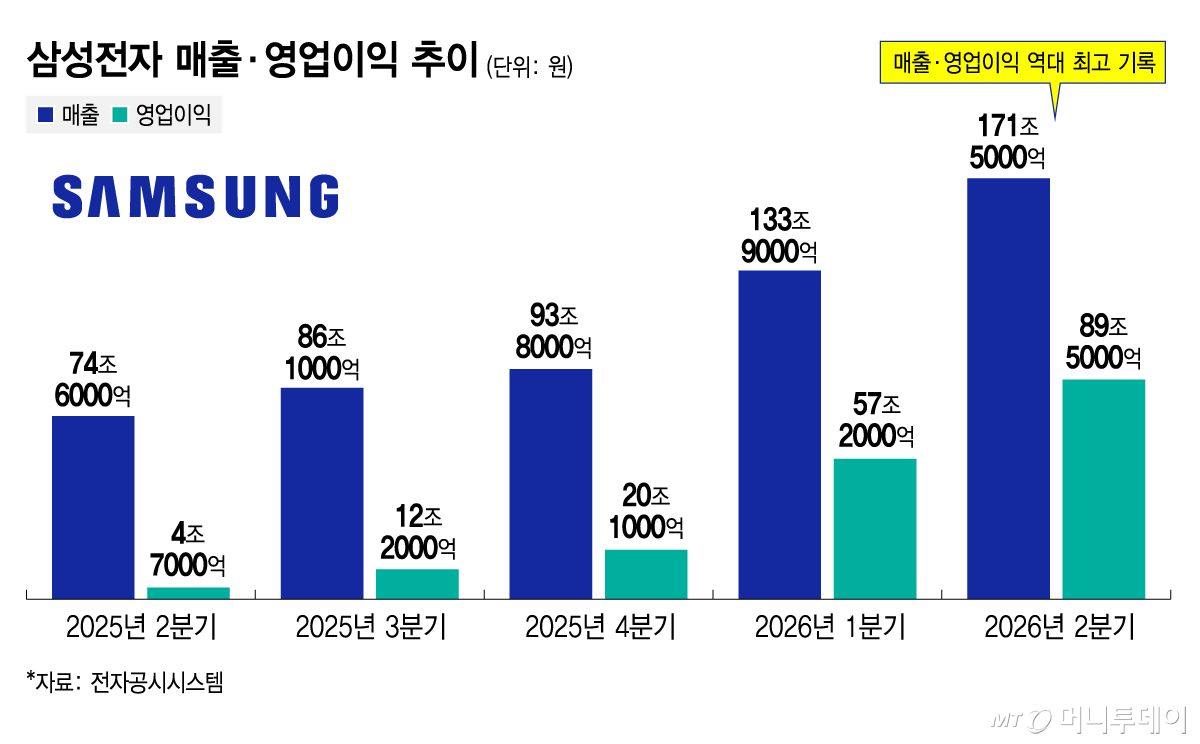
The paradox of a 'memory super-boom' has become reality. Samsung Electronics' semiconductor division posted its 'largest-ever in history' results, while the company's other pillar—the finished products (set) division—slid into losses. This is a counter-effect triggered by an unprecedented surge in memory semiconductor prices. Samsung Electronics plans to find a breakthrough in the second half of the year through new product effects and business diversification.
On the 30th, Samsung Electronics announced that the DX (Device Experience) division, which handles smartphones, TVs, and home appliances, recorded second-quarter revenue of 48 trillion won and an operating loss of 800 billion won. This stands in stark contrast to the DS (Device Solutions) division, which produces semiconductors, posting revenue of 127.5 trillion won and operating profit of 89.2 trillion won.
Of course, the operating profit generated from semiconductors is at a level previously unimaginable, so the company as a whole is showing overwhelming profits. In fact, the 800 billion won loss is less than one-hundredth the size of the semiconductor operating profit.
However, it carries significant symbolic meaning that Samsung Electronics' smartphone and TV/home appliance businesses, which have never posted a quarterly loss despite various external headwinds in the past, are turning into losses for the first time in history. This also relates to criticisms that South Korea's industrial growth has become overly skewed toward semiconductors.
The main cause is the sharp rise in semiconductor prices. A surge in AI infrastructure investment has intensified memory shortages, sending prices soaring to record highs. Typically, memory semiconductors accounted for about 10% to 15% of a single smartphone's cost, but recently this share has skyrocketed to nearly half. With limits on raising consumer prices, losses had to be absorbed. The MX business unit, responsible for smartphones, posted an operating loss of 700 billion won in the second quarter.
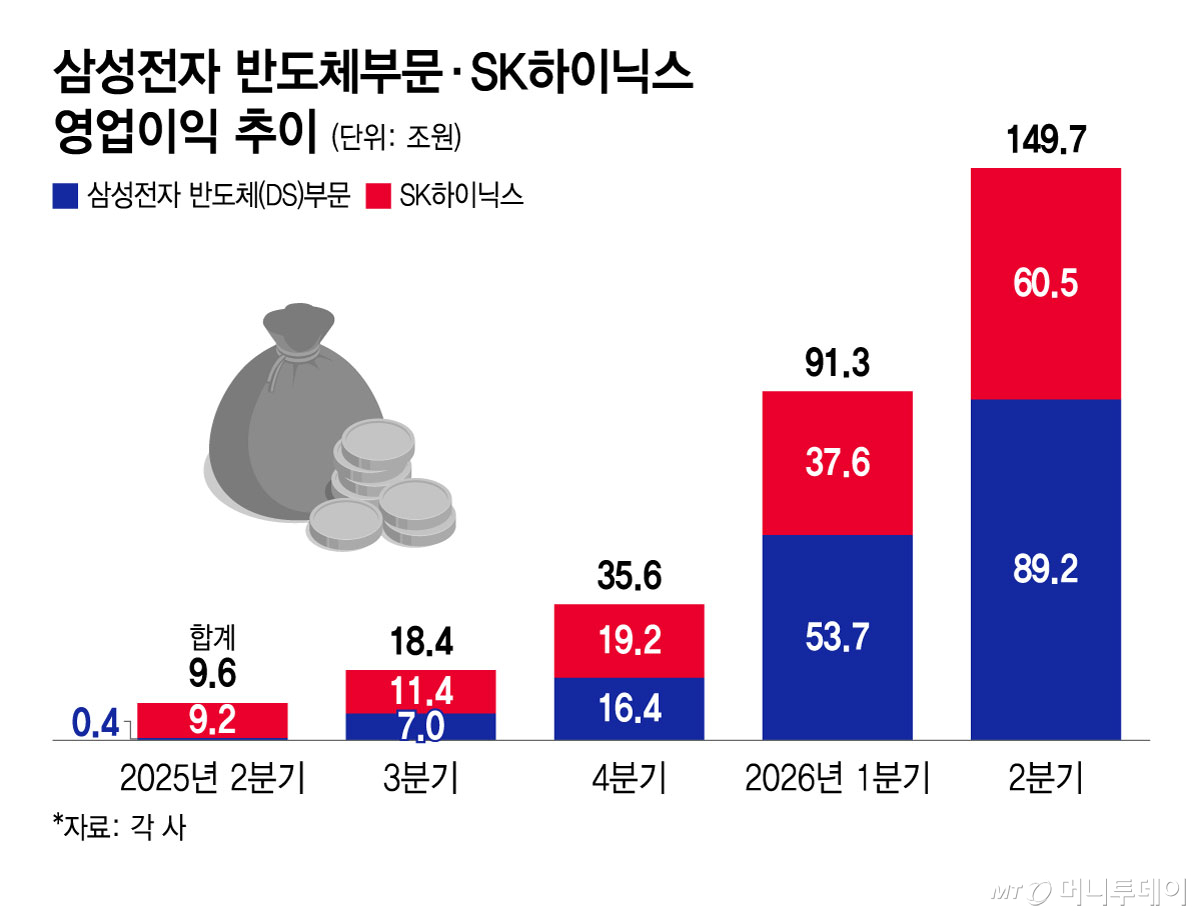
This is the same context as SK Group Chairman Choi Tae-won recently telling reporters, "I am worried that (semiconductor) prices will rise further." Paradoxically, this means South Korea's semiconductor industry can only be sustained if semiconductor prices fall. Excessively high prices can actually shrink the overall market and industry. If the burden on global consumers grows, political and economic attacks from major powers are also a concern. This is why Samsung Electronics and SK Hynix are going all out to expand production capacity through new fab (factory) construction.
However, there are limits to increasing supply immediately. Although China's CXMT (Changxin Memory Technologies) and others are ramping up production, the technology gap with us remains large. The industry expects memory prices to continue their high-flying trajectory for at least 2 to 3 years. This means semiconductor results will improve further, but setbacks for the set industry will continue.
Samsung Electronics' DX division plans to break through head-on by expanding premium sales, diversifying service businesses, and nurturing new businesses such as AI Daejeon (AX) and robots. Although it has turned into a loss, the company is placing its hopes on the fact that cumulative revenue for the first and second quarters reached 100.7 trillion won, surpassing '100 trillion won in H1 revenue' for the first time in DX division history. A Samsung Electronics official emphasized, "We maintained our scale with about 6% growth compared to the same period last year, and as improvements in each business unit's fundamentals become visible, expectations for a rebound in the second half are growing."
The MX business unit is pursuing a strategy to expand the share of high-value-added products by leading with the Galaxy Z8 series, which was unveiled on the 22nd. The VD (Video) business unit aims to overcome hardware limitations through service businesses. The free streaming platform 'Samsung TV Plus' provides over 4,300 channels in 30 countries and has surpassed 100 million monthly users. The DA (Home Appliances) business unit is focusing its efforts on maximizing the profitability of the HVAC (heating, ventilation, and air conditioning) business, which it is cultivating as a next-generation growth engine. Previously, it partnered with Flextronic Group, Europe's largest air-conditioning company acquired last year, to enter the central air-conditioning market targeting data centers and large industrial facilities.
Samsung Electronics is also nurturing its robot business. On the 21st, it established a new 'RX (Robot Transformation) Business Promotion Office' directly under the CEO to consolidate scattered robot capabilities, built a robot learning data factory in Gumi, and recruited leading scholars and experts from home and abroad. It plans to gradually commercialize humanoid robots for manufacturing purposes starting with this initiative.

 in INDUSTRY


