

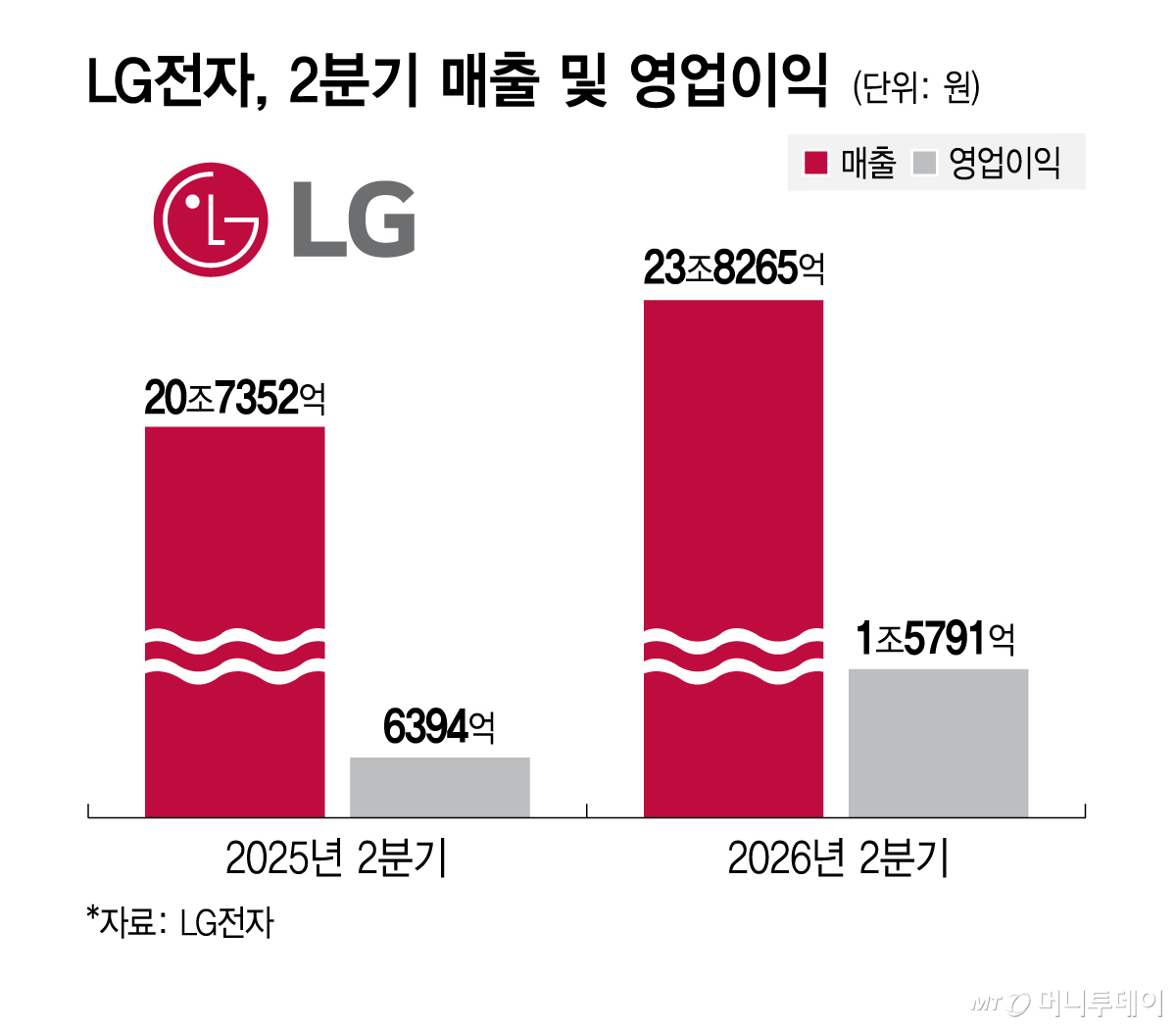
LG Electronics achieved its highest-ever performance in the second quarter, leveraging the competitiveness of its core businesses such as home appliances and TVs. Having demonstrated stable profitability in its main business, it is accelerating future business expansion by nurturing robotics and AI (artificial intelligence) data center cooling solutions (HVAC) as next-generation growth engines.
LG Electronics announced on the 30th that its second-quarter consolidated operating profit reached 1.5791 trillion won, a 147% increase from the same period last year. Revenue for the same period rose 14.9% to 23.8265 trillion won. Both revenue and operating profit for the second quarter reached record highs.
Despite unfavorable external conditions such as the Middle East war, the home appliance business continued to grow, contributing to revenue expansion through the effects of sports events like the World Cup and growth in the vehicle electronics business. Revenue increased as core businesses demonstrated solid competitive strength, and the sales mix of high-value-added products also grew.
Efforts to improve cost competitiveness across all businesses and a crisis management system proactively responding to uncertainties in the business environment also contributed to profitability improvements. Additionally, fully recovering tariffs paid on U.S. export shipments last year as one-time revenue played a significant role. The strong performance of LG Innotek, a consolidated subsidiary, also had a positive impact.
Second-quarter B2B (business-to-business) revenue reached 6.5 trillion won, a 5% increase from the previous year. B2B business accounted for 36% of total company revenue excluding LG Innotek. Subscription business revenue, including products and services, totaled 660 billion won, with expansion in overseas markets continuing.
By business division, the HS Business Division responsible for home appliances recorded revenue of 7.757 trillion won and operating profit of 685.9 billion won, breaking the 7th trillion won quarterly revenue milestone for the first time. A two-track strategy targeting both premium and volume zones (mid-price market), supply chain optimization, and expansion of subscription business supported these results.
The MS Business Division responsible for TV business reported revenue of 5.1146 trillion won and operating profit of 219.4 billion won, driven by growth in OLED and QNED (nano-based high-color-reproduction display) TVs and webOS. Despite intensifying competition, profitability was enhanced through cost structure improvements and operational efficiency.
The VS Business Division responsible for vehicle electronics business achieved its highest-ever second-quarter performance with revenue of 3.259 trillion won and operating profit of 191.2 billion won. Revenue exceeded 3 trillion won for two consecutive quarters, and the operating profit margin surpassed 6%, demonstrating stable cash generation capabilities. The ES Business Division recorded strong results with revenue of 2.7261 trillion won and operating profit of 235.8 billion won, driven by expanded overseas air conditioner sales.
LG Electronics' strategy is to nurture robotics and AI data center cooling solutions as next-generation growth drivers based on its core business competitiveness. Recently, it established a 'Robotics Business Center' directly under the CEO, and plans to operate the country's largest 'Robotics Data Factory' in the second half of this year. Cloyd robots are also being deployed in Yangsan for PoC (proof-of-concept) testing.
In addition, a pilot production line for actuators (driving devices), key components serving as robot joints, has been established at the Changwon plant in Gyeongnam province, with initial production underway. The company plans to begin active order-taking activities targeting potential customers from the second half of this year and also aims to establish a Yangsan system.
The AI data center cooling solutions business aims to secure orders worth several trillion won this year. It has already secured 600 billion won in orders during the first half alone. LG Electronics is receiving positive evaluations from customers by leveraging its quality and on-time delivery capabilities. Its self-developed 600-kilowatt (kW) coolant distribution unit (CDU) recently passed NVIDIA's final quality certification. To respond to increasing orders, the company plans to gradually expand domestic and overseas production capacities.
An LG Electronics official stated, "Currently, AI infrastructure investment is actively underway centered on big tech companies, and North America is a key strategic market for data center cooling business." He added, "In North America, we are expanding customer touchpoints centered on hyperscalers (large-scale data center operators) and major partners, increasing orders through integrated cooling solutions such as chillers and liquid cooling."

 in INDUSTRY
