

With the high-performance advancement of AI (artificial intelligence) semiconductors leading to larger packaging sizes, glass substrates are emerging as a next-generation material capable of overcoming heat and warping limitations. As domestic major component companies rush to build supply chains in line with the market's rapid growth, China's display giant BOE has also entered the competition, making the global struggle for leadership increasingly fierce.
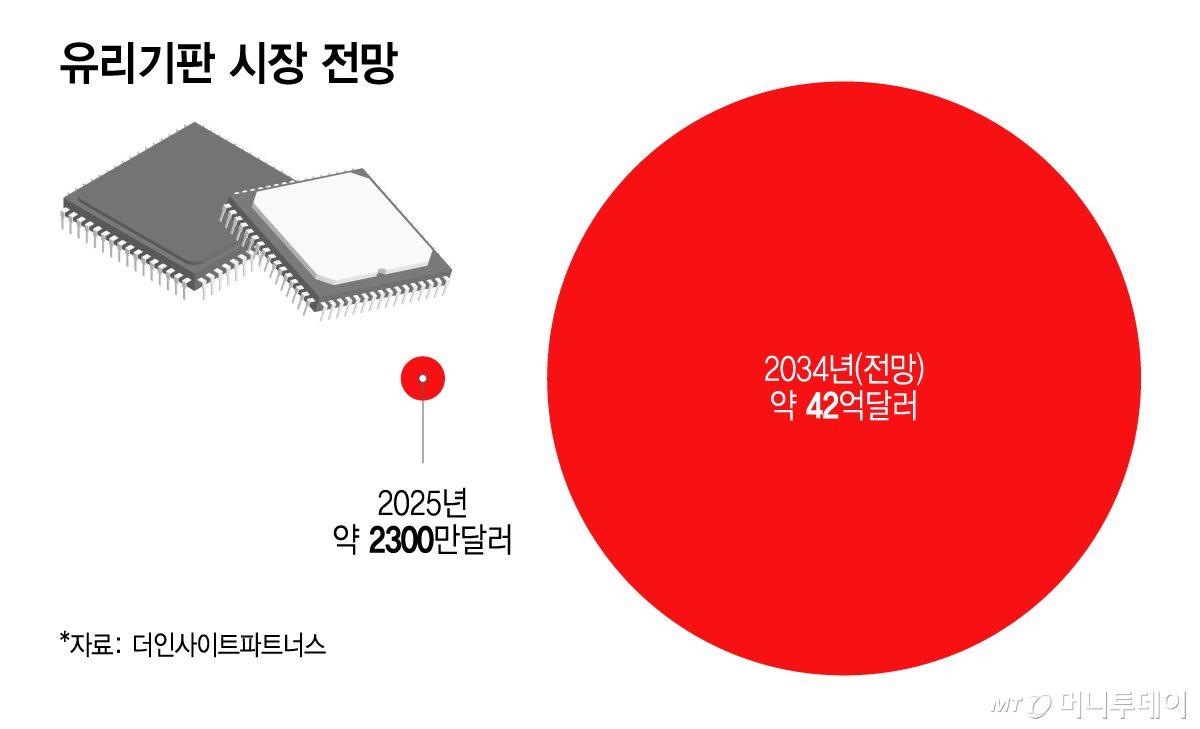
According to Global Market Insights on the 4th, the glass substrate market is projected to grow from approximately $23 million (about 32.9 billion won) in 2025 to about $4.2 billion (approximately 6 trillion won) by 2034, driven by changes in AI semiconductor packaging structures. This growth is fueled by rising demand for advanced packaging technologies that combine AI accelerators and HBM (high-bandwidth memory), drawing attention to next-generation materials set to replace existing substrates.
The current standard for semiconductor packaging is plastic (organic) substrates. However, as chip areas expand and data processing volumes surge, physical limitations such as thermal expansion and warping are becoming apparent. Organic materials tend to deform under high-temperature processes, and implementing fine circuits is also challenging. In contrast, glass substrates exhibit minimal thermal deformation and have smooth surfaces, making them advantageous for large-area and ultra-fine packaging.
For these reasons, global companies are racing to secure glass substrate supply chains. Following Intel's announcement of entry, SKC (Absolics) in South Korea is currently undergoing customer certification in the United States. Samsung Electro-Mechanics stated during a conference call held on the 30th of last month: "Following the public disclosure of an MOU (Memorandum of Understanding) for establishing a joint venture, we signed a definitive contract in early July with Dongwoo Fine-Chem, a subsidiary of Japan's Sumitomo Chemical, to establish a joint venture for producing glass core, the key material for glass substrates." The company added that it will hold a 66.2% stake and plans to finalize the establishment of the legal entity within this year. LG Innotek is also advancing technology development by building a pilot line.
BOE also revealed its progress on glass substrate technology development and the construction of a test production line at the 'Display Business Forum 2026' held on the 21st of last month. Bi Si, BOE's Vice Chief Strategy Officer, explained: "As AI chip sizes continue to grow, it is becoming increasingly difficult to cope with existing substrates," adding that "glass can serve as an alternative for next-generation packaging substrates." He further emphasized: "BOE is researching TGV (through-glass via), RDL (redistribution layer), and bump technologies, and we expect our test production line to contribute to the development of the AI industry."
BOE activated its pilot line invested in 2024 within two years and signed an agreement with U.S. Corning in May for the development of packaging substrates and optical interconnects. This appears to be a strategy to expand technologies accumulated during LCD (liquid crystal display) and OLED (organic light-emitting diode) production processes into the next-generation semiconductor packaging sector. Industry observers note that BOE's entry could initially have a positive impact on expanding the glass substrate ecosystem. However, given that Chinese companies have expanded their leadership in the LCD and OLED markets by leveraging price competitiveness, there are analyses suggesting they may also become a medium-to-long-term competitive variable in the glass substrate market.
A semiconductor industry official stated: "Glass substrates are not merely materials replacing existing substrates but technologies that will determine the structure of next-generation AI semiconductor packaging." The official added: "In the competition for glass substrates, securing yield and quality that meet actual customer requirements is more important than simply expanding production capacity."

 in INDUSTRY
