

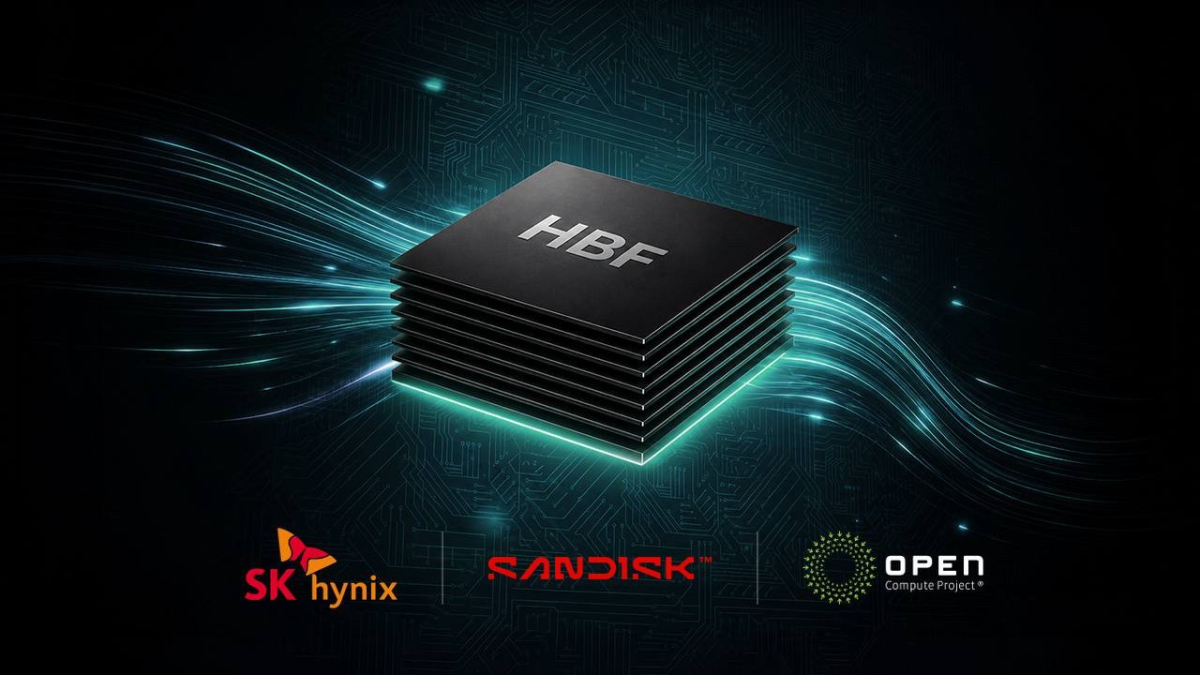
SK Hynix announced on the 4th that it has unveiled the first standard specification for HBF (High Bandwidth Flash), a next-generation storage technology, together with SanDisk.
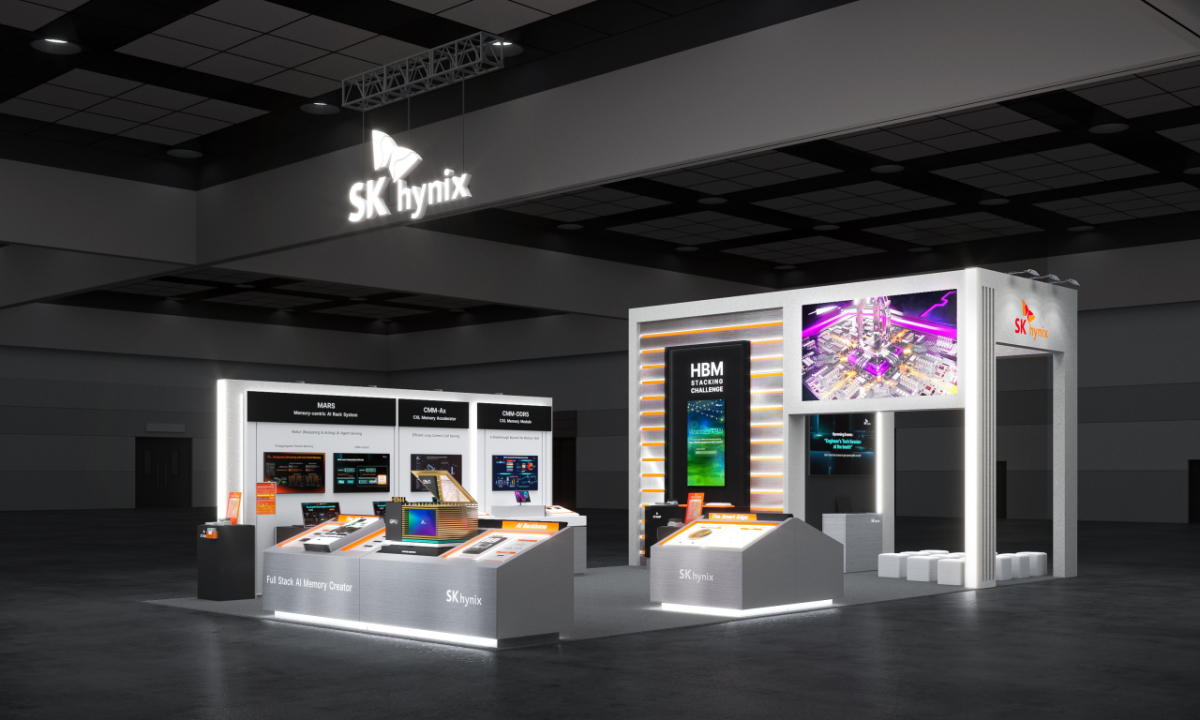
From the 4th (local time) over three days, SK Hynix plans to introduce HBF as a key technology to resolve memory bottlenecks in the AI era at 'FMS (Future of Memory and Storage) 2026' held at the Santa Clara Convention Center in California, USA. Like HBM (High Bandwidth Memory), HBF is characterized by its ability to rapidly exchange data while enabling large-capacity implementation based on NAND flash (NAND). With the proliferation of AI inference leading to a surge in data that must be processed, it is evaluated as a technology capable of securing both bandwidth and capacity scalability simultaneously.
This specification is the first achievement released approximately six months after SK Hynix launched a consortium with SanDisk for HBF standardization cooperation last August and formally established the consortium in February this year. The capacity is defined up to a maximum of 512 gigabytes (GB), based on two stack configurations: stacking NAND dies in 8-layer and 16-layer arrangements. Bandwidth is divided into three grades (Grade 1 to 3), allowing implementation from approximately 0.4 terabytes (TB) per second up to a maximum of 3.0 TB.
A notable point is the method of connecting HBF with processors. By adopting UCIe (Universal Chiplet Interconnect Express), an industry standard, it has laid the foundation for flexibly connecting HBF with different processors such as GPUs (Graphics Processing Units) and CPUs (Central Processing Units). Additionally, the specification includes: △connection interface and electrical characteristics; △HBF die stack process reliability and packaging guidelines; and △software usage guidelines for data input/output. The specification will be made public through OCP (Open Compute Project), the world's largest open data center technology collaboration body. It is intended to serve as an open standard usable by the entire industry, not just a specific company.
SK Hynix plans to accelerate the adoption of HBF in the AI storage market and foster ecosystem development, coinciding with the unveiling of the first standard specification. Currently, Google and Tenstorrent are participating in the HBF consortium. The plan is to enhance both technological maturity and market acceptance through open collaboration.
On the first day of 'FMS 2026', the 4th, Kim Cheon-seong, Head of SK Hynix Solution Development Division, and Kang Wook-seong, Manager of Next-Generation Product Planning, will deliver a joint keynote speech on the topic "Efficient Implementation of AI Infrastructure Based on Hierarchical Memory in the Age of AI Agents." They are expected to present the necessity and direction of next-generation architectures based on hierarchical memory that optimizes by connecting multiple memories with different characteristics into a single system. On the 6th, Im Ui-cheol, SK Hynix Solution AT Manager, Xiaowei Ma, Researcher at Google DeepMind, and Rajiv Nagabhirava, Vice President at SanDisk, will participate in a panel discussion on the topic "Crossing the Memory Wall with HBF." At this session, the role and potential of HBF will be closely examined.
Additionally, SK Hynix will unveil its 10th-generation (V10) 375-layer 4D NAND wafer and products for the first time at the 'FMS 2026' exhibition. The 375-layer 4D NAND is designed to optimize performance per power by 2.5 times compared to previous generations, making it ideal for AI infrastructure environments such as data centers. Based on this, SK Hynix plans to begin development of the high-performance, high-capacity enterprise eSSD (enterprise SSD) Yangsan in early next year, further strengthening its NAND competitiveness in the AI market. In addition, the company will also exhibit a lineup of products applicable to various fields including mobile, PC, automotive, and robotics.
Kim Cheon-seong, Head of SK Hynix Solution Development Division, stated, "As AI utilization spreads rapidly, we are at a point where a redesign of the entire data processing structure is required," adding, "Through HBF, we will contribute to implementing a new architecture that expands the boundary between memory and storage and improves overall system efficiency."

 in INDUSTRY

