

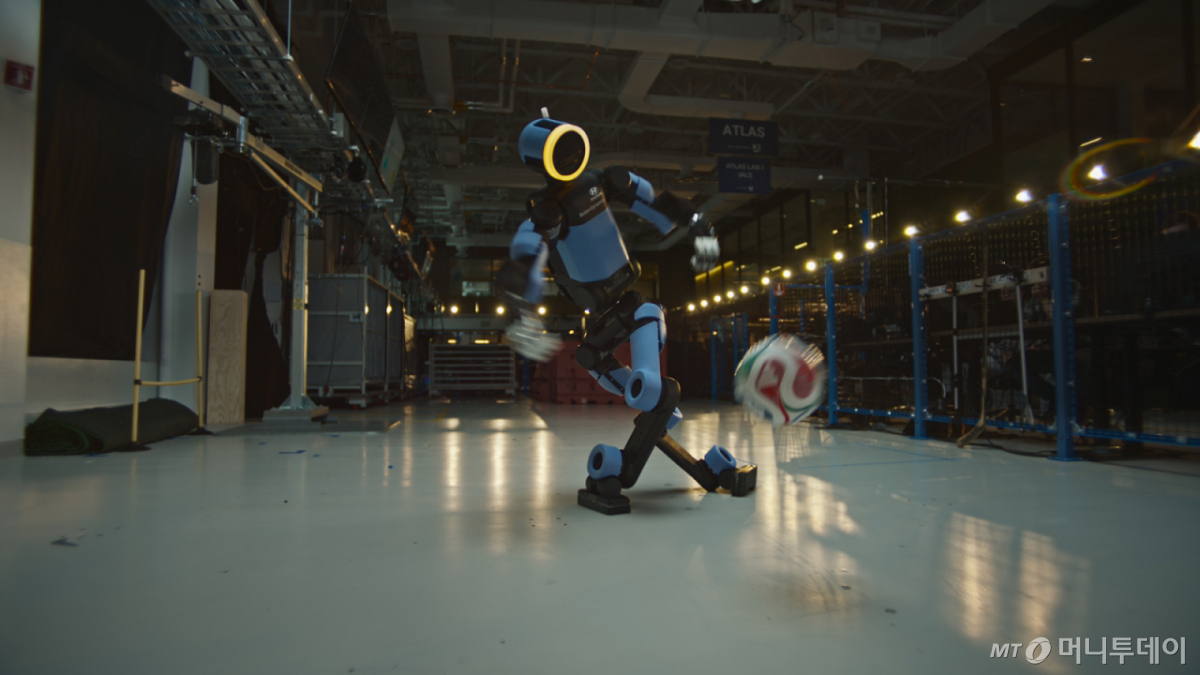
The head can be completely detached and attached to another robot, while its computing unit is swapped like a game console cartridge. This is the structure of "Atlas," a humanoid (human-shaped) robot unveiled by Boston Dynamics, a specialized subsidiary of Hyundai Motor Group. The company explains that with this design, even when new technologies emerge, there is no need to redesign the entire robot; simply replacing the head allows immediate integration of the latest innovations.
According to industry sources on the 5th, Boston Dynamics recently highlighted the modularity level of the head as a key differentiator for Atlas compared to other humanoid robots. The head itself can be easily detached and reattached from the robot's main body, and its internal computing unit is also separable. By redesigning only the head and mounting it on existing robots, the same effect as upgrading the brain of a new robot can be achieved. This approach extends the lifespan cycle of the robot's main body amid rapid advancements in AI (artificial intelligence) semiconductor performance.
In fact, the head is a newly added component for Atlas. Earlier generations of hydraulic-powered Atlas robots did not have heads. As they were research platforms designed to verify high-difficulty maneuvers like backflips, they only needed to check the terrain directly in front. In contrast, the electric-powered Atlas was developed with the premise of working alongside humans, requiring broad situational awareness. Thus, cameras were elevated to head height. The recognition module inside the head consists of four units: two camera sensors form a pair like human eyes, using stereoscopic vision to gauge distances to objects.
The humanoid robot market is seeing intensified competition as companies such as Tesla and Figure AI from the U.S., and Unitree and Ubtech from China, enter the field. While some robots have begun deployment in actual production processes, most remain limited to pilot operations for narrow, repetitive tasks. To be permanently stationed on production lines, success rates must be improved while reducing the burden of component replacement and maintenance.
The modularity of Atlas's head appears to be a design specifically targeting reduced maintenance burdens. If robots are commercialized in industrial settings, repeated replacements of computing units and components will occur. By swapping only the head without dismantling the main body, downtime for removing robots from production lines can be minimized. This context also explains why Boston Dynamics emphasizes not just performance capabilities but also the replaceable structure as a key differentiator for Atlas.
Hyundai Motor Group plans to deploy Atlas at HMGMA (Hyundai Motor Group Meta Plant America) in Georgia, U.S., starting in 2028. Initially applied to sorting tasks for component classification to verify on-site operations and reliability, the company intends to expand its usage scope to include part assembly processes from 2030 onward.

 in INDUSTRY
