

While the upward trend in mobile DRAM prices continues, the phase of sharp price surges is expected to gradually ease. Samsung Electronics, which raised prices significantly in the previous quarter, is now moderating its pace of increases this quarter, while SK Hynix and China's CXMT (Changxin Memory Technologies) are applying relatively higher hikes to narrow their gap, highlighting distinct strategies among manufacturers. In the semiconductor industry, it is anticipated that the price increase trend will continue for some time due to limited expansion in mobile DRAM supply caused by production reallocation toward AI data centers and HBM (high-bandwidth memory).
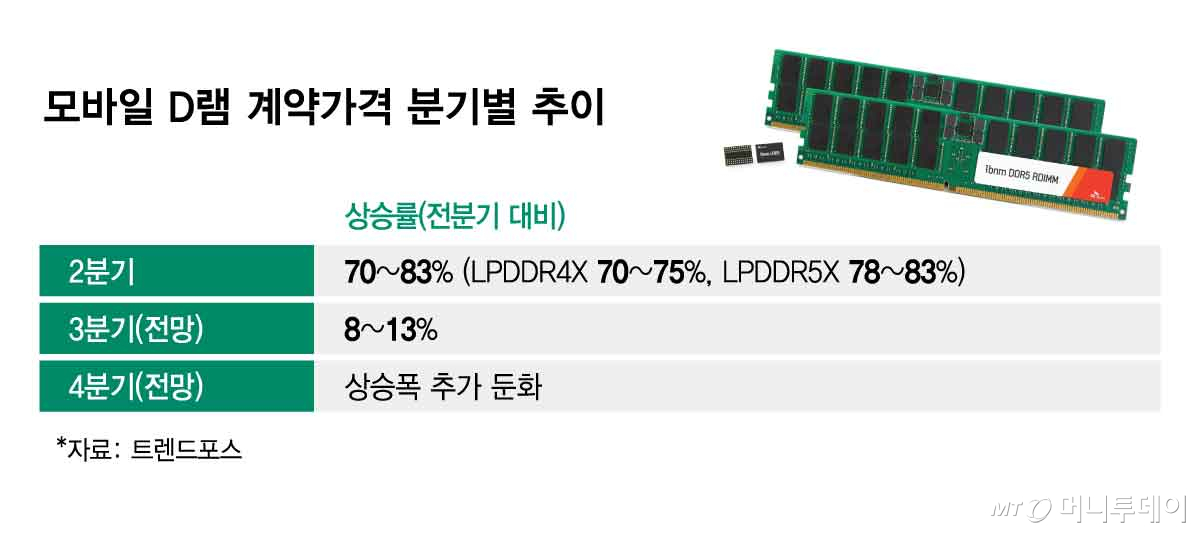
According to market research firm TrendForce on the 7th, mobile DRAM contract prices are expected to rise by 8% to 13% in the third quarter of this year compared to the previous quarter. The magnitude of the increase is smaller than that of the prior quarter. As smartphone manufacturers have largely completed inventory buildup and final demand has slowed, a shift in negotiation dynamics is being observed, with suppliers' price proposals now facing more scrutiny rather than automatic acceptance.
TrendForce analyzed that the market atmosphere earlier this year, where smartphone companies effectively accepted suppliers' price proposals, has disappeared, and third-quarter price negotiations have entered a tug-of-war phase. With inventory acquisition reaching a certain level of completion, the urgency of purchasing negotiations has decreased, and set manufacturers now have more room to review pricing conditions. However, distinct strategies among memory manufacturers are expected to become prominent in this round of price negotiations. In particular, Samsung Electronics, which already reflected a significant portion of price increases during the second quarter when LPDDR (low-power DRAM) 4X and 5X prices rose by 70% to 75% and 78% to 83%, respectively, is expected to have relatively limited room for further hikes. In contrast, SK Hynix and CXMT are projected to propose relatively higher increase rates to narrow the price gap with Samsung Electronics.
Industry observers view this mobile DRAM price negotiation as a case demonstrating that transaction structures vary by product category even in a market increasingly centered on AI memory semiconductors (hereinafter "memory"). In fact, driven by expanding demand for AI servers and HBM, major memory manufacturers such as Samsung Electronics and SK Hynix are expanding long-term supply agreements (LTAs) with customers. The transaction structure of the memory market is also shifting from quarterly price negotiations to a model that secures certain volumes and pricing conditions over an extended period. LTAs provide production planning stability for memory manufacturers and ensure stable volume acquisition for customers.
However, such expansion of long-term contracts is primarily focused on server DRAM and HBM. In Samsung Electronics' recent second-quarter earnings conference call regarding LTA-related content, mobile DRAM was not mentioned separately. The industry believes that since the mobile DRAM market still maintains a quarterly negotiation structure, inventory conditions and supply capacity among manufacturers will be key variables in price negotiations.
In the fourth quarter, the pace of mobile DRAM price increases may slow further. TrendForce forecasted that price hike margins will narrow even more as weak final demand and high inventory levels persist. However, Samsung Electronics and SK Hynix are maintaining their trend of adjusting production capacity toward server DRAM and HBM, making it difficult for mobile DRAM supply to expand in the short term. Consequently, there is speculation that memory manufacturers are more likely to maintain production allocation focused on high-value-added products rather than rapidly increasing general-purpose DRAM supply.
A semiconductor industry official stated, "With smartphone companies completing their inventory buildup, sharp price increases like in the past may become difficult." The official added, "Mobile DRAM supply capacity has not expanded rapidly, so negotiation power will vary depending on each manufacturer's production capacity and inventory conditions." The official concluded, "The upward trend is expected to continue for some time, but with adjusted magnitude."

 in INDUSTRY
