

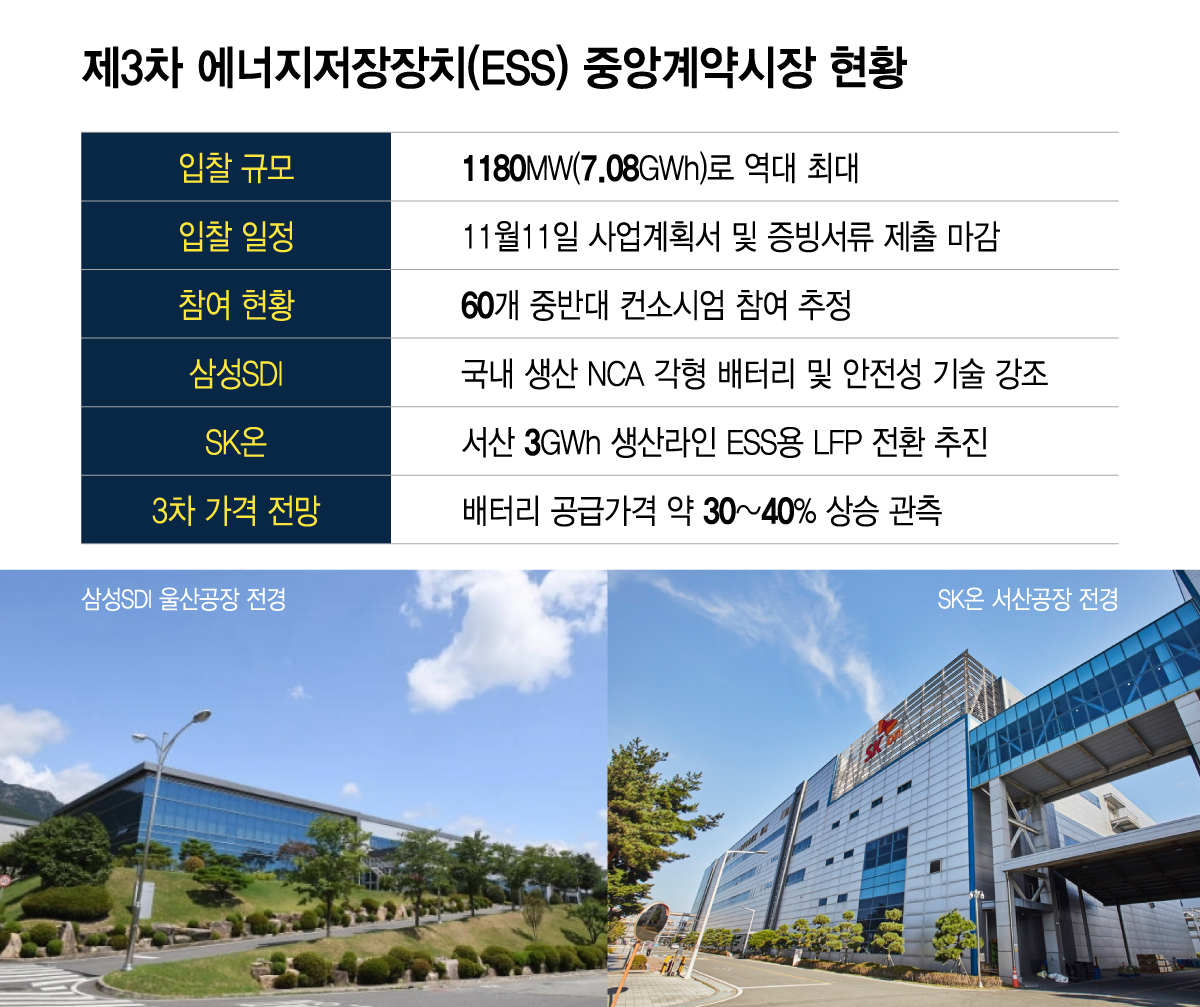
The 3rd Energy Storage System (ESS) Central Contract Market, being held at its largest scale to date, has narrowed down to a two-way contest between Samsung SDI and SK On due to LG Energy Solution's non-participation.
Unlike the excessive low-price competition seen in the previous two bids, forecasts suggest that battery prices will rise this time as the number of suppliers decreases. Attention is turning to what strategies domestic battery companies will choose amid the tension between expanding order volumes and securing profitability.
According to the battery industry on the 9th, the government will close submissions for business plans and supporting documents related to the 3rd ESS Central Contract Market bidding on the 11th.
The volume announced this time is 1,180 MW (megawatts), which exceeds the combined total of 1,128 MW from the first round's 563 MW and the second round's 565 MW. Converted to battery storage capacity, it reaches approximately 7.08 GWh (gigawatt-hours). It is known that mid-60s consortiums participated in the bid proposal submissions, which closed on the 4th.
This bidding war has narrowed down to a two-way contest between Samsung SDI and SK On after LG Energy Solution decided not to participate. Both Samsung SDI and SK On have already been selected as the largest supplier once each.
In the first round, Samsung SDI secured approximately 76% of the total volume, or 427 MW, while in the second round, SK On won orders for 284 MW, taking the largest share. In the third bid, the two companies will face off over the largest order volume in history.
Samsung SDI is leveraging the safety and supply chain competitiveness of its domestically produced NCA (nickel-cobalt-aluminum) series prismatic batteries.
The company has a battery production capacity of approximately 15 GWh annually at its Ulsan plant and has secured a stable supply system by utilizing the domestic ternary battery material supply chain. In particular, it plans to differentiate itself from pouch-type batteries by applying safety-enhancing technologies such as module-integrated direct injection (EDI) and thermal diffusion prevention (No TP) to its highly durable prismatic batteries.
SK On is focusing on strengthening the domestic supply chain for LFP (lithium iron phosphate) batteries, which yielded results in the second bid. Of the total 7 GWh production line in Seosan, Chungnam Province, it is converting a 3 GWh scale into an ESS-dedicated LFP battery production line.
The company has signed LFP cathode material supply contracts with POSCO Future M and L&F while also domesticating other core materials such as anode materials, electrolyte, and separators. Notably, KGP (Korea Giga Platform), which had cooperated with LG Energy Solution, is known to have changed its battery supplier to SK On for this bid.
LG Energy Solution's non-participation was also influenced by the excessive price competition that has occurred so far. According to industry sources, the average bidding price in the Central Contract Market fell from the 30th-won range per kWh in the first round to the 20th-won range in the second round.
Some winning bid prices are reported to have dropped below 20 won per kWh. Considering the ESS prices that domestic battery companies sell at in the United States, this level is assessed as difficult for securing profitability. Following the second bid, discussions centered on the three major battery companies and related associations regarding the need for institutional mechanisms to prevent cutthroat competition.
Conversely, it is predicted that prices will rebound in the third bid as the order volume increases while the number of suppliers decreases. The industry reports that battery supply prices have risen by approximately 30-40% compared to before, and estimates that the bidding unit prices presented by consortiums were formed in the low-to-mid 20-won range per kWh.
Professor Park Cheol-wan of the Department of Smart Automotive Engineering at Seongjeong University stated, "Since the ESS Central Contract Market is an important sales channel for the three domestic cell companies, it is difficult to assume that companies would participate in bidding without profitability," and advised, "The system must be continuously improved in a direction that comprehensively reflects not only price but also supply stability and production plans."

 in INDUSTRY
