

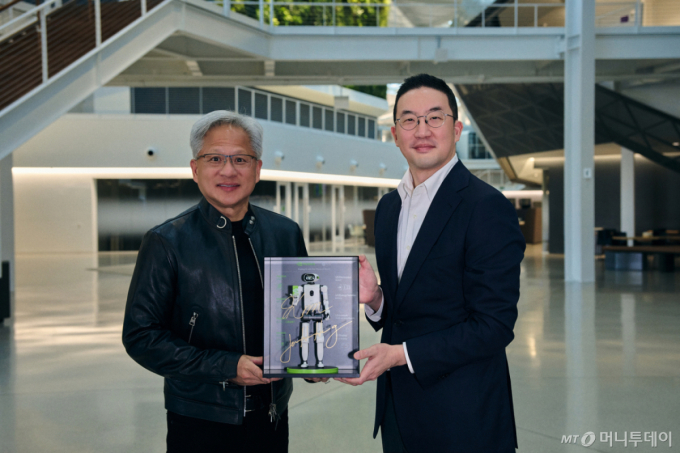
LG Group Chairman Jung Kwang-mo and NVIDIA CEO Jensen Huang have once again met to complete an 'AI alliance' in the fields of robotics, AI factories, and mobility. LG plans to leapfrog as a 'Physical AI Anchor,' connecting AI in virtual spaces to real industrial sites and daily life.
According to LG on the 17th, Koo (Chairman) and CEO Huang signed a 'Memorandum of Understanding (MOU) for Strategic Business Cooperation' at NVIDIA’s headquarters in Santa Clara, USA, on the 13th (local time). This is the outcome of their meeting held last June at Seoul Yeouido LG Twin Towers. The two companies will target the Physical AI market with three core pillars: robotics, AI factories, and future mobility.
Immediately after signing the MOU, Madison Huang, NVIDIA’s Senior Vice President of Marketing for Omniverse and Robotics products and daughter of CEO Huang, is scheduled to visit LG on the 18th to demonstrate the solidity of their partnership. Huang will tour the data factory being built by LG Electronics at Seoul Yongsan Research & Development (R&D) Campus and discuss the partnership. The data factory is a core infrastructure for robot intelligence.
LG’s strategy is to become a 'Physical AI Anchor' that expands the area where AI independently judges and moves in the real world—from manufacturing and logistics sites to homes and mobility—and connects them. The plan is to transform into an 'AI solution company' that implements autonomous operations in industrial and living spaces.
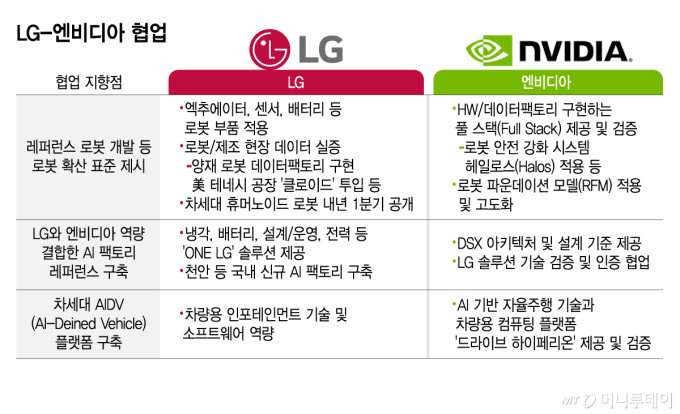
The core of the strategy is 'One LG + NVIDIA.' It involves consolidating capabilities across affiliates—LG Electronics, LG Innotek, LG Energy Solution, LG CNS, and LG Uplus—from actuators, sensors, and batteries to data center cooling, power, design, and operations—and adding NVIDIA’s AI technologies. Morgan Stanley previously analyzed that as AI expands into the real world, the value of business connections among LG affiliates could increase.
First, the robotics business scope will be gradually expanded from pilot demonstrations at manufacturing and logistics sites to replacing household labor. Aiming for a public launch in the first quarter of next year, they plan to develop humanoid robots based on NVIDIA’s 'Isaac Grok.' Additionally, this year, LG CLOi robots will be deployed on a washing machine production line at NVIDIA’s Tennessee factory in the U.S. for pilot testing.
In AI factories, a reference site applying and verifying LG’s cooling, power, and IT technologies based on NVIDIA’s Vera Rubin will be established in the first half of next year. By the first half of 2028, it will expand to an 80MW (megawatt) scale in Cheonan, South Chungcheong Province. The goal is to leapfrog as a 'supplier of AI factories.'
Furthermore, the mobility business area will be expanded beyond vehicle infotainment (IVI) to include autonomous driving. LG’s automotive electronics capabilities will be combined with NVIDIA’s Hyperion platform. The plan is to supply solutions integrating autonomous driving functions and in-vehicle AI services to global original equipment manufacturer (OEM) customers.
Koo (Chairman) stated, "As our collaboration gains momentum, the challenges we face together in the fields of AI factories, Physical AI, and mobility have become clear." CEO Huang responded, "By combining LG’s leadership in product engineering and manufacturing with NVIDIA’s technology, we are accelerating a new era for robots, AI factories, and autonomous vehicles."

 in INDUSTRY

