

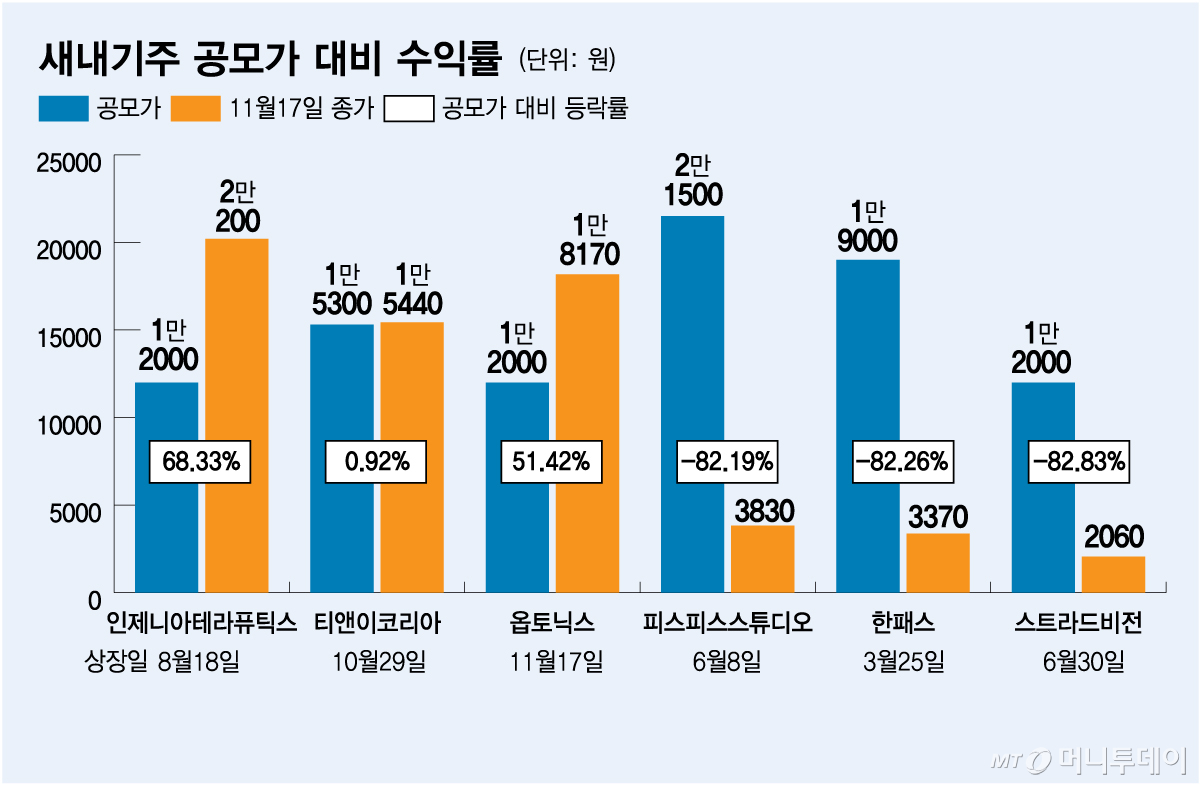
As the domestic stock market underwent a correction, newly listed stocks this year have fallen one after another below their initial public offering (IPO) prices. Excluding Optonics, which entered the market on the 17th, only two stocks are trading above their IPO prices. Even stocks that recorded a "tattaddeul" (a fourfold increase in price) by jumping to four times their IPO price on their first day of listing have given back all their gains.
According to the Korea Exchange, among the 65th new listings (including SPACs) on the KOSPI and KOSDAQ markets this year, only three stocks closed above their IPO prices on that day. The average return compared to the IPO price for newly listed stocks this year, based on closing prices on that day, was calculated at -36.27%. This means that if investors had been allocated and held IPO shares, they would have lost more than one-third of their investment on average.
The stocks trading above their IPO prices are Ingenia Therapeutics (Reg.S), T&N Korea, and Optonics. Ingenia Therapeutics closed at 20,200 won, which is 68.33% higher than its IPO price of 12,000 won, while T&N Korea ended trading at 15,440 won, a 0.92% increase from its IPO price of 15,300 won. Optonics, which listed on that day, closed at 18,170 won, up 51.42% from its IPO price of 12,000 won.
The remaining 62 stocks all fell below their IPO prices. Strad Vision dropped the most, falling 82.83% from its IPO price of 12,000 won to 2,060 won. Hanpass (-82.26%) and Peace Peace Studio (-82.19%) also declined by more than 80% compared to their IPO prices. Forty-four point six percent (29 stocks) of the total 65 stocks fell below half of their IPO prices.
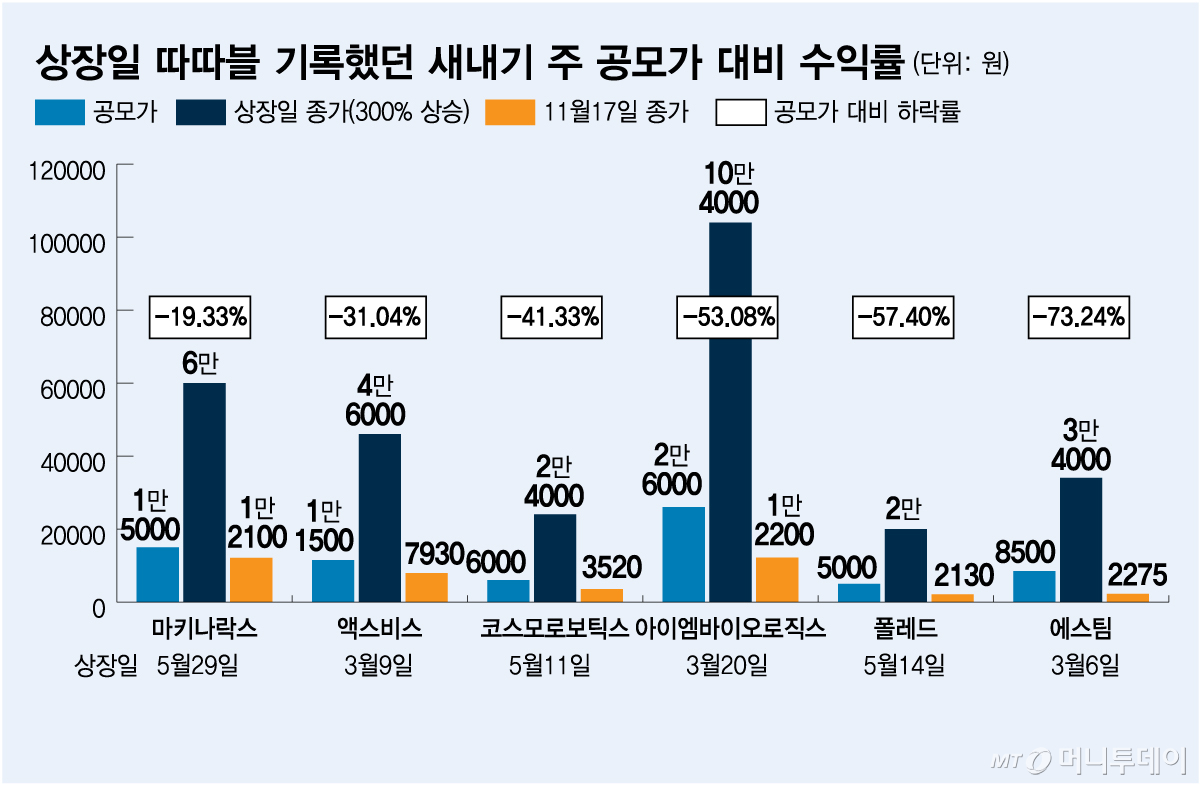
The six stocks that recorded a "tattaddeul" on their listing day were no exception. E-Team fell 73.24%, Poleed dropped 57.40%, and iM Biologics declined 53.08% compared to their IPO prices. Cosmos Robotics (-41.33%), Xbis (-31.04%), and Makina Racks (-19.33%) also slipped below their IPO prices.
The sharp surge in the early days of listing did not translate into medium- to long-term returns. All 19 stocks for which six-month post-listing returns have been calculated had stock prices below their IPO prices at the six-month mark. Cosmos Robotics, which listed on May 11, maintained a price 182.33% higher than its IPO price even three months after listing, but fell to a level 33.33% lower than its IPO price after six months.
Recently listed stocks are also struggling. Yeonggwang YKM Co., which listed on the 16th, dropped 22.27% from its IPO price within two days of listing. E-Steel (-65.44%), Yeonggwang (-59.47%), and Baro Farm (-59.15%), which all listed this month, also fell below half of their IPO prices.
The sluggishness in IPOs is interpreted as the result of overlapping factors such as stock market instability and supply-demand burdens. According to Dain Asset Management, there were nine new listings in October, a 50% increase from the previous month, but the total trading value on listing days decreased by 16%, and the trading value per stock dropped by 44%. While the number of stocks entering the market increased, the trading value per stock available to absorb them actually decreased.
Yum Eun-seo and Kim Seong-hwan, researchers at Dain Asset Management, explained in their "November IPO Market Outlook Report," "Investor sentiment across the market has contracted, and on days when the index plunges, there is simply a lack of buying power to absorb newly listed stocks. It is judged that what moved stock prices was not the valuation of the companies themselves, but the market conditions around the listing day."
Expectations for a recovery in the IPO market have gathered as 10 new companies are scheduled to enter the stock market in November, and the cornerstone investor system is also set to be implemented. The cornerstone investor system, introduced on the 13th, involves pre-allocating a portion of IPO shares to institutional investors under the condition of a lock-up period of six months or more. It aims to secure long-term holding institutional investors to mitigate the concentration of selling volume and sharp price drops immediately after listing.
However, it remains uncertain whether regulatory improvements will lead to a recovery in investor sentiment, as buying power for newly listed stocks has contracted due to the sluggishness of the KOSDAQ. Given that the market is unstable and the cornerstone system is in its early stages of implementation, it is expected to take time to confirm its actual effects.
Researcher Yum advised, "As new listings are concentrated in November and stock market events continue, selection and concentration based on mandatory holding commitment rates and per-stock valuations are necessary."
Yoon Cheol-hwan, a researcher at Korea Investment & Securities, also stated, "In November, a selective approach is expected to be more effective than relying on an inertial bullish trend. Since stock price corrections have led to meaningful declines in per-stock multiples, a conservative approach compared to the previous month is required."

 in STOCK

