

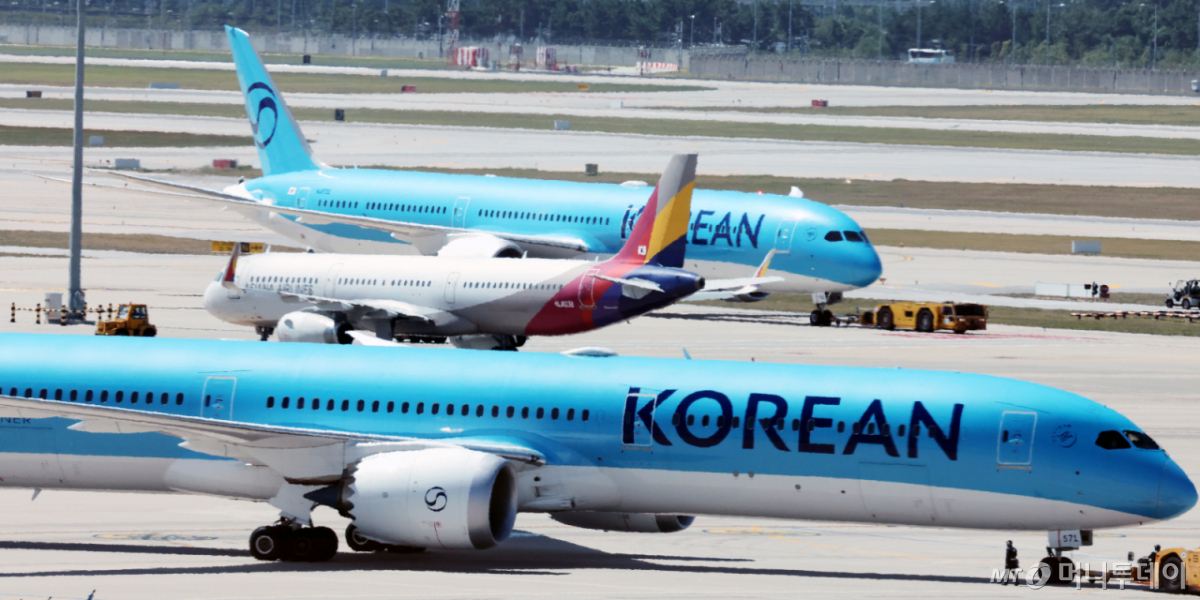
The international flight fuel surcharge, which had fallen for three consecutive months, will rise again in September. This comes as tensions between the United States and Iran escalated, causing jet fuel prices to rebound and pushing the surcharge tier from level 14 to level 21—a jump of seven tiers.
According to the aviation industry on the 18th, Korean Air has set its international flight fuel surcharge for tickets issued in September departing from Korea at a minimum of 48,000 won and a maximum of 354,000 won per one-way trip.
Shortest-distance routes under 500 miles, such as Incheon to Shenyang, Qingdao, Dalian, Yanji, Fukuoka, and Busan to Fukuoka and Shanghai Pudong, will see an increase from 35,200 won in August to 48,000 won in September—a rise of 12,800 won (36.4%).
For the longest-distance routes spanning 6,500–9,999 miles, including Incheon to New York, Dallas, Boston, Chicago, Atlanta, Washington, and Toronto, the fuel surcharge will increase from 259,200 won to 354,000 won—an increase of 94,800 won (36.6%).
Asiana Airlines has also set its international flight fuel surcharge for tickets issued in September departing from Korea at between 52,000 won and 291,001 won per one-way trip. Compared to August's range of 36,600–202,900 won, the shortest-distance routes will rise by 15,400 won (42.1%), while the longest-distance routes will increase by 87,200 won (43%).
Shortest-distance routes to Fukuoka, Yanji, Changchun, Yanqing, Yantai, Dalian, Weihai, Qingdao, Miyazaki, and Kumamoto will incur a surcharge of 52,000 won. For the longest-distance routes to Los Angeles, San Francisco, Seattle, New York, Sydney, Frankfurt, Paris, London, Rome, Barcelona, Prague, Milan, and Budapest, the fuel surcharge is set at 291,001 won.
The significant increase in international flight fuel surcharges for September is due to a rise in the average price of Singaporean jet fuel (MOPS), which serves as the calculation benchmark, amid fallout from the Middle East war. During the calculation period from last month's 16th to this month's 15th, the MOPS average price was recorded at 355.46 cents per gallon and $149.29 per barrel. Compared to the previous calculation period of 283.48 cents per gallon and $119.06 per barrel, this represents a 25.4% increase.
As a result, the international flight fuel surcharge tier applied by Korean Air and Asiana Airlines has risen from level 14 in August to level 21 in September—a seven-tier increase. Even when the same tier is applied, the actual surcharge amount varies by airline depending on factors such as flight distance and route classification.
International flight fuel surcharges had reached their highest tier of 33 in May due to fallout from the U.S.-Iran war. Since then, they have fallen for three consecutive months—27 in June, 19 in July, and 14 in August—but with renewed instability in the Middle East, they have risen again after four months.
Fuel surcharges are applied based on the ticket issuance date, not the actual travel date. If your overseas travel plans are confirmed, you must purchase your airline tickets by the end of this month to avoid the surcharge increases that take effect in September. However, since the total airfare is determined by combining base fares—which vary depending on seat availability—with taxes and other fees, it is necessary to compare the total amounts at the time of ticket issuance.

 in INDUSTRY
