

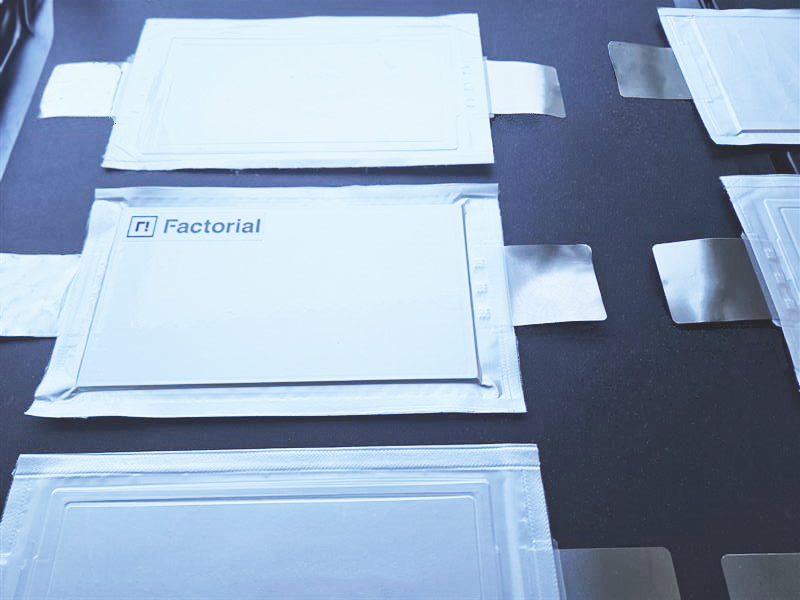
The equity value of an American battery company that Hyundai Motor and Kia invested in five years ago has nearly sextupled in the first half of this year alone. The company, Factorial, which develops all-solid-state batteries, is drawing significant market attention as global automakers including Mercedes-Benz and Stellantis, along with domestic firms, continue to invest.
According to the semi-annual reports filed by Hyundai Motor and Kia on the 20th, the book value of their holdings in Factorial rose from 11.7 billion won at the end of last year to 67.3 billion won as of late June this year. Hyundai Motor's book value increased from 7 billion won to 43.8 billion won, while Kia's rose from 4.7 billion won to 23.5 billion won. Combined unrealized gains from both companies amount to 55.6 billion won.
Hyundai Motor and Kia signed a Joint Development Agreement (JDA) alongside their equity investment in Factorial in October 2021. In June this year, Factorial merged with SPAC Cartesian Growth III and listed on the NASDAQ. Prior to listing, its shares were classified as unlisted equity and valued at acquisition cost; however, after listing, they were revalued based on market prices, causing a surge in book value. The number of shares held also increased: Hyundai Motor's holdings rose from 561,577 shares to 2,069,400 shares, while Kia's grew from 374,385 shares to 1,373,397 shares—a 3.67-fold increase for both. The acquisition cost appears to have been zero, as existing shares were converted during the merger process.
The all-solid-state battery being developed by Factorial is a next-generation technology that replaces the liquid electrolyte of lithium-ion batteries with a solid one. By eliminating flammable liquids, it reduces fire risks and allows more energy to be stored in the same volume, earning it the nickname "dream battery." It enables reduced battery weight and size while extending driving range, making it a key differentiator for automakers. Recently, demand has expanded into physical AI (artificial intelligence) sectors such as humanoid robots and drones, where power-to-weight ratio is critical.
Global automakers have also rushed to join Factorial's investor list. Following Hyundai Motor and Kia, Mercedes-Benz and Stellantis joined in November 2021. Mercedes-Benz tested a vehicle equipped with Factorial batteries, achieving over 1,200 kilometers on a single charge. Stellantis is validating performance by installing 77Ah cells in electric vehicle prototypes.
Domestic companies have also participated. SK On signed a memorandum of understanding (MOU) with Factorial on the 29th last year (local time), agreeing to validate the feasibility of transitioning its existing lithium-ion production facilities to Yangsan by demonstrating Factorial's battery technology there. Earlier, POSCO Future M completed its investment payment in January and began full-scale collaboration on cathode materials. Battery equipment maker Fil Energy secured rights to supply all-solid-state assembly equipment through an equity investment in February. LG Chem also signed an MOU with Factorial in April 2024 for the development of all-solid-state battery materials. The fact that Factorial operates an all-solid-state pilot plant in Cheonan, South Chungcheong Province, has further strengthened ties with domestic firms.
Most notably, its differentiated technological competitiveness stands out. Instead of building a new dedicated factory, Factorial designed its batteries to be compatible with most existing lithium-ion production lines, reducing the time and cost required for commercialization. Consequently, Factorial anticipates its first commercial sales in 2027.
Meanwhile, the equity values of other next-generation battery companies invested in by Hyundai Motor declined during the first half of this year due to stock price fluctuations. Solid Power, invested in 2018, saw its book value drop from 34.3 billion won to 22.4 billion won; SES AI, invested in 2021, fell from 24.9 billion won to 14.3 billion won. In Solid Power's case, the book value had previously risen from 15.6 billion won to 34.3 billion won last year, indicating volatility. Ioniq Materials, invested in 2018, ceased operations in 2024, resulting in the total loss of its 5.6 billion won investment.

 in INDUSTRY
