

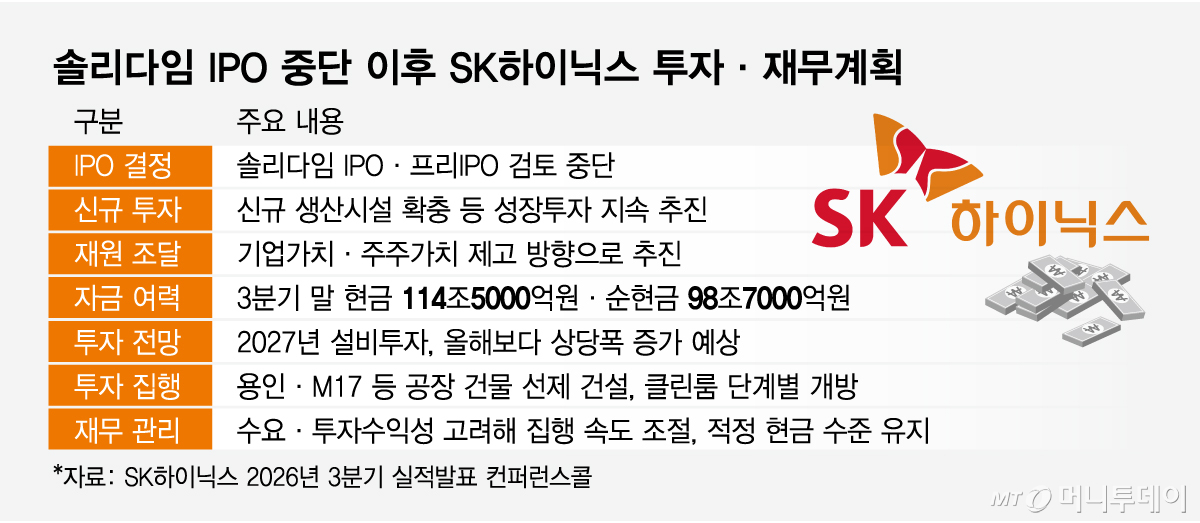
With SK hynix halting its push for an initial public offering (IPO) by its grand-subsidiary Solidigm, securing funding for the construction of a new U.S. NAND flash (hereinafter NAND) factory has emerged as a key challenge. The profitability of its Dalian plant in China and whether the parent company can utilize its own funds are major variables.
On the 28th, during its Q3 earnings announcement conference call, SK hynix outlined its investment and funding direction following the suspension of reviews for Solidigm's IPO and pre-IPO fundraising. President and CEO Kwak No-jung stated, "We will pursue investment and funding plans in a manner that aligns with corporate valuation and shareholder value enhancement for both Solidigm and our company."
The scale and timeline of investment for the new U.S. plant have not been finalized. However, foreign media reports have suggested that Solidigm is in discussions with the U.S. Department of Commerce to construct a NAND factory worth $45 billion (approximately 60 trillion won).
A notable aspect of the funding concept is the linkage between the Dalian plant in China, which SK hynix acquired through its purchase of Intel's NAND business, and new investments in the U.S. It is understood that Solidigm has proposed to U.S. authorities a plan to upgrade the processes at the Dalian plant to improve profitability, then utilize the internally generated cash from this facility as funding for the construction of the U.S. factory.
The crux of the matter is U.S. government approval for the import of semiconductor equipment. Since the U.S. government revoked the "Verified End User (VEU)" status previously granted to Chinese plants operated by Samsung Electronics, SK hynix, and others in August last year, delays in approving equipment imports to the Dalian plant could hinder plans for process upgrades and securing internal funds.
The parent company's own funds are also an option. As of the end of Q3, SK hynix held 114.5 trillion won in cash, with net cash standing at 98.7 trillion won. However, considering large-scale investments both domestically and abroad, relying solely on internal funds to meet all investment demands could place a significant burden on the company.
SK hynix's announced medium- to long-term domestic semiconductor investment plan alone totals 1,100 trillion won. This includes 600 trillion won for Yongin in Gyeonggi Province, 100 trillion won for Cheongju in Chungcheongbuk-do, and 400 trillion won for a new semiconductor cluster in the southwestern region. If investments in new overseas production facilities in the U.S., Japan, and elsewhere are also pursued, funding needs are expected to increase further. Chief Financial Officer (CFO) Kim Woo-hyun stated, "We will proactively prepare foundational infrastructure to meet medium- to long-term demand, while adjusting core resources that lead to actual supply increases, such as equipment imports and mass production expansion, according to demand."
Industry sources note that external funding methods, such as borrowings from financial institutions and the issuance of corporate bonds, are also being discussed as alternatives. SK hynix plans to maintain its financial capacity by considering its medium- to long-term net cash targets and appropriate cash levels. It is assessed that formulating a funding strategy to maintain financial soundness while pursuing large-scale domestic and overseas investments remains a key challenge.

 in INDUSTRY
