

Tesla's domestic sales are expected to exceed '100,000 units annually' for the first time this year. In particular, with Model Y selling over 80,000 units annually, there is talk that the formula of 'domestic cars hold the top spot in the local market' may be broken. Despite unceasing controversies over limited Full Self-Driving (FSD) functionality and price and safety issues, Tesla's popularity shows no sign of fading, and changes are being detected in the landscape of the Korean automobile market.
According to KAIDA (Korea Association of Imported Vehicles) on the 23rd, Tesla's cumulative domestic sales from January to July this year reached 66,376 units. Even if it records only 33,347 units in the remaining five months (August to December 2025), matching last year's same-period sales, annual sales are expected to reach the level of 100,000 units (99,723 units). Considering the recent steep sales growth trend, this figure is also forecast to be easily surpassed.
Considering that Tesla sold only 303 units in its first year of entering Korea (2017), sales have increased approximately 330 times within nine years. Looking at annual sales trends, Model 3 deliveries began in earnest in 2020, when it first broke the 10,000-unit annual mark (11,825 units). Since then, it approached 30,000 units in a single year in 2024 (29,750 units). Last year, when interest in electric vehicles exploded due to the early disbursement of government subsidies and fierce promotional competition, Tesla sold 59,916 units, more than double the previous year. Growth of around twice the previous year is also predicted for this year.
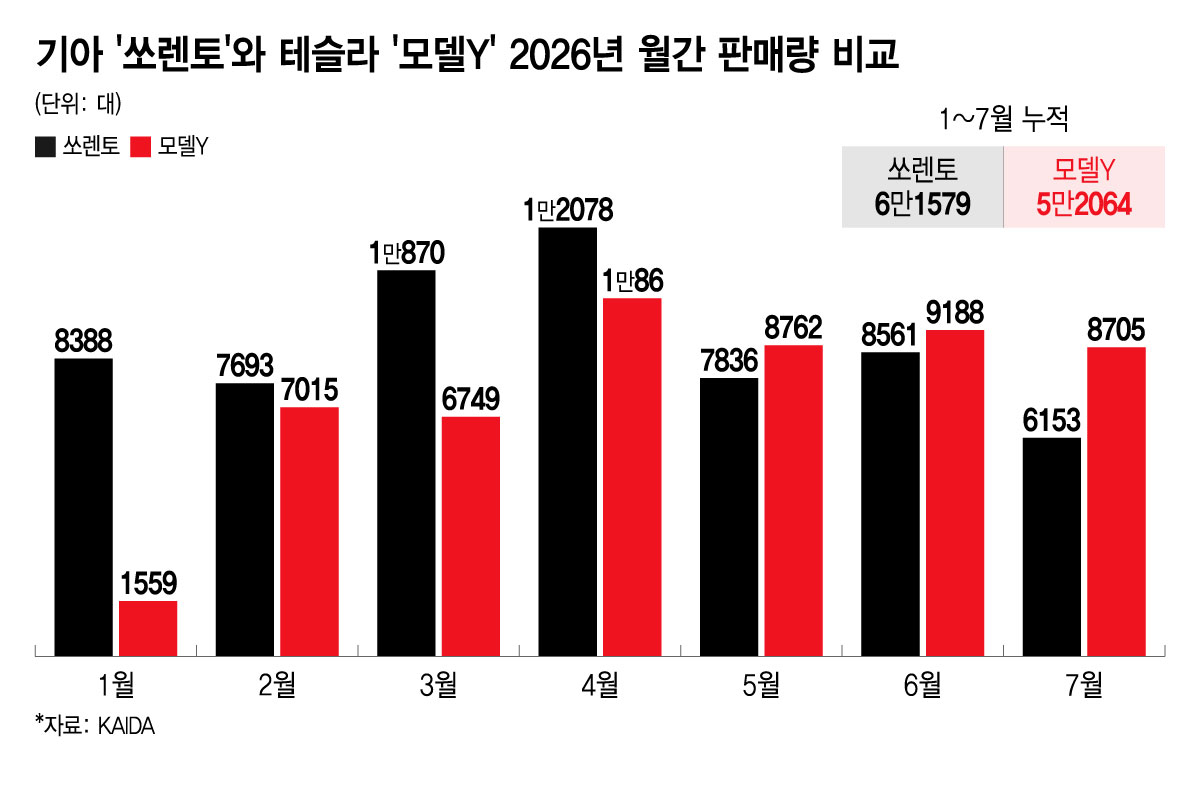
The Tesla storm is shaking not only the imported car market, traditionally represented by the so-called 'German Three' (Mercedes-Benz, BMW, and Audi), but also the domestic car market that has maintained its 'unshakable best-selling cars.' From January to July this year, 52,064 units of Model Y were sold domestically, ranking second overall after the Kia Sorento (61,579 units). On a monthly sales basis, Model Y sales surpassed Sorento starting in May. This means that on an annual basis, the sales figures could be reversed. The Sorento peaked at 12,078 units in April and gradually declined to 7,836 units in May, 8,561 units in June, and 6,153 units in July. While Model Y trailed Sorento in April, when it recorded its highest sales (18,006 units), it reversed the trend in May with 8,762 units and continued the same momentum with 9,188 units in June and 8,705 units in July.
The industry generally acknowledges that Tesla vehicles possess a well-balanced 'trinity' of price competitiveness, advanced features, and emotional appeal. Nevertheless, evaluations even suggest that its rising popularity is a 'bizarre phenomenon,' citing issues such as: △most Teslas imported into Korea are made in China, making FSD functionality unavailable; △pricing policies change like rubber bands; and △safety concerns, including flush-mounted electric door handles that fail to operate when the battery is depleted.
Kim Pil-soo, a professor at Daelim University's Department of Future Automotive Engineering, noted, "There are things Korean automakers can learn from Tesla, such as its innovativeness," but also pointed out, "However, there are problems, including safety issues and the use of LFP (lithium iron phosphate) batteries with low recycling economics, which will lead to high disposal costs in the future. The fact that the Korean government is essentially standing by while positive perceptions of Tesla spread is a problem."

 in INDUSTRY
