

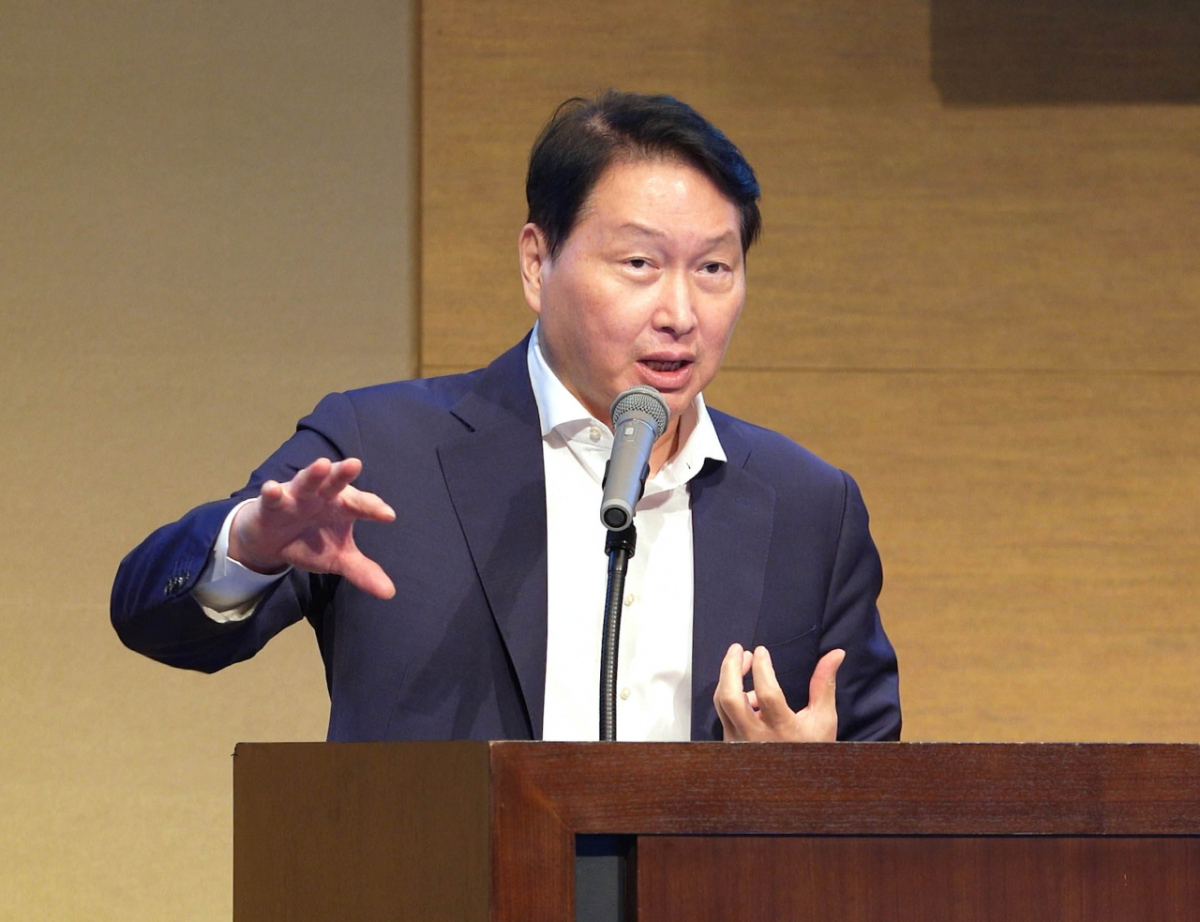
Choi Tae-won, president of the Federation of Korean Industries (SK Group chairman), emphasized economic cooperation between South Korea and Japan to address low birthrate issues, suggesting, "Let us broaden opportunities for young people to travel between the two countries, work, and learn."
In his opening remarks at the 'First Meeting of the Korea-Japan Low Birthrate Response Exchange Committee and Symposium on Low Birthrate Response' held on the 30th at the Westin Sendai Hotel in Japan, Choi stated, "If skills acquired in one country or professional qualifications can be utilized in the other, it will genuinely expand individuals' income levels and horizons."
As a result of today's meeting, the Exchange Committee, a private-sector cooperation channel for jointly addressing low birthrate and population decline, was officially launched. The event was attended by exchange committee members from both nations, including Choi (Chairman), the Korean co-chairman, and Ken Kobayashi, the Japanese co-chairman of the Japan Chamber of Commerce and Industry (JCCI), along with representatives from business, government, and local communities in both countries.
Choi noted on this occasion that "the low birthrate issue is lowering our growth potential and continuously increasing social costs," stressing the need for stable employment and income to support marriage and childbirth.
To expand high-quality job opportunities, he once again proposed his long-held vision of a Korea-Japan economic community. Choi remarked, "Until now, South Korea and Japan have operated as independent economic systems, but combining them would significantly reduce costs." He added, "Lowering costs increases the likelihood of generating stable income for us."
Regarding expanded bilateral exchanges, he stated, "Last year in Jeju, I suggested creating tourism packages that allow visitors to explore regions from both countries simultaneously. Now, chambers of commerce and industry from both nations must move beyond the tourism sector to concretize new avenues for deeper exchange."
He also highlighted the utilization of AI (artificial intelligence) technology. Choi said, "We need to provide young people with many new tools that leverage advancing technologies like AI to boost productivity. As the workforce shrinks while demand for caregiving and healthcare rises, artificial intelligence can serve as a tool to alleviate burdens on the front lines."
Meanwhile, the Federation of Korean Industries also released survey results on marriage and childbirth among youth from both countries. Among single young Koreans, 81.4% expressed willingness to marry, compared to only 57.6% in Japan. The proportion desiring children was 76.8% for Korean youth versus 50.5% for Japanese youth. In both nations, the most frequently cited condition for marriage was "stability of employment and income for oneself and one's spouse," while the top condition for childbirth was "relief from economic burdens."
The survey was conducted online in June and July among 2,000 young people aged 20–39 in each country, totaling 4,000 respondents. The margin of error is ±2.2 percentage points at a 95% confidence level based on total respondents from each nation.

 in INDUSTRY
