

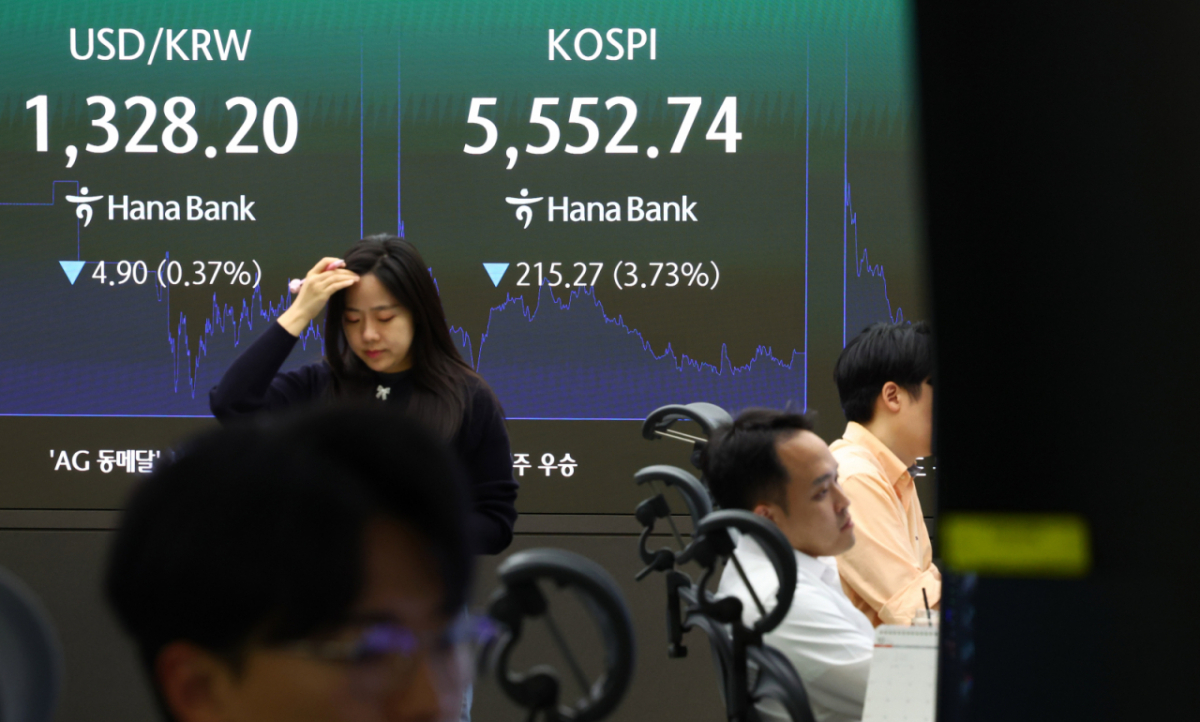
On the 20th, the KOSPI index closed below 5,600 despite a rebound in semiconductor stocks on the U.S. New York Stock Exchange. Foreign investors and institutional investors both engaged in net selling, exerting downward pressure on the index. As major semiconductor stocks uniformly weakened, the KOSPI was pushed deeper into a long-term downtrend. With more investors facing losses, the possibility of sell-offs driven by break-even recovery psychology has increased each time the index attempts a short-term rebound. However, some view the current price range as having reduced enough burden to consider bargain hunting.
On this day, the KOSPI closed at 5,552.74, down 215.27 points (3.73%) from the previous day. The KOSPI opened at 5,733.57, down 34.44 points (0.60%). It widened its decline immediately after opening, making the opening price the intraday high, and at one point fell to 5,493.24, a drop of 274.77 points (4.76%). In the KOSPI market, retail investors made net purchases worth 898.1 billion won, while foreign investors and institutional investors made net sales of 530 billion won and 1 trillion 4.8 billion won, respectively.
Samsung Electronics closed at 211,500 won, down 2.98%. SK Hynix closed at 1,223,000 won, down 4.23%. The declines in major large-cap stocks included: SK Square (-5.00%), Hyundai Motor (-4.91%), LG Energy Solution (-4.17%), Samsung Life Insurance (-3.07%), Samsung Electronics Preferred Shares (-2.93%), Samsung Biologics (-2.52%), Samsung Electric (-1.28%), and KB Financial Group (-1.11%).
![[Seoul=NEWS1] Designer Yoon Ju-hee = Copyright © NEWS1. All rights reserved. Unauthorized reproduction, redistribution, and use for AI learning are prohibited. /Photo=NEWS1] Designer Yoon Ju-hee](https://thumb.mt.co.kr/cdn-cgi/image/f=avif/21/2026/10/2026102015564089989_2.jpg)
The overnight rebound in U.S. tech stocks failed to boost the domestic stock market. On the 19th (local time), counter-buying flows entered the New York Stock Exchange, causing tech stocks to rise uniformly. However, concerns over the debt repayment capacity of AI (artificial intelligence) companies did not fade as the share price of CoreWeave, which recently faced a corporate bond crisis, declined.
Researcher Roh Dong-gil at Shinhan Investment Corp stated, "There is anxiety in the market regarding funding sources for AI investment," adding, "The market is currently applying a greater discount to how long profits can be sustained rather than the size of the profits." He further added, "There are concerns that memory excess profits may decrease even if AI demand grows."
The widening gap between the KOSPI index and the 200th-day moving average (the average stock price over the last 200 trading days) is also a burden. Based on the previous day's closing price, the 200th-day line was in the 6,400 range, more than 800 points higher than this day's closing price. This means that a significant number of investors who entered the KOSPI over the last 200 trading days are experiencing losses. From the perspective of technical analysis focused on market supply and demand, a situation significantly below the 200th-day moving average is interpreted to mean that short-term recovery is difficult.
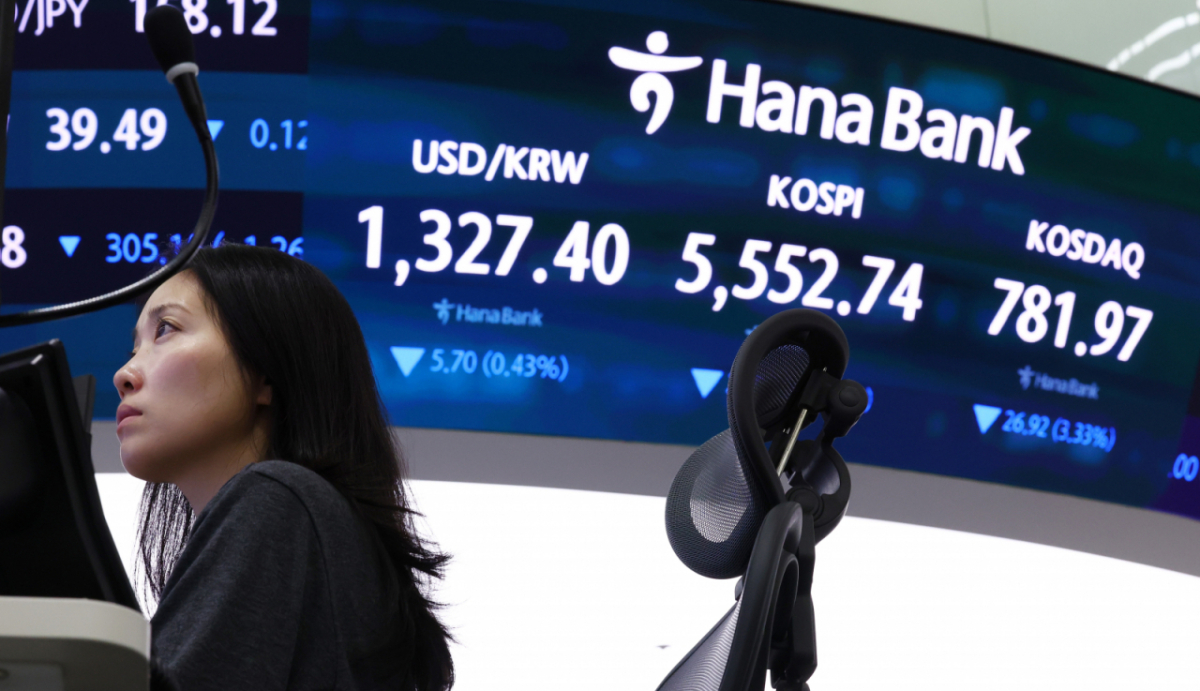
Researcher Han Ji-young at Kiwoom Securities stated, "From a technical perspective, the key point to confirm a full-fledged reversal into an uptrend is whether the index can climb back above the 200th-day line." She added, "In fact, since the 200th-day line is at the 6,410 level, which requires a rebound of more than about 11% from the closing price on the 19th to reach, it is not easy to achieve this in the short term this week."
However, the burden regarding stock price levels has been significantly reduced. According to Kiwoom Securities, the KOSPI price-to-earnings ratio (PER, calculated by dividing stock price by earnings per share) based on forward 12-month profit forecasts is 4.4 times, entering a historically low range. The PER for the semiconductor sector is 2.89 times, an extremely low level, and the PER excluding semiconductors is 10.3 times, significantly lower than this year's high (14.5 times). Analysis suggests that while maintaining caution during the period of confirming whether the 200th-day line will be recovered, it is necessary to broaden interest to sectors such as transportation, construction, chemicals, and information technology (IT) hardware, whose forward 12-month operating profit forecasts have risen since the beginning of this month.

 in STOCK


