

Companies within the Yeosu Industrial Complex (hereinafter Yeosu IC), which receive raw materials from the soon-to-be-shutdown Yeosu NCC (Naphtha Cracking Unit) Plant 2, are facing a supply chain emergency. Critics argue that the government's business restructuring support focused solely on reducing NCC capacity must also carefully examine downstream processes.
According to the petrochemical industry on the 1st, at least 10 downstream companies affected by raw material shortages due to the shutdown of Yeosu NCC Plant 2 have been identified. These are firms currently receiving raw materials via pipelines from Yeosu NCC. Under the final business restructuring plan approved by the Ministry of Trade, Industry and Energy for Yeosu NCC, Lotte Chemical, Hanwha Solutions, and DL Chemical within the Yeosu IC, the shutdown of Plant 2 is scheduled as early as the first half of next year. Without securing alternative supply sources, production disruptions appear inevitable.
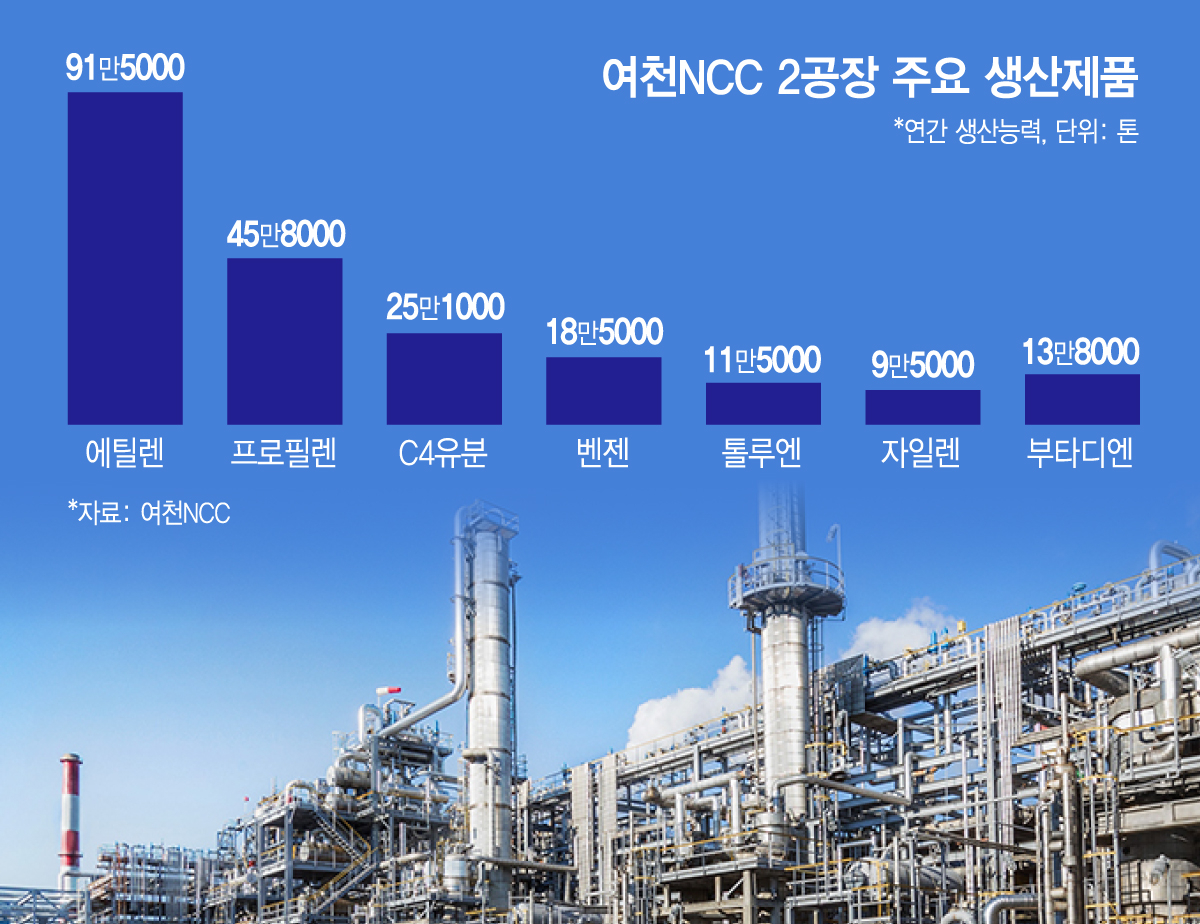
The ripple effects of Plant 2's shutdown are intensifying because the reduction in production extends beyond ethylene alone. In terms of annual production capacity, it includes 915,000 tons of ethylene, 458,000 tons of propylene, 251,000 tons of C4 fractions, 185,000 tons of benzene, 115,000 tons of toluene, and 95,000 tons of xylene. Companies that have received these products via pipelines must find new supply sources before Plant 2 stops operations.
The problem is that simply switching suppliers will not resolve the issue. To import raw materials by ship or truck from domestic or foreign sources, companies must invest in facilities tailored to the characteristics of liquid or gaseous raw materials. Moreover, since the timing of Plant 2's shutdown and the establishment of alternative supply chains are unlikely to align, gaps in raw material supply are unavoidable.
Company A, which receives toluene, must immediately construct large-scale storage tanks for raw material storage. Construction alone will take at least six months, and permitting and reporting procedures under laws such as the Chemical Substance Management Act are complex, inevitably requiring significant time and costs. Company B, which produces butadiene and other products from C4 fractions, must substitute with domestic or foreign supplies, incurring additional cost burdens. Company C is also seeking supply lines for hydrogen and pyrolysis fuel oil. A common view among companies is that coordinating the type of raw materials, quantities, timing, and delivery methods varies significantly by firm.
Recently, six downstream companies submitted a proposal to Gwangju Metropolitan City in Jeollanam-do to develop measures to prevent damage. One official stated, "While operating Plant 2 to supply Busan port raw materials is not a viable solution given the lack of demand support for ethylene—the main product of NCC—at least the deadline for shutting down the plant should be delayed to protect downstream industries."
Given that the ultimate goal of the government's petrochemical business restructuring is not merely reducing NCC capacity but strengthening industrial competitiveness centered on eco-friendly and high-value-added products, voices are calling for a comprehensive review that includes downstream sectors. Another industry official emphasized, "If downstream companies producing high-value products from basic fractions generated by NCC lose their competitiveness due to supply chain disruptions, the very purpose of structural reform will be undermined."

 in INDUSTRY
