

The won-dollar exchange rate has fallen to its lowest level in 23 months, dipping into the mid-1,300 won range, causing divergent profit-and-loss calculations across industries ahead of third-quarter results. The domestic finished vehicle sector, which produces cars at home for export abroad, faces an inevitable downward adjustment in profitability, while the airline industry, which incurs costs in dollars, is expected to deliver surprise earnings amid strong freight rates.
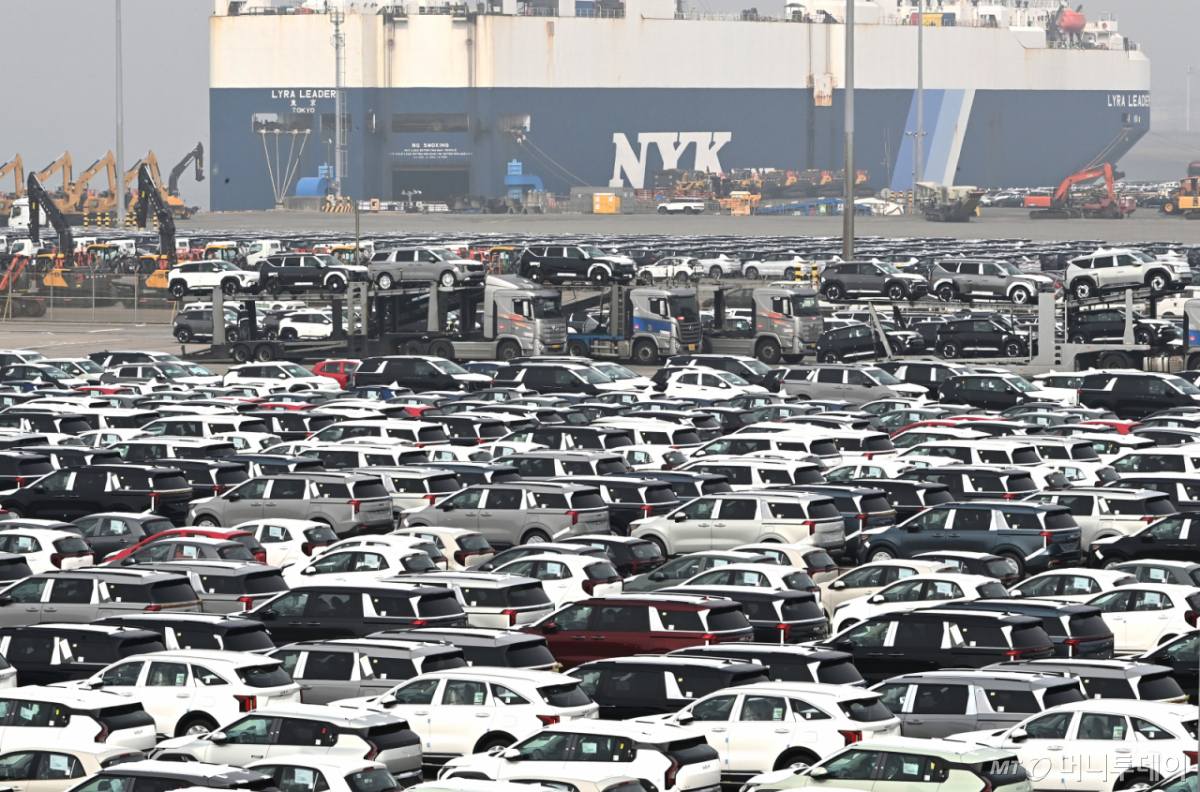
According to relevant industry sources on the 7th, finished vehicle manufacturers operate under a structure where cars produced domestically are exported overseas; thus, when the exchange rate falls, their profitability also declines. This is because production costs are paid in won, while sales proceeds come in dollars or euros. Based on Hyundai Motor, of approximately 2 million vehicles produced at domestic factories, 1.3 million are for export, with about 70% settled in dollars and 20% in euros.
According to Daol Investment & Securities, an annual fluctuation of 100 won in the exchange rate results in an operating profit change of approximately 1.9 trillion won for Hyundai Motor and about 1.4 trillion won for Kia. This translates to a movement of roughly 1 percentage point (p) in operating profit margin. Assuming the third-quarter average exchange rate drops to 1,430 won, this would be 4.8% lower than the second-quarter average (1,501.9 won), making downward revisions to earnings estimates inevitable, according to analysis.
There is also a view that the direction of the won-yen exchange rate is important. The current won-yen rate stands around 860 won, and since 2014, the won has maintained a trend of strength against the yen. Given that Korean companies compete with Japanese firms in major export markets such as the United States, Japanese companies gain more flexibility to lower prices or increase incentives when the yen is relatively weak; even if they sell at the same price, their revenue converted into their domestic currency becomes larger. Conversely, Korean companies are inevitably placed at a disadvantage in export markets.
The airline industry, which has struggled this year due to high oil prices and other factors, is anticipating a turnaround. This is because a significant portion of major costs such as fuel expenses, aircraft lease fees, and maintenance costs is denominated in dollars; thus, as the won strengthens, the cost converted into won decreases. Additionally, the burden of evaluating foreign currency debt incurred during aircraft acquisition eases, leading to improvements in non-operating profit and loss. In particular, low-cost carriers (LCCs) are expected to benefit more. Jeju Air, Jin Air, and Trinity Air have a high proportion of Korean-origin passengers on short-haul routes such as Japan and Southeast Asia, resulting in revenue primarily in won while costs are paid in dollars.
Moreover, the increase in demand for near-distance outbound (overseas) travel, long-distance inbound (visit to Korea) travel and transit, and air cargo is also a positive factor supporting freight rates. Fueled by AI (artificial intelligence)-driven industrial shipments, Korean Air's air cargo freight rates are estimated to have risen by more than 30% year-on-year even in July and August. LCCs, which have seen sustained demand strength centered on Japan routes, are also expected to improve their results after passing through the summer peak season. The rise in oil prices has been offset by the decline in exchange rates, reducing uncertainty from a cost perspective. Cho Goe-ho, a researcher at Korea Investment & Securities, forecasted, "In the third quarter, profits for virtually all companies will see further improvement."

 in INDUSTRY
