

Rising demand for AI (artificial intelligence) servers has caused a sharp spike in PC DRAM prices, deepening the dilemma for Samsung Electronics and LG Electronics. While memory costs are soaring, the price-sensitive nature of the PC market makes it difficult to pass these increases directly onto finished product prices. To prevent demand from shifting away, both companies are adjusting their product and sales strategies by bolstering value-oriented product lines and integrating subscription services.
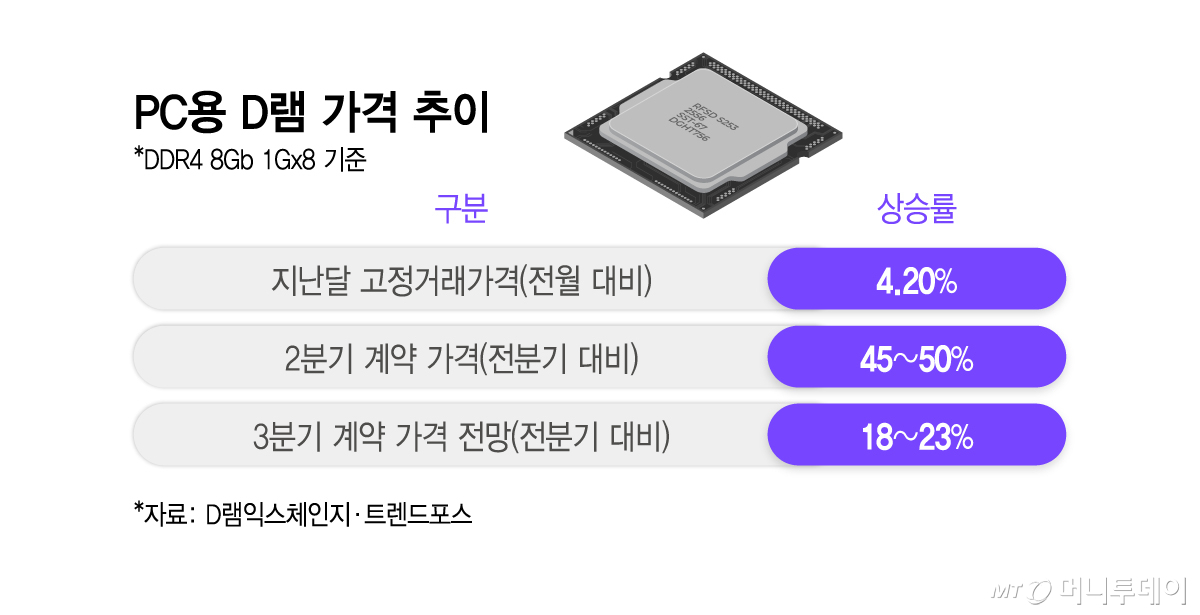
According to market research firm TrendForce on the 9th, the average fixed transaction price for general-purpose PC DRAM products (DDR4 8Gb(1 gigabit) 1Gx8) last month was $25, a 4.2% increase from the previous month. TrendForce forecasts that PC DRAM contract prices will rise by 18–23% in the third quarter of this year compared to the previous quarter. While the pace of increase has slowed compared to the 45th–50% surge seen in the second quarter, the upward trend continues.
Rising PC memory prices are also affecting sales strategies for finished product manufacturers like Samsung Electronics and LG Electronics. If product prices are raised in line with higher memory costs, demand may shrink; if companies absorb the cost increases themselves, profitability will decline. In fact, within the memory market itself, growing price burdens are driving some demand to shift from high-capacity to low-capacity products. Related companies are increasingly needing to adjust component configurations or expand product lines with relatively lower price burdens to balance costs and selling prices.
In this context, Samsung Electronics and LG Electronics are responding by strengthening their value-oriented product offerings. Samsung Electronics launched the 'New Galaxy Book6' priced between 1.19 million won and 1.49 million won this month. Following the January launch of the Galaxy Book6 Ultra and Pro, and the April release of the Galaxy Book6, the company has added more affordable options to broaden consumer choices. LG Electronics is also entering the mid-to-low-end PC market with its 'LG Grambook AI 2026,' starting at 1.45 million won. Unlike servers, the PC market, where individual consumers are the primary customers, is highly sensitive to price changes. As higher prices can lead consumers to delay purchases or opt for lower-specification products, companies are adopting strategies to segment their product lines and minimize demand loss.
Efforts to reduce price burdens are also extending to diversifying sales methods. Samsung Electronics has enabled purchases of the New Galaxy Book6 through its 'AI Subscription Club,' while LG Electronics is applying a subscription service to the LG Grambook AI 2026. This strategy lowers the product price tier while spreading initial purchase costs through subscriptions. Additionally, the inclusion of maintenance services in these offerings acts as a factor in lowering customers' psychological barriers.
Price resistance in the PC market could become a variable for the future memory market. As long as memory prices remain at high levels, demand is likely to shift toward low-capacity products, and PC manufacturers may adopt more conservative purchasing behaviors for components. Although AI server demand is driving up PC DRAM prices, if finished product demand contracts, it could act as a limiting factor on further price increases for general-purpose memory.
An industry official stated, "The PC market makes it difficult to fully pass component price increases onto consumer prices, so if memory prices remain high, manufacturers' burdens will inevitably grow." The official added, "We expect continued efforts to protect demand by segmenting product specifications and price tiers while reducing consumers' initial purchase burdens."

 in INDUSTRY
