


KT, which has joined the government's "Universal Utilization Support for AI (Artificial Intelligence) Services for All Citizens" ("AI for All") project, aims to expand "AI for All" beyond a standalone service into applications and web services that citizens use daily. By launching "i-um Inside," which allows users to access AI with just one button click within existing services, KT plans to convert its 48 million existing accounts into AI users.
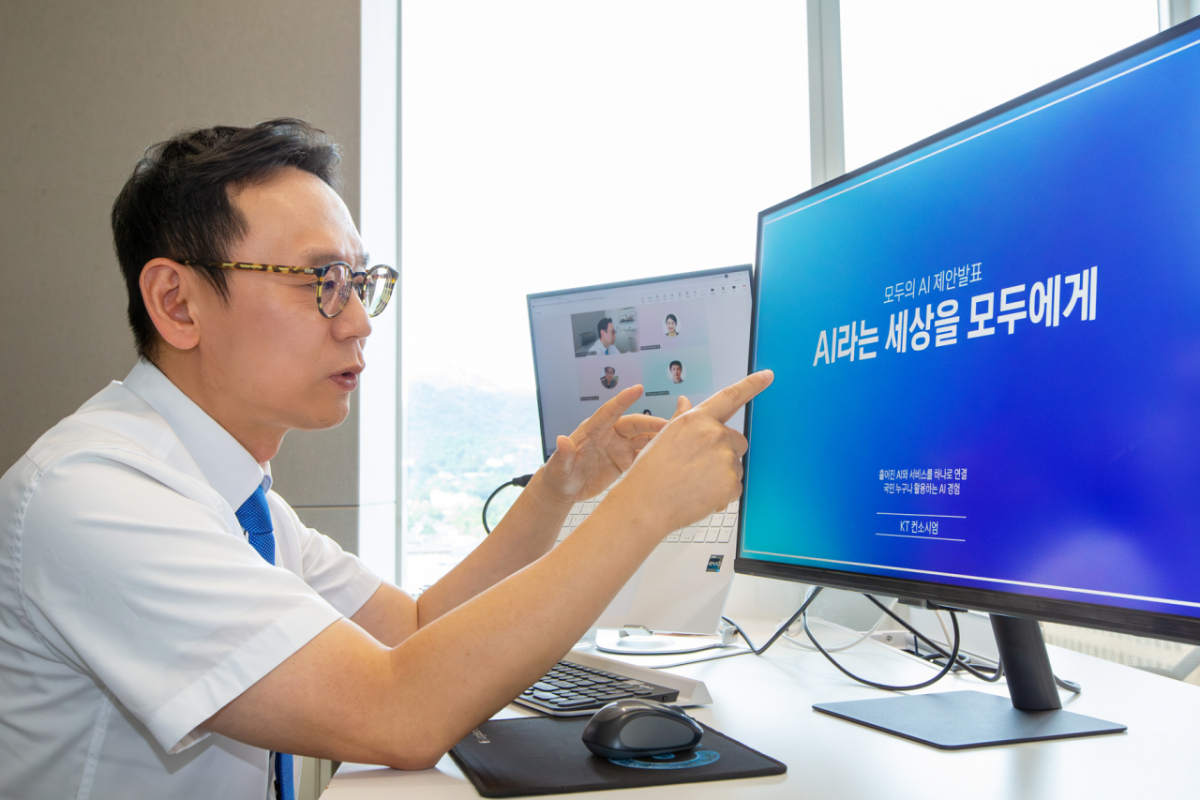
Lee Jin-hyung, Executive Vice President of KT's AX Business Division, stated during an online briefing on the 11th that "not only can i-um agents be used, but they can also be accessed with a single button when using services like Naver, Danawa, Musinsa, or Zigbang." He added that this is a business model that transforms 48 million accounts into new AI modes.
The core of the strategy is "i-um Inside." It not only allows users to seek out "AI for All" directly but also enables two-way connections so that AI can be called from partner companies' existing services. For example, if a user searches for a window-type air conditioner on Danawa, clicks the i-um Inside button, and inputs their installation environment, the system compares and recommends products based on actual product information and connects them to purchase options.
KT is pushing beyond simple external service connections to achieve deeper integration, which it calls "Open MCP." In addition to the standard MCP (Model Context Protocol) approach, KT will enable integrations that allow access to partner companies' databases when necessary, so AI can provide information similar to actual search results. The executive explained, "It's not just about simple MCP; because we are implementing agents more deeply, partnerships between companies are required."
i-um Inside will also be opened to entities outside the consortium. Currently, around seven companies have requested to join. These include financial groups and life-oriented service companies such as hotel and restaurant reservation platforms. The executive stated, "Increasing the number of ecosystem partners is a key goal for this service," adding, "Companies that need it will sign MOUs, and those ready can begin implementation immediately."
For personalization, the system utilizes a "Memory Map" that remembers user interests through conversation. For users highly interested in real estate, actual property listings are connected; in public services, individuals are informed of benefits tailored to their life stages. The executive noted, "The area where memory-based responses are most needed is public services," and explained, "If the government opens its services, we aim to automatically and conveniently support application processes when necessary."
Behind the scenes, the service leverages a domestic AI ecosystem. Five AI models—Upstage, Motif, NC AI, KT, and Saltlux—are selected based on use cases, and Rebellion's NPU (Neural Processing Unit) is also utilized. Upstage handles inference and agent tool calling, Motif manages long-context processing, and NC AI is applied to 3D and sound-related tasks.
KT plans to continue expanding i-um Outside the consortium. The executive said, "It may be difficult for everything to launch in December, but as we proceed, we will keep opening opportunities for partners to join." Ultimately, how effectively KT connects its existing services and 48 million accounts to actual AI usage will determine the success or failure of its "i-um Inside" strategy.

 in TECH

