

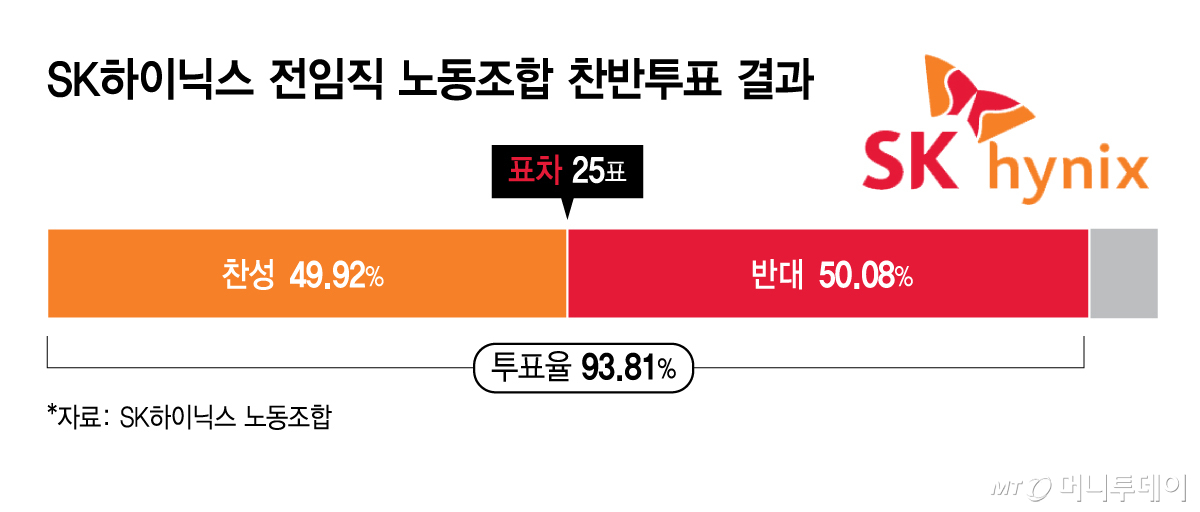
The 2025 wage and collective bargaining agreement (CBA) between SK Hynix management and its labor union failed to clear the threshold of a union member vote, sending negotiations back to the table. Although management introduced safeguards such as a cash option and loss protection against stock price declines to reduce the burden of distributing excess profit sharing (PS) in company shares, the tentative agreement was rejected. With the stock price falling significantly from its peak amid continued demands for cash payment of multi-million won bonuses, criticism has emerged that employee compensation is being prioritized over shareholder interests.
Previously, management highlighted several safeguards to allay members' concerns about stock-based compensation. For the 2026 PS to be paid early next year, members were allowed to choose 40% of the shares issued in cash. Combined with the existing 40% cash portion, up to 80% could be received in cash, effectively delaying the application of the new payment method by one year. The number of shares was also determined based on the lowest closing price among the preliminary earnings disclosure date, PS cash payment date, and stock payment date. The agreement also included provisions to compensate for losses if the stock price falls after distribution.
However, it is reported that there was strong opposition among members to changing the payment method itself. Management and the union had agreed last year to abolish the PS cap and maintain a system using 10% of operating profit as funding for 10 years, with full cash payments. This shift to stock-based payments just one year later appears to have influenced the voting outcome. Dissatisfaction also arose over detailed conditions regarding welfare and benefits. Although it was decided to pay welfare points from the Highwell program to the internal labor welfare fund to reduce income tax burdens, restrictions such as the inability to purchase gift certificates limited usage options, and tax issues related to stock loss compensation funds became contentious.
Alongside internal controversies over the tentative agreement, voices warning that shareholder interests could be infringed are growing. In fact, SK Hynix shares plummeted nearly 50% from their peak of 2.919 million won on June 22, yet bonus amounts calculated based on this year's performance are expected to increase significantly. Applying the 10th% PS funding ratio to SK Hynix's projected annual operating profit of 250 trillion won for this year yields a total fund size of 25 trillion won. The average PS per person is estimated at approximately 0.7 billion won (pre-tax). Amid a situation where stock prices have effectively been halved, there is an atmosphere that public criticism over demands for full cash payment of multi-million won bonuses is inevitable.
Shareholders directly bear the risk of corporate valuation declines, yet the tentative agreement includes mechanisms to reduce losses from falling stock prices caused by employees receiving company share bonuses. The bonus fund is also set at 10% of operating profit, meaning that as performance improves, the compensation scale distributed to employees increases in tandem. Nevertheless, if cash payment ratios or additional benefits are expanded during renegotiation, the gap in risk borne by shareholders and employees could widen further. Critics point out that while shareholders bear stock price decline risks, employees would receive a 'reversed order' compensation structure that covers not only performance but also risks from stock price fluctuations.
If labor-management conflict drags on, not only shareholders but public sentiment across society could turn cold. SK Hynix plays a core role in the global semiconductor supply chain, centered on HBM (high-bandwidth memory) for AI. Given the significant share of semiconductors in the national economy, prolonged conflict over payment methods for multi-million won bonuses could increase the burden of public opinion that the union must bear.
However, since the difference between yes and no votes in today's union member referendum was only 25 ballots, prospects for renegotiation are positive. Industry observers believe that rather than completely revising the framework of the existing tentative agreement, if management offers additional compensation such as settlement bonuses or adjusts certain conditions, the outcome of the next vote could change. Regardless of the voting results from the office and technical union, full-time employee unions and management must proceed with renegotiations.
An industry source stated, "Since the yes and no votes are nearly split in half, there is room for a different result if management presents additional compensation proposals during renegotiation." The source added, "Given that both labor and management face significant burdens from prolonged conflict, adjusting additional conditions could lead to the tentative agreement passing in the next vote."

 in INDUSTRY
