

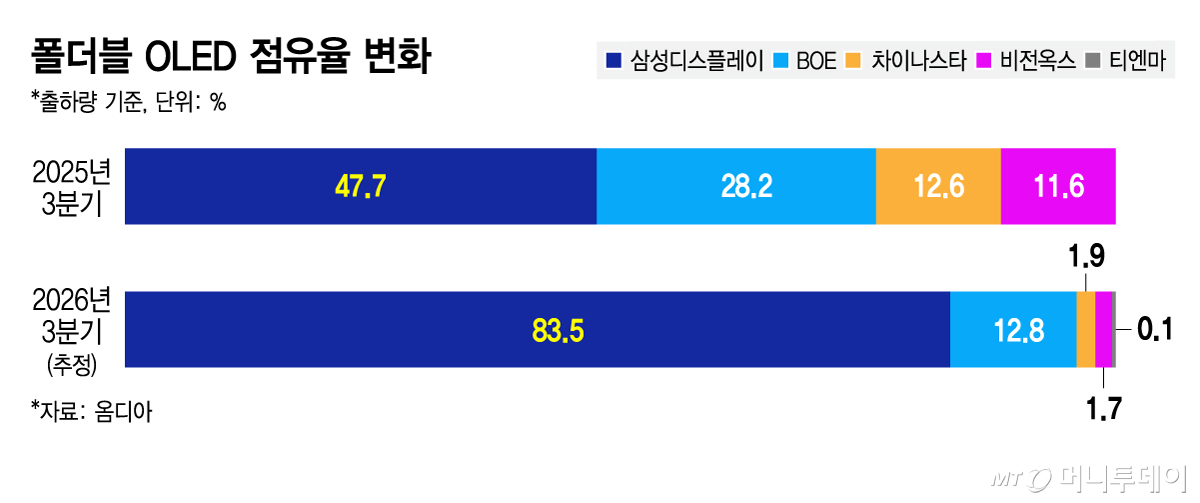
Samsung Display solidifies its dominant position in the global foldable OLED (organic light-emitting diode) panel market. With Apple added to its customer base alongside Samsung Electronics, its market share is projected to exceed 80% in the third quarter of this year. Although Chinese companies are closing in, Samsung Display remains ahead in terms of panel technology and stable mass production capabilities.
According to market research firm Omdia on the 16th, Samsung Display's share of the global foldable OLED panel market is expected to reach 83.5% based on shipment volume in the third quarter of this year. This represents a 35.8 percentage point (p) increase compared to the same period last year.
Samsung Display's shipments of foldable OLED panels for the third quarter are forecast to rise to 7.95 million units, a 2.3-fold increase from the previous quarter. In contrast, shipments by Chinese panel makers including BOE, which holds second place in market share, as well as China Star Optoelectronics Technology (CSOT), Visionox, and Tianma, are expected to decline across the board.
Samsung Display increased its shipment volume even as the overall market contracted during the first half of this year. The global foldable OLED panel market size in the first half reached 9.455 million units, a 14.2% decrease compared to the same period last year. However, Samsung Display's shipments grew by 4.8% during the same period, capturing a market share of 46.5%.
In the second half, performance is expected to improve significantly as supply of panels for Apple begins in earnest. Samsung Display's revenue from foldable OLED panels in the second half of this year is projected to reach $2.825 billion (approximately 3.85 trillion won), or 4.3 times the first-half figure.
The reason behind Samsung Display's dominance in the foldable OLED panel market lies largely in its near-exclusive supply of panels for Samsung Electronics' Galaxy Z series and Apple's first foldable smartphone, "iPhone Duo," set to launch next month. Industry sources estimate iPhone Duo shipments this year at approximately 5 million units.
This means that both the top two global foldable smartphone manufacturers this year are using panels from Samsung Display. Some analyses suggest the internal foldable panel price for iPhone Duo could reach about $250 (approximately 340,000 won) per unit.
Samsung Display's competitiveness stems from "accumulated technology." The company opened the foldable OLED market by supplying panels for Samsung Electronics' first foldable smartphone, "Galaxy Fold," in 2019. Since then, it has consistently supplied panels for the Galaxy Z Fold and Z Flip series, advancing technologies related to durability, thinness, and wrinkle reduction.
Now, competition for foldable panels no longer ends with simply folding the screen. Competitiveness is determined by durability that maintains performance even after hundreds of thousands of folds and unfolds, as well as how thin and light the panel can be made. Samsung Electronics' foldable smartphones have become thinner, from 17.1mm (Galaxy Fold) in 2019 to recently 8.9mm (Galaxy Z Fold8).
Apple also demands high-level specifications regarding wrinkles, durability, thickness, and power consumption. Currently, only Samsung Display can stably supply large volumes while meeting Apple's requirements. Although Chinese companies like BOE are rapidly catching up, Samsung Display remains significantly ahead in mass production technology capable of supplying millions of units of top-spec foldable panels.
With both Samsung Electronics and Apple entering the foldable smartphone market, the foldable OLED panel market is expected to enter a full-fledged growth phase. The share of foldable products in total smartphone OLED panel shipments is projected to expand from 5.8% last year to 11% by 2031.
An industry official stated, "With Apple launching foldable smartphones, significant growth in the foldable panel market is anticipated," adding, "Samsung Display holds a competitive edge not only in panel technology but also in optimizing with hinges and assembling display modules during the finished product mass production process."

 in INDUSTRY
