

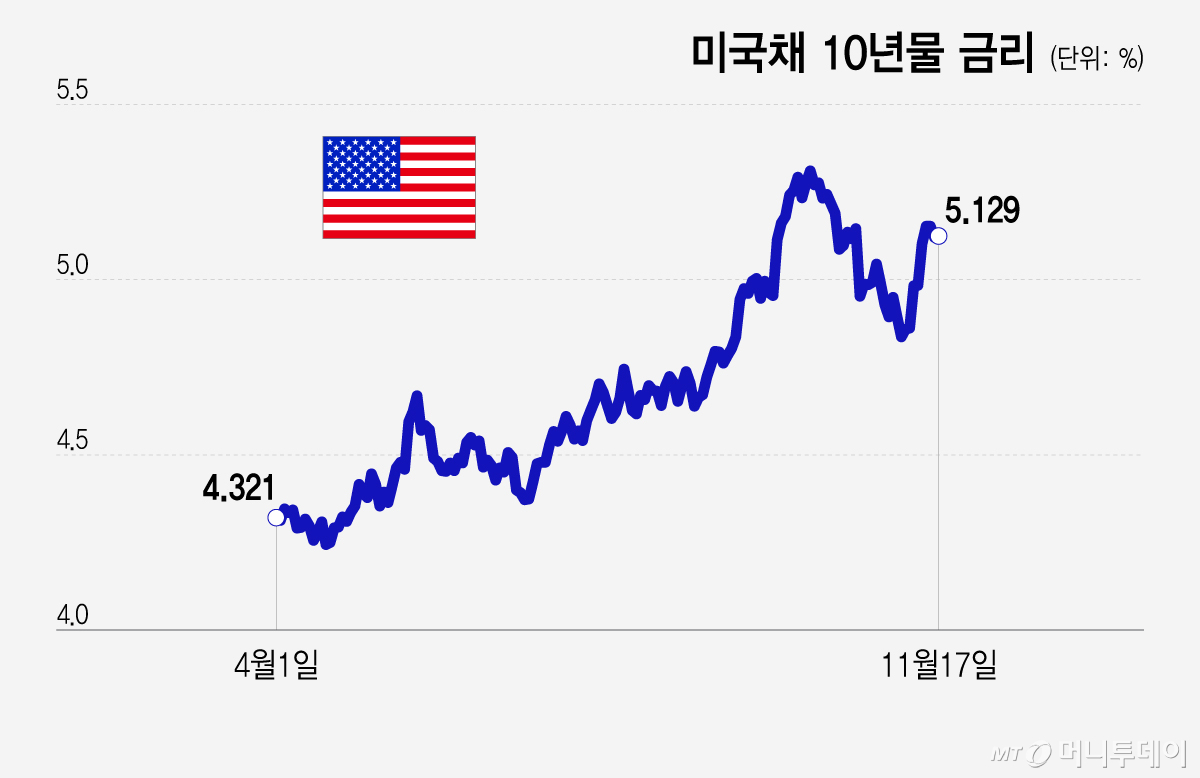
As inflation indicators came in above expectations, the risk of monetary tightening in the United States is rising again. The yield on US 10-year Treasuries has surpassed 5%, and a Federal Reserve governor even mentioned the possibility of a big step (a 50bp rate hike), weighing on the stock market.
While some argue that risks are already priced in and the likelihood of a big step (a 50bp rate hike) is low, securities firms expect interest rate volatility to persist for the time being and are paying attention to dividend stocks.
According to financial investment industry sources on Tuesday, the yield on US 10-year Treasuries stood at 5.129%. Although it fell slightly on the day, it had risen by 27.5bp over the past week. The yield on 2-year Treasuries also approached its late-September peak.
This is due to heightened tensions over rate hikes following recent inflation indicators that came in higher than expected. The October CPI (consumer price index) rose 0.4% month-on-month, exceeding expectations (0.3%), and core CPI also rose 0.3%, surpassing forecasts.
Additionally, comments by Federal Reserve Governor Waller stating that "a 50bp hike in December is also under consideration" contributed to concerns about a big step (a 50bp rate hike). Subsequently, Kansas City Fed President Jeff Schmid emphasized inflation concerns, further heightening vigilance against tightening.
Tightening concerns highlighted by rising interest rates have acted as a headwind for the stock market. Lee Kyung-min, a research analyst at Daishin Securities, explained, "Driven by hawkish remarks from Federal Reserve officials and inflationary pressures, the yield on US 10-year Treasuries rose to around 5.15%, expanding downward pressure on the stock market."
In particular, it was noted that interest rate volatility is acting as a burden amid heightened concerns over AI (artificial intelligence) investment.
Kim Jun-young, an analyst at iM Securities, said, "The September rate hike was not seen as a burden because the narrative around AI investment remained solid," while pointing out, "As doubts grow about the sustainability of AI investment, market confidence has weakened, and rate hikes in this phase could become a factor suppressing AI investment."
Such vigilance is expected to continue for the time being. Since the last inflation indicator before the December FOMC (Federal Open Market Committee) meeting came in high, the direction of interest rates is likely to move according to hawkish remarks from Federal Reserve officials going forward.
During such periods, dividend investment can serve as an alternative. As domestic interest rates show a relatively stable trend, it is analyzed that dividend yield could act as an important factor.
Analyst Kim said, "The overall market will follow US interest rates and the US stock market, but dividends on Korean stocks are compared against Korean interest rates," adding, "Stocks with dividend yields exceeding government bond yields will maintain their attractiveness relative to bonds."

 in STOCK
