

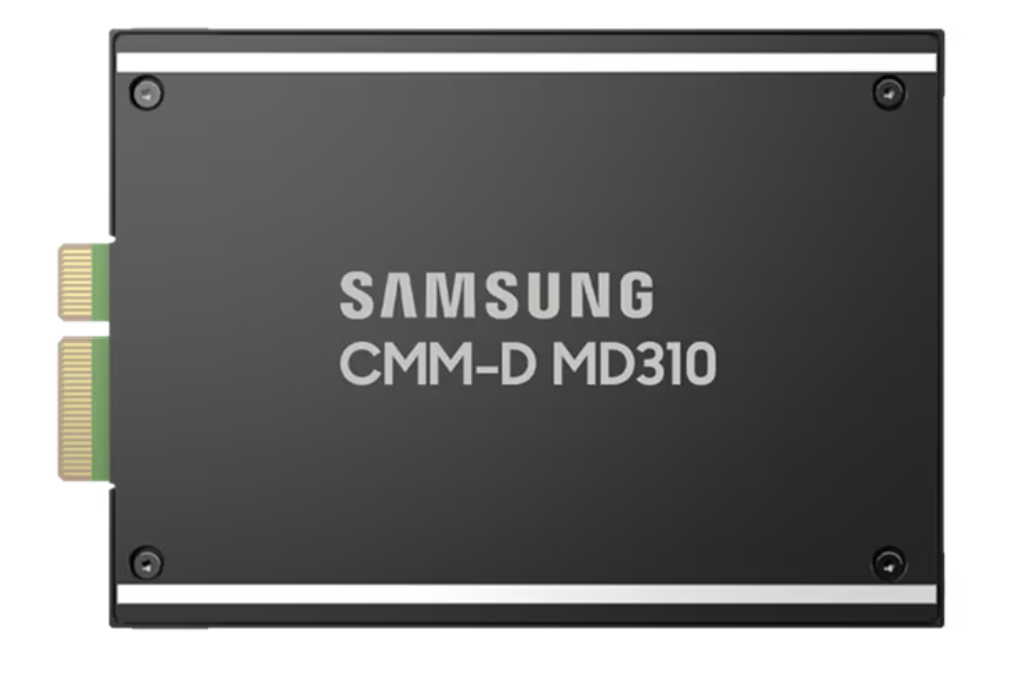
Samsung Electronics will unveil its next-generation AI (artificial intelligence) memory strategy centered on CXL (Compute Express Link) at a global data center technology event in the United States next month. The core of this strategy involves expanding memory capacity and enabling multiple servers to share it, addressing the surging demand for memory during AI inference processes.
According to the electronics industry on the 28th, Samsung Electronics will participate in the 'OCP Global Summit 2026' (hereinafter OCP Summit), held from the 12th to the 15th next month in San Jose, California, USA. During the OCP Summit, Samsung Electronics plans to announce various memory expansion technologies centered on CXL.
The OCP Summit is a global conference hosted by OCP (Open Compute Project), the world's largest open-source data center technology collaboration association. This year, with the theme 'Expanding Innovation for the AI Era,' participating companies will share their development of data center and computing infrastructure technologies driven by the spread of AI.
CXL is a technology that connects devices such as CPUs (central processing units) and memory at high speeds. It can enhance system performance and data processing efficiency through memory sharing and expansion. In particular, it enables 'memory pooling,' where multiple servers jointly use memory resources, reducing memory resource waste that occurs in each server.
As AI inference demand grows, the importance of CXL technology is also increasing. In AI systems, storing 'KV (Key Value) cache' containing previously processed contextual information is necessary to remember long conversations or perform multiple tasks sequentially. As conversations lengthen and the number of concurrent users increases, KV cache is surging, emerging as a new bottleneck in AI inference.
Samsung Electronics is proposing a memory strategy that utilizes customized HBM (high-bandwidth memory) for data immediately required for computation, while storing less frequently used data across CXL memory and SSDs (solid-state drives). Samsung Electronics has already launched the market with CMM-D, a CXL memory module designed to support memory expansion.
At the OCP Summit, Samsung Electronics will present plans to expand KV cache storage space using CXL memory pools and SSDs. It will also announce technologies such as CXL-PNM (near-memory computing), which processes data close to memory, and software for managing memory across multiple servers. The presentation topics also include system structures for agent-type AI that combine memory pooling, sharing, and PNM.
SK Hynix plans to present a 'memory-centric AI rack system' at the OCP Summit. It will introduce methods for rack-level memory pooling and data sharing utilizing next-generation HBM and CXL. The company emphasized designing memory layers tailored to the characteristics of each AI computation data type.
Cases are also emerging where CXL has been applied to actual servers with demonstrated effects. Meta recently announced that it is operating a CXL memory expansion server using its self-designed chip, 'Vista.' This system is characterized by adding CXL memory to existing server memory and utilizing legacy DRAM (DDR4). It has reduced the number of servers required for certain services or improved processing performance.
Semiconductor design firm Marvell also conducted interoperability testing between its CXL memory expansion product, 'Structura X,' and NVIDIA's next-generation CPU platform, 'Bera.' In its earnings announcement last August, Marvell stated that multiple large cloud service providers are adopting CXL technology and that it has secured additional design orders.
Market research firm S&S Insider projected that the CXL-related memory market will grow from $1.35 billion in 2025 to $16.55 billion in 2035. Among these, CXL memory modules are expected to account for the largest share.
An industry official stated, "There is also a view that more time is needed before CXL becomes commercially viable." However, they added, "As the rate of increase in KV cache outpaces improvements in data compression technology, the need for technologies that can supplement the shortage of expensive HBM has grown even greater."

 in INDUSTRY
