

"Please recommend today's lunch menu." New terms like "jeom-mechu (lunch menu recommendation)" that AI initially fails to understand are identified as issues during actual use, prompting re-learning and performance improvement. If a user arranges an evening appointment via text message, the AI recognizes it and proactively suggests, "Would you like to add this to your schedule?"
Samsung Electronics is actively integrating self-learning, "action-oriented AI" into products and business operations. The company is shifting its focus from merely intelligent AI to "practical AI" that delivers real results, ranging from smartphones to semiconductor design and manufacturing.
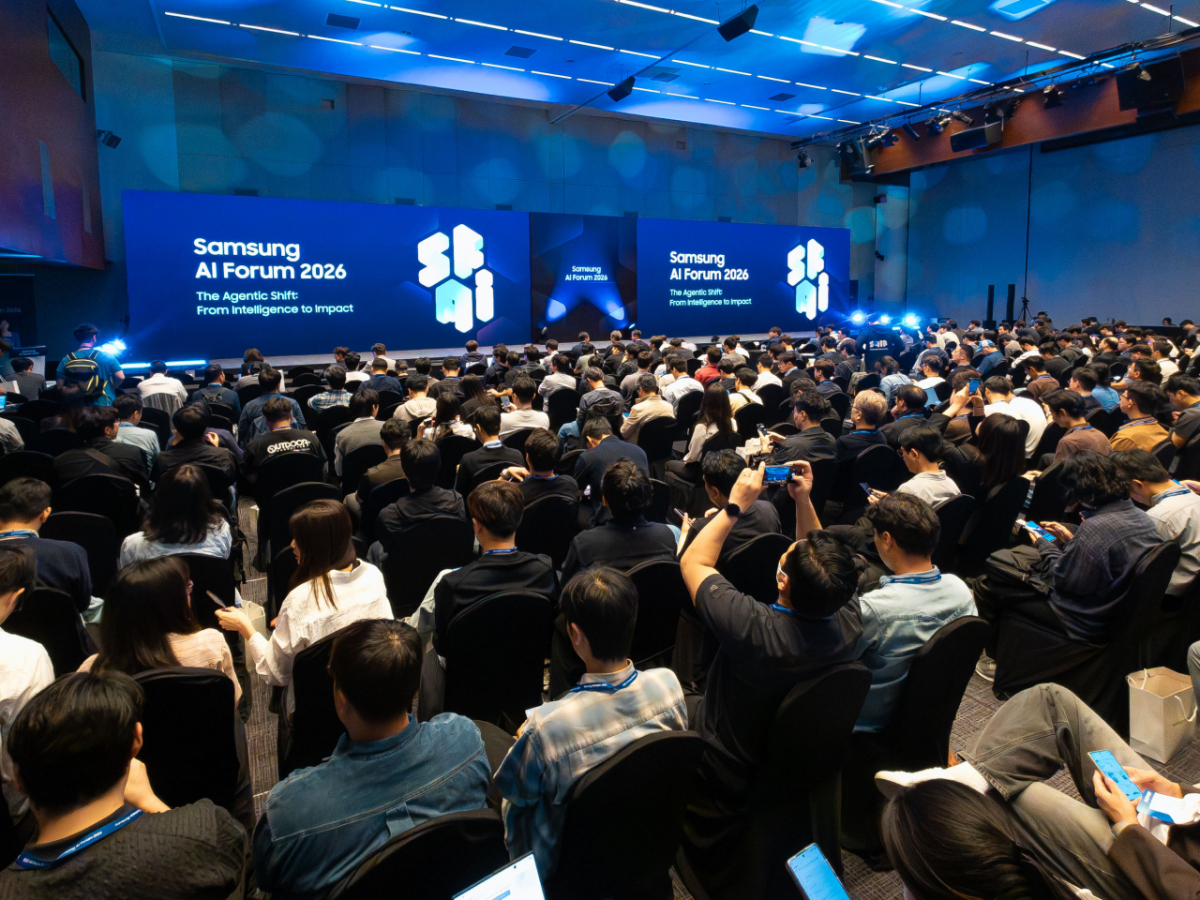
On the 30th, Samsung Electronics held the 'Samsung AI Forum 2026' at its Seocho headquarters in Seoul, sharing the latest research achievements and application cases in the field of AI. The forum, themed "Agentic Shift: From Intelligence to Impact," focused on discussing ways to connect AI technology with actual business operations and outcomes.
Chung Young-hee, Vice Chairman and CEO of Samsung Electronics, stated, "Agentic AI will bring about a fundamental change in the way we work and organizational culture, going beyond simple technological innovation." He added, "We will explore the direction we should head in together with global AI leaders and drive practical AI technology innovation."
Vice Chairman Chung emphasized, "AI is both a core driving force leading innovation in our daily lives and poses new challenges regarding security, trust, and harmony with the business environment." He stressed that it is time to examine what kind of impact will be generated in our society when each technology converges into one, going beyond the development of AI technology itself.
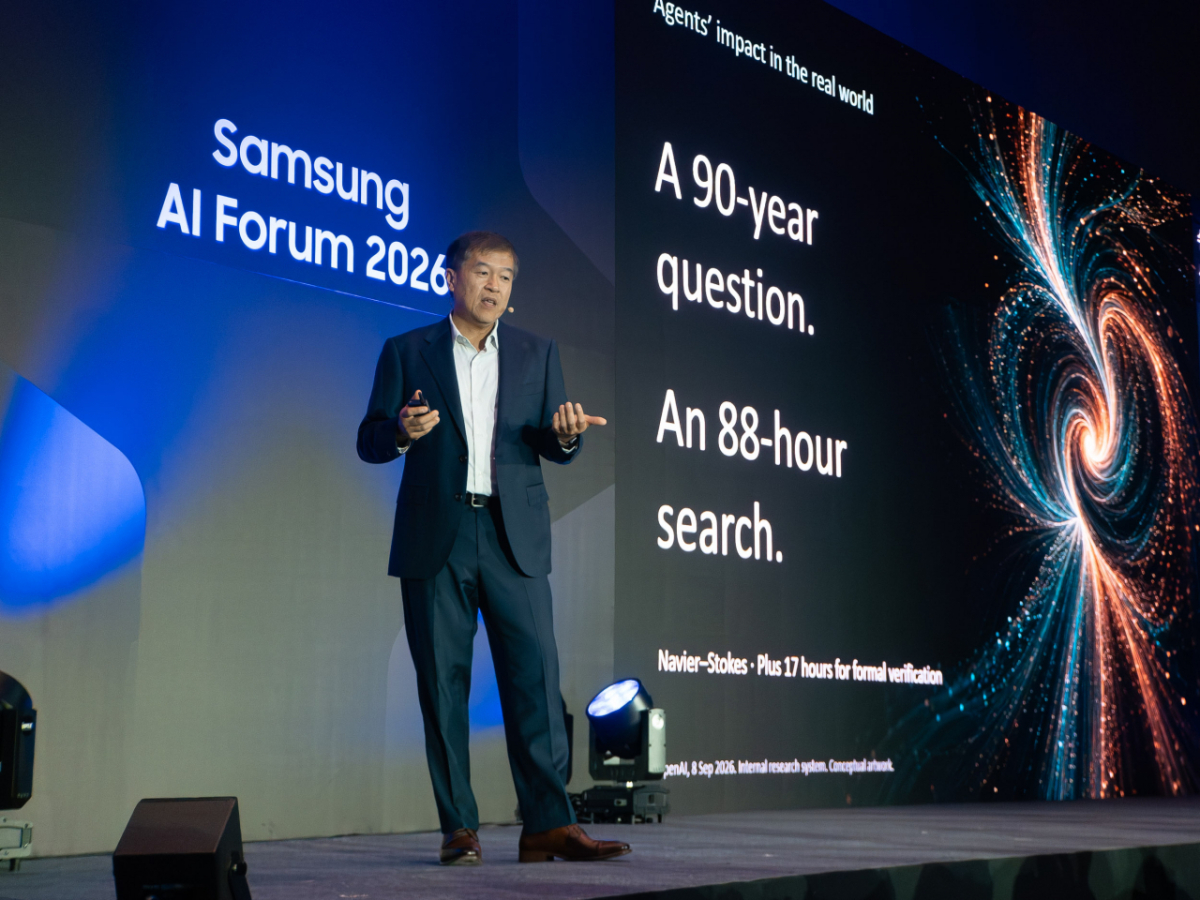
The forum featured Richard Ho, Vice President of Hardware at OpenAI, and David Green, an AI technology leader for the Asia-Pacific and Japan region at AWS (Amazon Web Services), who presented on industrial changes and security strategies brought about by agentic AI. Subsequently, Ranjey Krishna, a professor at Washington University, and Kim Yun-hyung, Senior Executive Vice President of Samsung Research (concurrently a professor at MIT), introduced next-generation physical AI and agentic AI technologies.
Samsung Electronics also introduced plans to utilize AI in the process of applying and improving AI within its products. Hwang In-cheol, Vice President of the MX Business Division, said, "Once AI is deployed, the process from data collection to automated verification and service integration is continuously repeated." He noted, "In the past, humans were involved in every single step, but recently many parts have been automated."
For example, if a user says, "Please recommend today's lunch menu," AI previously could not interpret it correctly, but now it uses this as a new learning target. It creates and learns together with sentences that change the context and expression, such as "Give me some lunch menu recommendations" or "Recommend a lunch menu with the remaining ingredients." This shortens the improvement cycle from data collection and augmentation to learning, verification, and service integration using AI.
As AI becomes more advanced, the importance of efficiency and memory also grows. Vice President Hwang pointed out that while computing performance increases by approximately three times every two years, memory bandwidth only increases by about 1.5 times, highlighting the possibility that memory could become a bottleneck for AI performance. He stated, "For AI to be sustainable, efficiency is essential."
A "smartphone where AI acts first" also becomes possible. Lee Yun-soo, Vice President of the MX Business Division, said, "Until now, AI phones have been phones that understand me well, but next they will evolve into 'phones that act for me.'" This structure connects app, system, and sensor data within the smartphone to grasp the user's situation, allowing the AI to proactively suggest and execute necessary actions.
In particular, Samsung Electronics views its status as a smartphone manufacturer as a differentiating factor in AI competition. In addition to conversations with AI agents, it can broadly collect data through app, system, and sensor information accumulated within the device while using the smartphone.
Along with this, the forum shared the possibilities of world models that predict changes in the real world and simulate action outcomes, as well as robot-based models. The DS (Device Solutions) division, responsible for semiconductors, revealed innovative cases of applying AI to semiconductor design and manufacturing operations.

 in INDUSTRY

