

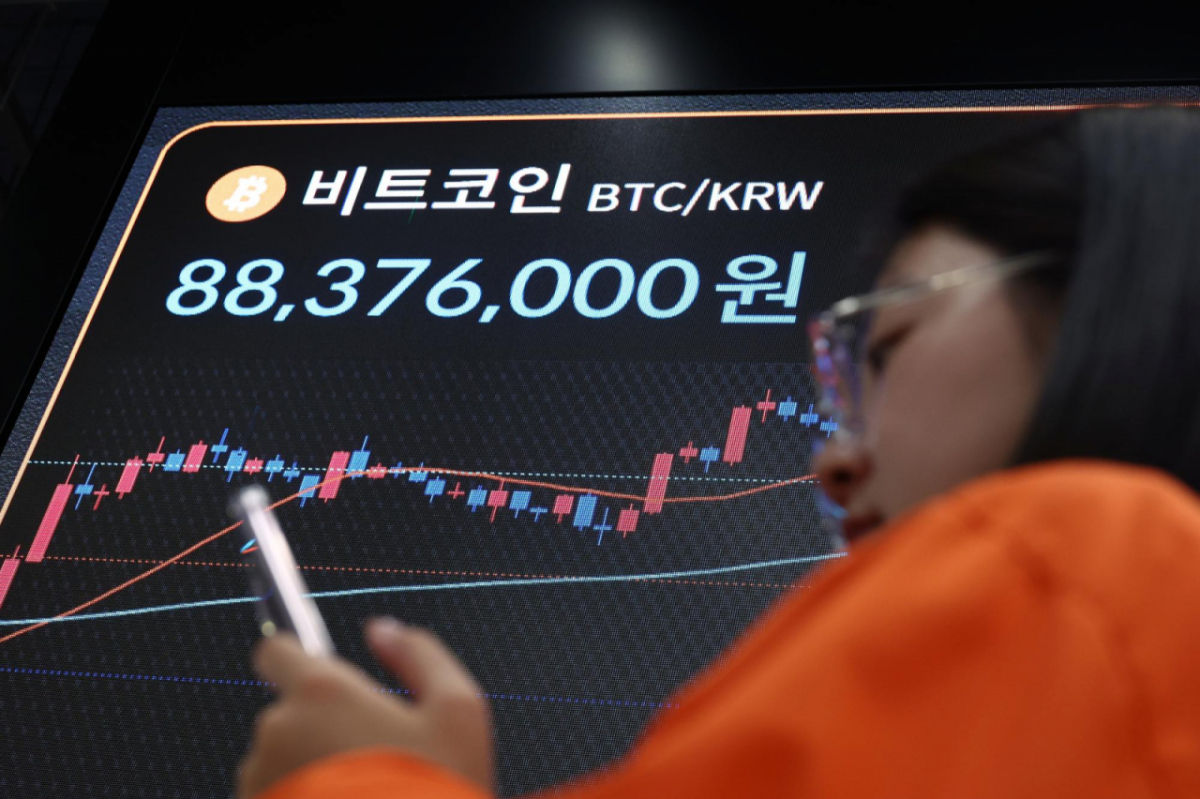
Upbit and Bithumb, South Korea’s leading virtual asset exchanges, both posted losses in the third quarter. The aftermath of a bear market for virtual assets accelerated the decline in trading volume, resulting in year-on-year negative growth in performance.
According to disclosures on the Financial Supervisory Service’s electronic disclosure system (DART) on Tuesday, Dunamu, the operator of Upbit, announced the previous day that its consolidated revenue for the third quarter was 151.7 billion won, a 60.7% decrease from the same period last year.
This represented a 12.6% decline compared to the previous quarter. Operating loss stood at 3.5 billion won, and net loss at 18.6 billion won, marking a shift into the red both year-on-year and quarter-on-quarter.
Dunamu faced its first quarterly operating loss since launching Upbit in 2017. The quarterly net loss marks the first time in approximately four years that the company has posted such a result, following the so-called “crypto winter” (a major virtual asset slump) triggered by consecutive U.S. base rate hikes and the Terra-Luna collapse in 2022.
Bithumb’s situation is no different. Its standalone revenue for the third quarter was 59.4 billion won, a sharp 69.7% drop from the same period last year and a 31.2% decrease from the previous quarter. An operating loss of 8.1 billion won was recorded, indicating a shift into losses both year-on-year and quarter-on-quarter. The net loss amounted to 1.5 billion won, marking three consecutive quarters in the red.
The setbacks at the two exchanges stemmed from shrinking trading volumes following falling prices. According to statistics platform CoinGecko, global daily average virtual asset trading volume in the third quarter was $73.3 billion (98 trillion won), down 52.7% year-on-year and 8.6% quarter-on-quarter. Domestic exchanges rely on a structure where over 95% of revenue comes from trading fees.
The outflow of idle funds is fueling concerns about domestic exchanges. The scale of deposits at each exchange at the end of the third quarter was 3,973.3 billion won for Dunamu and 1,387.5 billion won for Bithumb, up 6.4% and 5.1%, respectively, from the end of the previous quarter. However, compared to the end of the same period last year (Dunamu: 7,488.3 billion won; Bithumb: 2,576.6 billion won), the figures are roughly halved.
As the performance slump intensifies, the outlook in the over-the-counter stock market for the two exchanges, which are exploring a medium- to long-term initial public offering (IPO), is also cooling.
On Tuesday afternoon, Dunamu traded around 250,000 won on Naver Pay’s OTC market, expanding its cumulative decline over two trading days into the double digits, while Bithumb also saw a cumulative plunge in the high single-digit percentage range.
With profitability deteriorating, the two exchanges have entered a war of attrition, relying on financial strength accumulated during boom times to wait for an industry turnaround.
With liquid assets reaching 6,330.1 billion won for Dunamu and 1,820.2 billion won for Bithumb at the end of the third quarter, market insiders and outsiders believe the companies can sustain operations for at least two to three years even if conditions worsen further.
Efforts to control spending are also evident. In the third quarter, Dunamu recorded operating expenses of 155.2 billion won (a 3.1% increase year-on-year), narrowing the growth rate compared to normal levels, while Bithumb reduced its third-quarter operating expenses by 46.4%, from 125.9 billion won in the same period last year to 67.5 billion won.
The virtual asset industry expects that starting with the fourth quarter, the burden of negative growth for the two major exchanges will gradually ease.
In the first three quarters of last year, expectations for pro-virtual asset policies from U.S. President Trump’s second administration drove Bitcoin prices to break previous highs, allowing exchanges to post surprise earnings. However, because market conditions turned in the fourth quarter due to U.S.-China trade tensions, the base burden on performance is expected to decrease.
An industry official said, “Until rising momentum returns to the global virtual asset market or institutional tailwinds such as expanded corporate trading occur domestically, exchanges’ concerns over cost-cutting and revenue diversification will deepen.”

 in STOCK
