

With surging demand for low-power DRAM for AI (artificial intelligence) servers, the supply shortage of consumer products is expected to intensify further next year. The supply-demand imbalance persists to such an extent that even NVIDIA, the world's largest AI computing platform company, struggles to secure sufficient quantities. As the strong trend in memory semiconductor prices continues, it is predicted that the reduction of low-end products and the upward trend in smartphone prices will also persist.
According to industry sources on the 6th, NVIDIA appears to be able to secure only about 60-70% of the LPDDR (Low Power Double Data Rate)5X volume it needs next year. This is due to the rapid increase in demand for server-grade LPDDR5X as the importance of memory bandwidth and power efficiency grows with the high performance of AI servers. LPDDR is DRAM specialized in reducing power consumption, and mobile devices such as smartphones have been its main demand source in the past.
Previously, NVIDIA reduced the capacity of the 'SOCAMM2' module embedded in its next-generation CPU (Central Processing Unit) 'Vera' by about half, from 192GB (gigabytes) to 96GB. This is known as a measure to minimize production disruptions by reducing the memory load per product, as LPDDR5X supply has failed to keep up with demand. SOCAMM2 is a next-generation memory module based on LPDDR5X.
Starting next year, the demand sources for LPDDR5X are expected to expand beyond NVIDIA to AMD and Intel. AMD is developing its '6th Generation EPYC' server CPU based on LPDDR5X, targeting a release in the second half of next year. Intel's inference GPU (Graphics Processing Unit) 'Crescent Island,' also based on LPDDR5X, is expected to begin full-scale supply from next year. Market research firm TrendForce analyzed that "AI servers will surpass smartphones to become the largest demand source in the global LPDDR market between 2028 and 2030."
The upward trend in LPDDR5X prices also shows little sign of slowing. According to TrendForce, LPDDR5X contract prices rose by 78-83% in the second quarter compared to the previous quarter. The firm forecast an additional increase of 8-13% in the third quarter. The share of memory in smartphone manufacturing costs also exceeded 40% in the first quarter of this year.
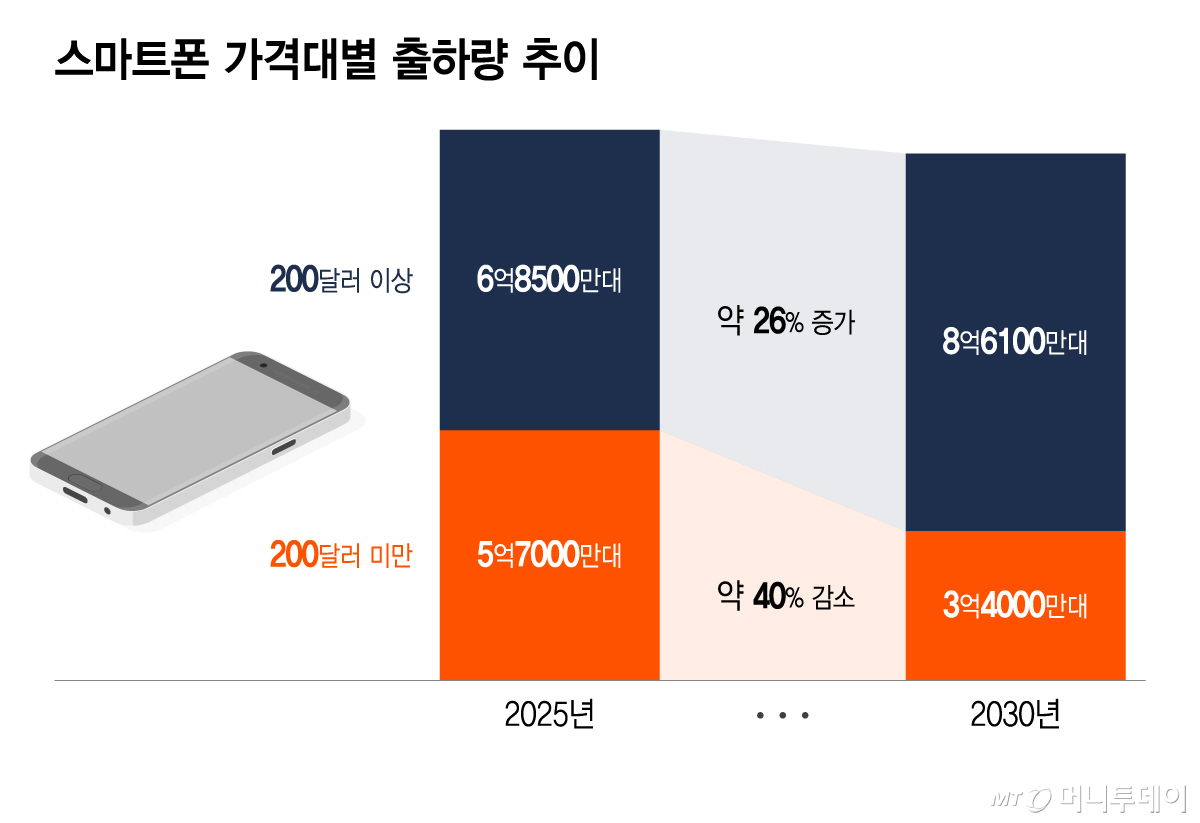
The surge in LPDDR demand for AI servers is becoming a burden on the smartphone market. This is because, with memory manufacturers' production capacity limited, increasing volumes for AI servers reduce the supply margin for consumer-grade LPDDR. In particular, low-end smartphones, which find it difficult to reflect rising costs in selling prices, are expected to be hit hard. Market research firm Counterpoint Research analyzed that, due to rising component prices such as memory, annual shipments of smartphones under 200 dollars will decrease by about 40%, from 570 million units this year to 340 million units in 2030.
Premium smartphone companies are responding to cost burdens with price increases. Samsung Electronics raised the selling prices of its 'Galaxy S26' series, released in March of this year, starting from the 1st. Prices for the 256GB and 512GB models of the S26 and S26 Plus were increased by 149,600 won each, while the price of the S26 Ultra 1TB (terabyte) model was raised by 276,100 won. Apple also raised prices for its 'iPhone 17' series by 160,000 to 500,000 won per model last month.
An industry official diagnosed that "the memory supply-demand structure is being rapidly restructured as a large-scale demand source in AI servers joins the LPDDR market, which was previously mobile-centric." The official added, "As it is difficult to expand production capacity in the short term, there is a high possibility that LPDDR supply shortages and price increase pressures will continue next year."

 in INDUSTRY
