

As Samsung Electronics posted the highest-ever results in the history of global tech companies, it is accelerating the expansion of its semiconductor production facilities both domestically and abroad. To respond to increasing demand for AI (artificial intelligence) semiconductors, the company is expanding HBM (High Bandwidth Memory) production LINEs at Pyeongtaek and pursuing the securing of medium- to long-term production bases in Yongin and Gwangju. In the U.S., it aims to build an advanced foundry (semiconductor contract manufacturing) production base to respond to the memory semiconductor (hereinafter referred to as memory) boom while simultaneously strengthening its competitiveness in system semiconductors.
Samsung Electronics disclosed on the 8th that, on a consolidated basis, its preliminary Q3 results showed revenue of 195 trillion won and an operating profit of 107.4 trillion won. It became the first domestic company to surpass 100 trillion won in quarterly operating profit. The industry estimates that the DS (Device Solutions) division, which handles semiconductor business, posted an operating profit of around 108 trillion won. Analysts attribute the performance improvement to expanded HBM supply and rising prices for general-purpose DRAM.
To respond to increasing memory demand, Samsung Electronics is expanding the production LINE for 6th-generation (1c) DRAM at its Pyeongtaek Campus Fab 4 (P4). According to industry sources, the goal is to build equipment capable of producing 100,000 to 120,000 wafers per month by Q1 2027. 1c DRAM is used in HBM4, the 6th-generation HBM. HBM is a product made by stacking multiple DRAM chips, requiring more processes and equipment for production than general DRAM. Consequently, expanding advanced DRAM production capacity is crucial to simultaneously increase HBM supply and maintain general-purpose DRAM production.
Construction of new fabs (factories) to secure medium- to long-term production capacity is also underway. Pyeongtaek Fab 5 (P5) will be built in stages, with the first fab targeted for operation in 2028 and the second in 2029. The industry forecasts that more than 60 trillion won will be invested in each of the two fabs. While P4 is an expansion to meet immediate HBM demand, P5 is an investment to secure production capacity needed for next-generation products Yangsan in the medium term.
Investments in new production bases outside Pyeongtaek are also proceeding. Samsung Electronics plans to invest 360 trillion won in the Yongin National Industrial Complex, centered on system semiconductors, to build six fabs. The first factory in Yongin targets operation in the second half of 2029. Gwangju is being conceived as an additional production base to prepare for future semiconductor demand expansion. Samsung Electronics plans to invest approximately 400 trillion won in Gwangju to construct two fabs.
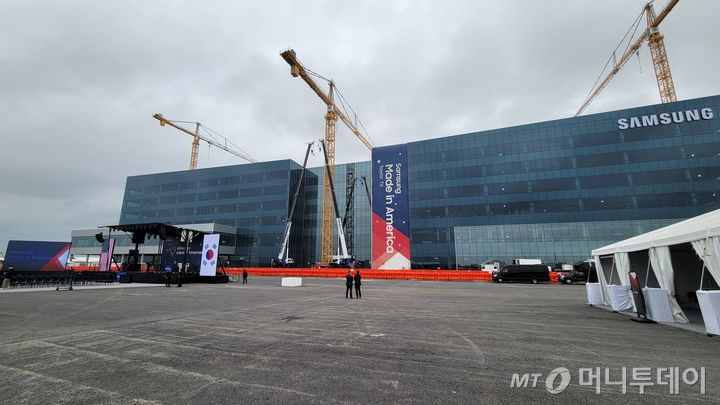
Along with expanding domestic production bases, the company is focusing on broadening its customer base for advanced foundry business in the U.S. It is currently building an advanced semiconductor production facility in Taylor, Texas. The first Taylor factory is preparing for operation this year, while the second is being built targeting Yangsan in 2030. This is to establish advanced process production capacity locally in the U.S., respond to customer product development and Yangsan demand, and expand orders for AI semiconductors.
The success of large-scale expansions depends on how quickly the secured production capacity can be reflected in performance. For memory, investment effects can only be expected if demand is maintained even after new equipment comes online. In the case of foundry, it must raise yields and utilization rates for advanced processes to reduce the fixed cost burden associated with large-scale capital investments. An industry official stated, "Since semiconductors require enormous funds and time to build factories, proactive investment based on forward-looking demand is necessary," adding, "However, what matters more than the scale of investment itself is stably operating new production LINEs and connecting secured production capacity to actual revenue."

 in INDUSTRY
