

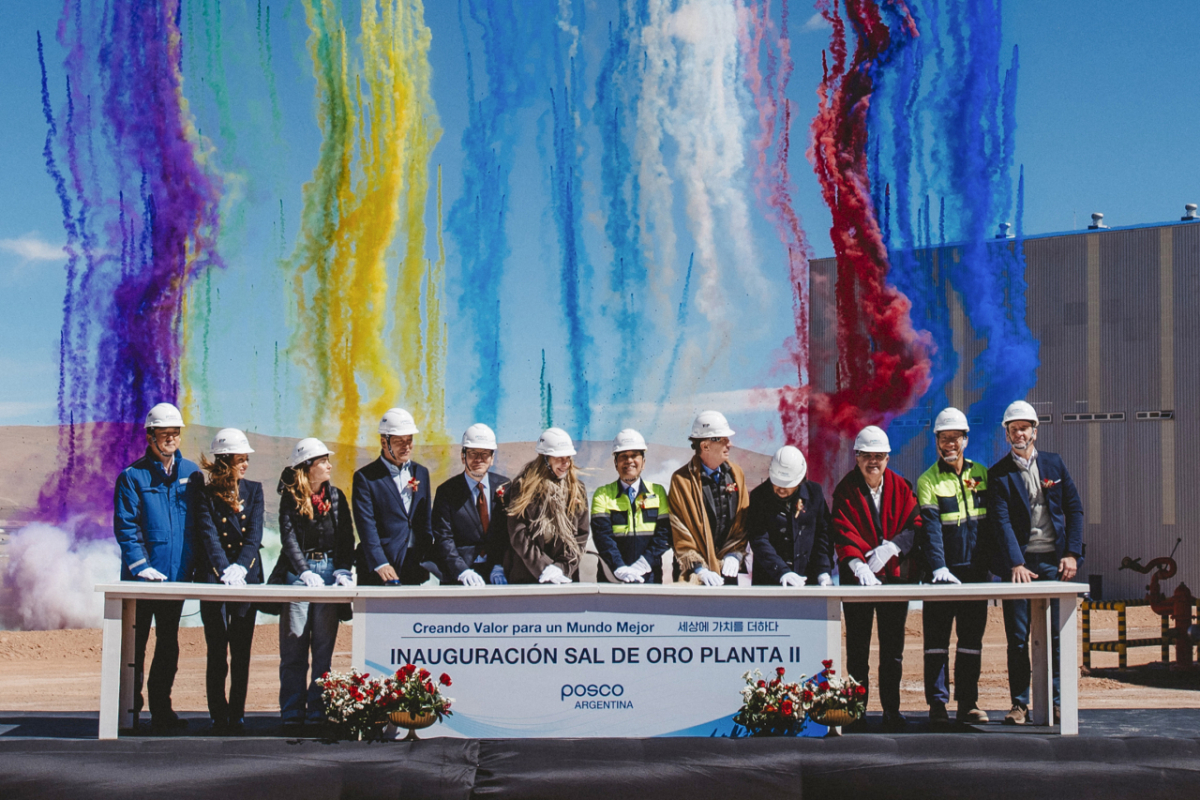
POSCO Holdings announced that it held a completion ceremony for the front-end process of its second brine lithium plant on the 6th (local time) near the Salar de Ombre Muerto salt flat in Argentina, located at an elevation of 4,000 meters.
The front-end process of the second plant, completed with a total investment of USD 954 million by POSCO Holdings, has an annual production capacity of 23,000 tons of lithium carbonate. This expands commercial production capacity in Argentina to a total of 48,000 tons, including the existing 25,000-ton capacity of the first plant. The milestone is significant as it marks a further expansion of the commercial production base following POSCO Group’s proactive securing of lithium resources.
Additionally, by linking the lithium carbonate produced at the second plant’s front-end process with the back-end process scheduled for completion in 2027 at the Yulchon Industrial Complex in South Jeolla Province, the company will be able to convert an annual scale of 25,000 tons into battery-grade lithium hydroxide. This will complete a brine-based lithium hydroxide production system with a total capacity of 50,000 tons.
The POSCO Group has continued proactive investments, beginning in 2010 when it recognized the growth potential of lithium and initiated the development of proprietary lithium extraction technology, followed by the acquisition of the Salar de Ombre Muerto salt flat in Argentina in 2018. As a result of these efforts, the group completed the first plant with an annual capacity of 25,000 tons in 2024 and began commercial production.
Policy support from both the Korean and Argentine governments is also being provided. POSCO Argentina, the legal entity for the POSCO Group’s lithium business in Argentina, obtained approval under the Argentine government’s large-scale investment incentive system (RIGI) as the first Korean company to do so, ahead of the Korea-Argentina summit held last July. This secured benefits such as corporate tax reductions and tariff exemptions. In August, the company also received approval for a short-term borrowing limit of USD 700 million from IDB Invest, establishing a stable foundation for securing operating funds.
POSCO Holdings is promoting the early normal operation of the newly completed second plant and accelerating new investments in the third and fourth plants to complete a 100,000-ton brine lithium production system by 2033. The third and fourth plants will each feature a lithium carbonate production system with an annual capacity of 25,000 tons, aiming to respond to the growth of the ESS (Energy Storage System) market and increasing demand for LFP (Lithium Iron Phosphate) batteries. Through this, the company aims to complete a balanced product portfolio encompassing both lithium hydroxide and lithium carbonate.
On the day of the completion ceremony, POSCO Argentina also signed a Memorandum of Understanding (MOU) with the provincial governments of Salta and Catamarca to promote the third and fourth plants. The two provincial governments agreed to cooperate on administrative support and permits necessary for future project execution. Jang In-hwa, Chairman of the POSCO Group, visited Argentina directly to inspect the second plant’s production facilities and completion status, oversee plans for the third and fourth plants, and address cooperation tasks with local governments, thereby bolstering the expansion of the Argentine lithium business.
The POSCO Group is pursuing a "Triple-Core" strategy that cultivates industrial resources, strategic resources, and energy resources as core growth pillars for the group. The direction is to strengthen business competitiveness from resource securing through development, production, and revenue generation, leapfrog into a leading Korean resource development company, and contribute to stabilizing the national critical mineral supply chain.
Jang (Chairman) stated, "Since my time as Shin Sa-eop (Head) in 2014, I have personally visited sites to find salt flats suitable for lithium development. It is deeply moving that we have reached completion after overcoming numerous difficulties in the extreme environment at an elevation of 4,000 meters." He added, "Going forward, we will proactively secure competitive resources, link them to production and revenue, and stably supply critical minerals essential to the national industry."

 in INDUSTRY
