

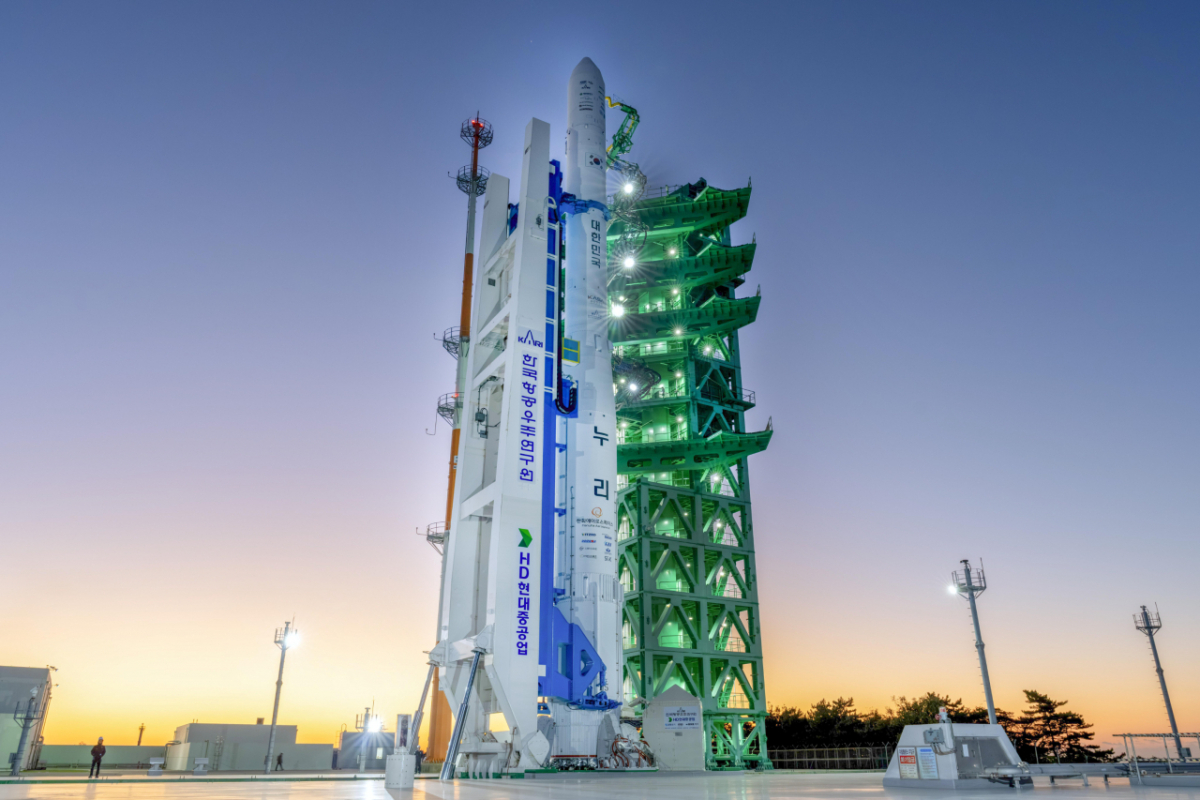
HD Hyundai Heavy Industries announced that it supported pre-launch inspections and tests, as well as the operation of the launch pad system, during the fifth launch of the Nuri (KSLV-II) rocket conducted on the 7th.
HD Hyundai Heavy Industries was responsible for the overall design, manufacturing, and construction of the Nuri launch pad system, and has also supported operations for the first through fourth launches.
In particular, ahead of this launch, the company repaired key facilities that had been exposed to flames and high temperatures during the fourth launch process, including the launch pad and the vehicle hold-down device (VHD). It also inspected various sensors and control and instrumentation equipment to verify the overall performance and soundness of the launch pad system.
Based on its experience in designing, manufacturing, constructing, and operating the launch pad system for Naro (KSLV-I), South Korea’s first space launch vehicle, HD Hyundai Heavy Industries won a contract from the Korea Aerospace Research Institute (KARI) in 2016 to build the "Korean-type launch pad system" for the Nuri rocket.
While Naro was a two-stage launch vehicle with a total length of 33.5 meters and a weight of 140 tons, Nuri has been scaled up to a three-stage launch vehicle with a total length of 47.2 meters and a weight of 200 tons. Accordingly, HD Hyundai Heavy Industries constructed a dedicated second launch pad for Nuri, separate from the existing first launch pad used for Naro.
The second launch pad was completed in 2020, featuring three underground floors and a total floor area of approximately 6,000 square meters. HD Hyundai Heavy Industries independently designed, manufactured, and installed the entire launch pad system using proprietary technology, including ground infrastructure construction (civil engineering and architecture), launch pad ground support equipment (MGSE), propellant supply equipment (FGSE), and launch control equipment (EGSE), and also carried out launch operations.
By raising the domestic production rate of Nuri launch pad system process technologies to 100%, the company has laid the foundation for South Korea to independently build and operate space launch infrastructure.
HD Hyundai Heavy Industries is expanding its capabilities in launch pad design, manufacturing, construction, and operation, accumulated through the Naro and Nuri projects, to the next-generation launch vehicle (3rd generation) project. In September last year, it was selected as the preferred negotiation candidate for the "Next-Generation Launch Vehicle Launch Pad System Detailed Design Technical Service" by KARI.
The next-generation launch vehicle is scheduled to be developed with a height of approximately 70.8 meters and a weight of approximately 530.6 tons. HD Hyundai Heavy Industries plans to continue expanding its business capabilities in the space launch infrastructure sector by pursuing contracts for the manufacturing and construction of future next-generation launch pad systems and participating in the development of the second space center.
An official from HD Hyundai Heavy Industries said, "Based on the experience gained from Naro and Nuri and our detailed design capabilities for next-generation launch pads, we will contribute to the development of South Korea’s space industry."

 in INDUSTRY
