

With the implementation of the "GMO (Genetically Modified Food) Full Labeling System" scheduled for next year, it was revealed that approximately 90% of food-grade non-GMO corn imported last year originated from Russia and Ukraine. Additionally, import volumes of non-GMO corn have decreased while the share of GMO corn has increased. Given the difficulty in securing non-GMO raw materials, there are calls for the government to prioritize measures such as diversifying supply sources rather than rushing the implementation of the system.
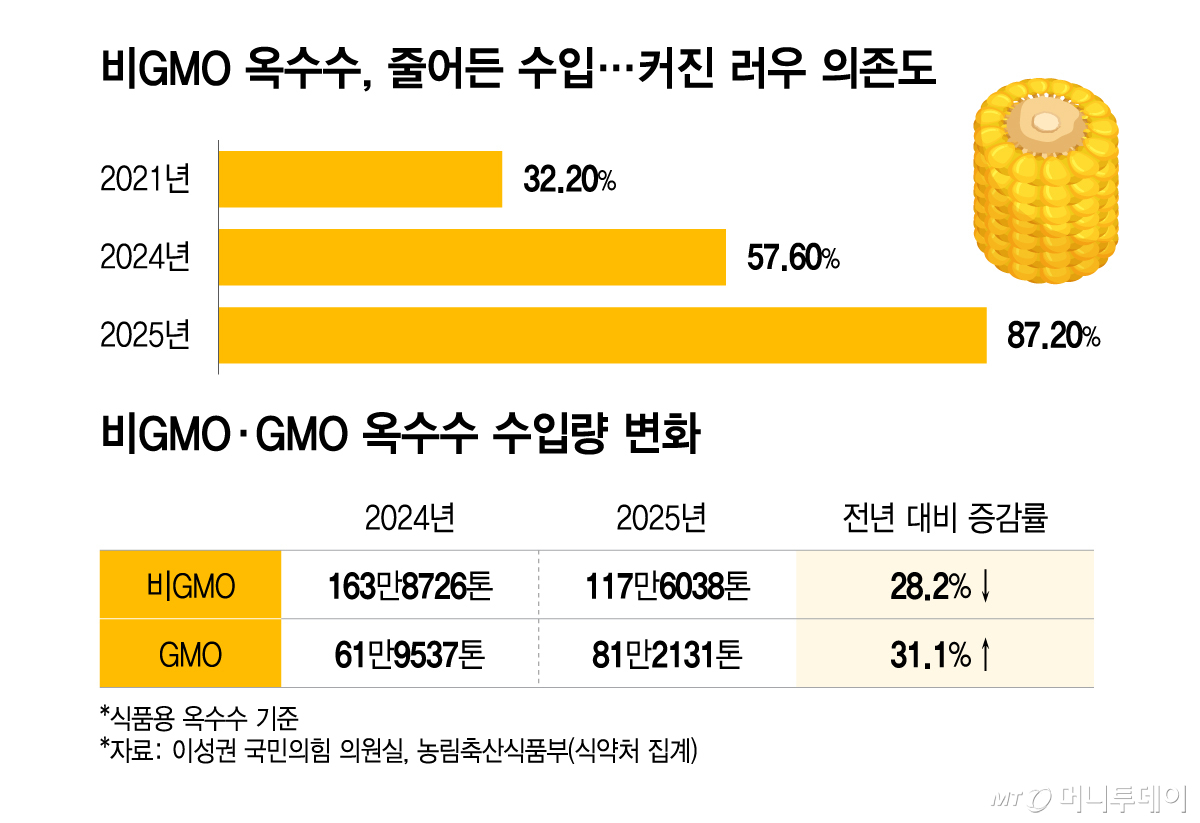
According to data submitted by the Ministry of Agriculture, Food and Rural Affairs to Lee Seong-gwon, a People Power Party lawmaker on the National Assembly's Committee on Agriculture, Forestry, Food, Livestock, Fisheries and Ocean Affairs, the import volume of food-grade non-GMO corn last year was 1.176038 million tons. Of this, 749,327 tons were from Ukraine and 276,705 tons from Russia, accounting for 87.2% of the total. Before the outbreak of war in 2021, this figure was 32.2%, representing an increase of 29.6 percentage points (P) over one year compared to 2024 (57.6%).
As dependence on the two warring nations has increased, import volumes of non-GMO corn fell by 28.2% from 1.638726 million tons in 2024 to 1.176038 million tons last year. While overall imports of non-GMO corn entering the country are decreasing, the concentration on these two countries has intensified. If non-GMO corn cannot be imported from these two nations in a timely manner, the impact on the domestic food industry could also grow significantly.
In contrast, import volumes of food-grade GMO corn have increased. Last year's imports reached 812,131 tons, up 31.1% from 619,537 tons in the previous year. The share of GMO corn in total food-grade corn imports also rose to △14.3% in 2023, △27.4% in 2024, and △40.8% last year. This means that approximately 4 out of every 10 tons of corn imported for food use last year was GMO.
The GMO Full Labeling System being promoted by the government requires labeling if GMO raw materials are used, even if no genetically modified DNA (genetic factors) or proteins remain in the final product; soy sauce, sugars, and edible oils are among the targeted items. While the intent is to allow consumers to choose products based on whether GMO ingredients are used, the industry worries that consumers will avoid products bearing GMO labels. Corn is a core raw material used for starch, corn syrup, and fructose. Companies have immediately switched to using GMO raw materials to address urgent needs, but with supplies from Russia and Ukraine, which account for a significant portion of non-GMO corn imports, being unstable, they will need to find alternative import sources at higher prices starting next year.
Corn is typically purchased through contracts made several months in advance, and non-GMO corn specifically requires securing volumes through contract farming before planting. If the war causes transportation disruptions, alternative supplies must be sought from other countries, potentially leading to additional costs. This is the background behind food industry concerns that production costs will increase due to the implementation of the system.
In August last year, the Ministry of Food and Drug Safety issued a public notice for a partial amendment to the "Labeling Standards for Genetically Modified Foods," moving the implementation date of the GMO Full Labeling System for sugars and edible oils forward from December 31 next year, as originally announced, to December 31 this year.
In political circles, there are calls for the government to assess where and how much non-GMO raw material can be secured before expanding the implementation of the labeling system. Lee Seong-gwon (Rep.) stated, "For food-related policies, safety is more important than speed, but by moving up the implementation of the GMO Full Labeling System by one year, the food industry has been thrown into emergency mode, and consumer confusion is inevitable." They added, "The government must establish safeguards to dispel concerns from both the industry and consumers regarding the implementation, including measures to secure alternative supplies as soon as possible."

 in INDUSTRY
