

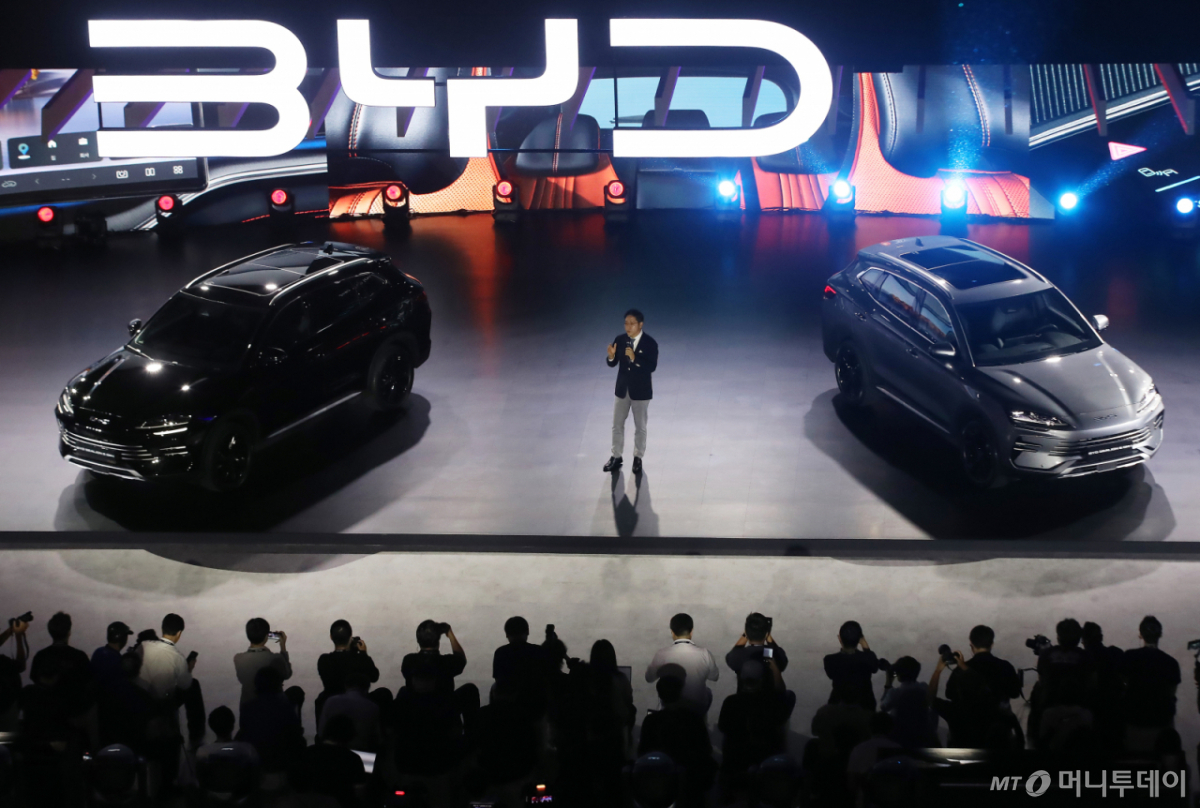
Concerns are emerging that the fallout may reach the South Korean market as the EU (European Union) has agreed to set an annual import cap on Chinese hybrid electric vehicles (HEVs), starting at 350,000 units and gradually increasing it. Unlike the U.S., the EU, and others, South Korea effectively lacks a "institutional protective barrier" to restrict imports of Chinese automobiles, leading to warnings that Chinese HEVs pushed out of the EU could flood into South Korea in large numbers.
According to a Bloomberg report on the 11th (local time) citing internal EU documents, the EU will implement an annual import cap of 350,000 units for Chinese HEVs as early as December 1, based on an agreement with China. Starting from the second year after the implementation of the import cap, the limit will increase by 6% each year, reaching 350,000 units in 2027, 371,000 units in 2028, 393,000 units in 2029, and 416,000 units in 2030.
The EU's move comes as the rapid penetration of low-priced Chinese HEVs into Europe has spread quickly. Although the EU applied tariffs of up to 35.3% on Chinese electric vehicles (EVs) last year in 2024, it only imposed a basic tariff of 10% on HEVs, resulting in a significant increase in imports. In August last year, approximately 35% of European HEV sales were from China. However, Chinese EVs, which faced relatively higher tariff rates, are also rapidly expanding in major EU countries.
Expectations are rising that South Korean automakers will partially fill the gap left by Chinese HEVs in the EU market due to this decision. However, since the EU's import cap measure applies to HEVs imported from all countries, not just China, under the WTO (World Trade Organization)'s non-discrimination principle, with only variations in caps by country, the spillover benefits are expected to be limited.
![[Seoul=NEWSIS] Reporter Jo Seong-woo = Amid a downturn in overall used car prices, used EV and HEV models led by Tesla are showing an upward trend. Expectations for the introduction of Tesla's advanced driving assistance system, FSD, are driving market prices. On the 17th, citizens inspect vehicles at a Tesla store in Seoul. According to EnCar.com, the average August used car price for 37 models of the 2023 model year with 60,000 km mileage and no accident history was down 1.43% from the previous month. In contrast, the Tesla Model 3 Long Range AWD and Model Y Long Range AWD rose by 3.32% and 3.05%, respectively. August 17, 2026. xconfind@newsis.com /Photo=Jo Seong-woo](https://thumb.mt.co.kr/cdn-cgi/image/f=avif/21/2026/10/2026101215324248136_2.jpg)
Concerns about the impact on South Korea's domestic market are even greater. Analysts argue that if Chinese brands attempt to "dump" inventory originally intended for the EU into South Korea at low prices, it will inevitably hit domestic companies hard. Currently, the domestic HEV market is dominated by the share of local firms such as Hyundai Motor and Kia. However, sales of Chinese HEVs in South Korea are on an upward trend, with models like BYD's PHEV (plug-in hybrid electric vehicle) "Sealion 6 DM-i," launched in Korea at a low price, gaining popularity. According to the Korea Automobile Importers Association (KAIDA), a total of 868 units of the Sealion 6 DM-i were sold domestically over the past three months.
The automotive industry points out that, unlike the U.S., the EU, and others, South Korea effectively lacks domestic measures to protect local companies against the offensive of Chinese automobiles. South Korea imposes only an 8% tariff on Chinese cars. While some Chinese companies were excluded from the scope of application during the restructuring of the EV subsidy system, they still remain competitive in price. Tesla, which manufactures most of its vehicles in China and imports them, continues to receive large-scale subsidies. Based on this, Tesla is projected to record over 100,000 annual sales in South Korea for the first time this year.
An industry official emphasized, "Just as Tesla's 'dumping' of Chinese-made models shook up the Korean EV market, the EU's current sanctions could lead to a massive import of Chinese HEVs into South Korea," adding, "Our government must also consider measures to check the import of Chinese cars that are impossible to match in price due to full-scale support from the Chinese government."

 in INDUSTRY

