

“Only China Will Laugh at the ‘Splitting’ Stigma”... The Misconceptions and Truth Behind SK Hynix’s “Dual Listing”
The specter of duplicate listings has descended upon SK Hynix. This follows news that the company is pushing for a Nasdaq initial public offering (IPO) for its U.S.-based enterprise solid-state drive (eSSD) subsidiary, Solidigm (formerly Intel’s NAND business division). With national attention already focused on the stock price of “Samsung-Nix,” scrutiny has become even more intense. Critics argue that listing core assets separately to attract new investors causes existing shareholders to suffer losses, though counterarguments stating such a move is necessary for growth are equally substantial. This context explains why voices are emerging calling for a careful case-by-case examination to distinguish between beneficial and detrimental instances amid the recurring controversy over duplicate listings.
Stripping out a company's key assets to list them as a separate entity is the classic form of a duplicate listing. In that regard, Solidigm's IPO is different. Rather than spinning off its core growth business for a separate listing, it is taking an acquired overseas subsidiary public in its local market. This is also a method long employed by global tech companies such as Intel.
It is not as if it would undermine the very foundation of SK Hynix. As of 2021, just before its initial public offering, LG Energy Solution-related businesses accounted for a share in the 40th percent range of LG Chem’s revenue and assets, whereas Solidigm represents less than 10 percent of that ratio.
More importantly, the value of the equity stake matters more than the percentage itself. The argument is that even if the parent company's ownership stake is diluted, timely investment funded by capital raised through the listing will enhance the growth prospects of SK Hynix and Solidigm, ultimately increasing shareholders' stock value.
The corporate value of Solidigm, which has been overshadowed by SK Hynix and thus not properly evaluated until now, may also be reassessed. With the surge in demand for AI (artificial intelligence) servers, the eSSD market is forming a structure where supply cannot keep up with demand. According to foreign media reports, the post-listing value of Solidigm, which was acquired for just $9 billion, is estimated at $100 billion to $150 billion.
Nevertheless, one might still ask why an "IPO" is specifically necessary, pointing out that investment could be made with internal funds or debt financing. However, the landscape of the semiconductor industry is shifting. Simultaneous large-scale investments in high-bandwidth memory (HBM), DRAM, and NAND are urgently needed. Considering only the investment plans announced by SK Group so far this year, it must raise a staggering amount of over 1,000 trillion won in the medium to long term. It is in a situation where all available means and methods, including existing cash reserves, IPOs, and corporate bond issuances, must be mobilized to find the optimal combination.
If we impose a duplicate listing framework on our companies and leave them unable to move, only China will benefit. This is because Chinese firms are exploiting the gap created by Samsung Electronics' production capacity failing to meet demand, thereby expanding their market position.
Hwang Yong-sik, Gyeong Yeong-hak-bu (Prof.) at Sejong University, emphasized, "Unlike a typical spin-off listing where an existing business division is carved out and listed separately, Solidigm is a foreign venture that was launched by acquiring Intel's NAND and SSD (Solid State Drive) business, so its starting point is different." He added, "In the AI semiconductor competition, investment speed and flexibility in fundraising are crucial. Therefore, rather than questioning the listing itself, judgment should be centered on how the raised funds will be utilized and whether existing shareholder value will be enhanced."
Selling "equity" to buy "growth"... The profit and loss calculation of Solidigm's IPO

Concerns are emerging that the potential initial public offering (IPO) of Solidigm on the U.S. stock market could erode shareholder value at SK Hynix. The rationale is that by ceding equity to external investors, future profits will need to be shared. However, some argue that it is difficult to equate equity dilution with a reduction in economic value. If the company secures funding by being recognized for a high corporate valuation and utilizes those funds for growth, the absolute value of SK Hynix’s stake could actually increase.
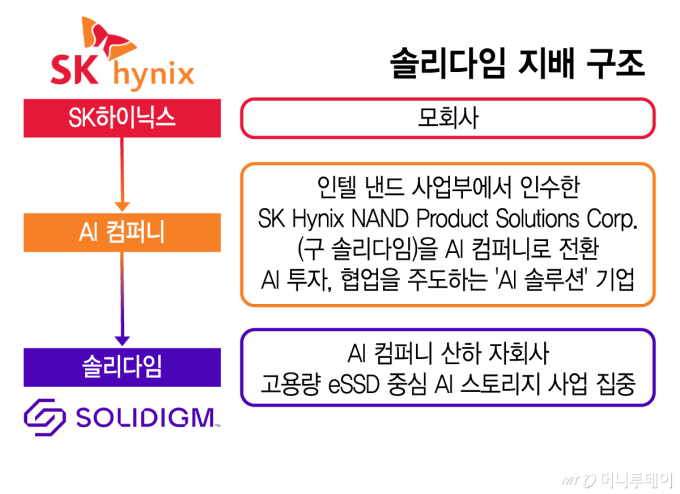
Solidigm was established on the foundation of Intel's NAND and storage business, which SK Hynix decided to acquire in 2020. SK Hynix paid a total acquisition price of $8.844 billion (approximately 11.85 trillion won). Following a restructuring of its U.S. business structure this year, Solidigm has become a grand-subsidiary of SK Hynix, controlled through NPS (SK Hynix NAND Product Solutions).
The speculation of a potential IPO stems from the need for investment capital to secure production capacity and technological competitiveness amid growing demand for enterprise solid-state drives (eSSDs) driven by expanded artificial intelligence (AI) infrastructure investments. According to Bloomberg, Solidigm has selected Wi Han (CEO) as its lead underwriter for a U.S. IPO and is expected to raise approximately $10 billion (13.4 trillion won) through a listing as early as next year. The anticipated corporate valuation is reportedly in the range of up to $100 billion to $150 billion. SK Hynix stated that it is considering various options but has not finalized any decisions.
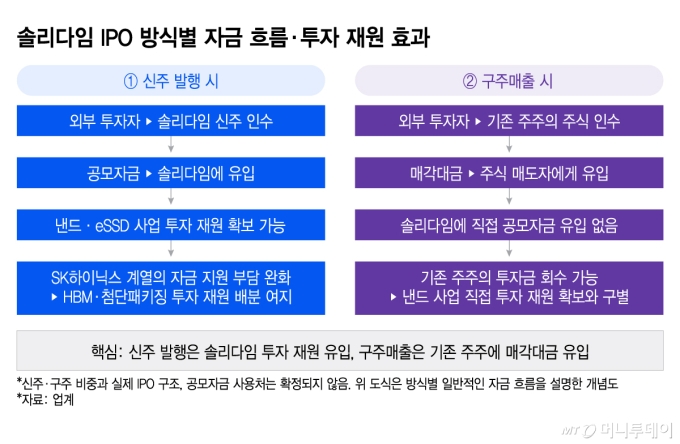
To assess the profit and loss of an IPO, it is first necessary to distinguish between new share issuance and the sale of existing shares. New share issuance involves Solidigm issuing new shares, which dilutes the ownership stake of existing shareholders while channeling funds into Solidigm. The sale of existing shares involves current shareholders selling their holdings, with the proceeds going to SK Hynix’s subsidiary that is selling the shares. The economic impact differs depending on whether the transaction secures growth capital for a listed company or allows existing investors to recover part of their investment.
The core of a new share issuance lies not in the percentage of equity but in the issue price. The higher the market values Solidigm, the less equity is needed to raise the same amount of capital. Even if existing shareholders' ownership percentages are diluted, it is difficult to conclude that the value of their holdings has decreased simply because cash flows into the company as consideration for the new shares. By simple calculation, if a corporate valuation of $100 billion is accepted and approximately $10 billion is raised, existing shareholders can maintain an ownership stake of around 90 percent.
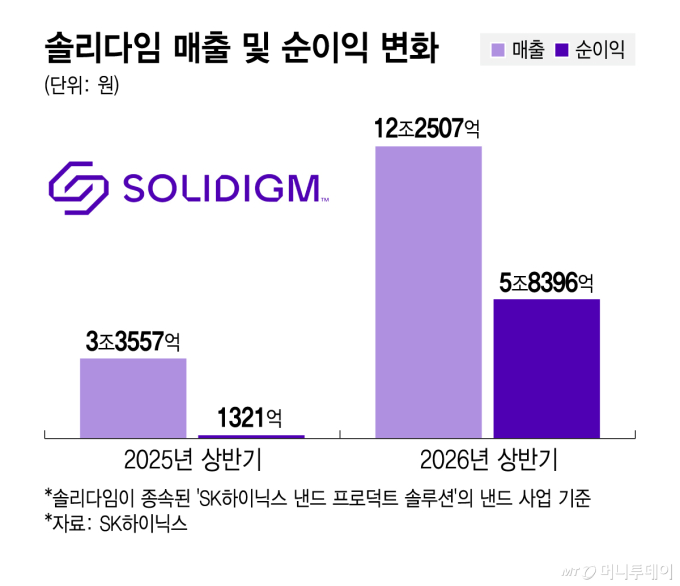
The timing of the listing is also important in securing a high corporate valuation. Solidigm (NPS's NAND business) recorded revenue of 1,225.07 billion won and net income of 583.96 billion won in the first half of this year. These figures increased by 3.7 times and 44.2 times, respectively, compared to the same period last year. Strong performance in the high-capacity eSSD business drove the improvement in results.
The corporate valuations of competing companies that serve as benchmarks at the time of listing are also at their highest levels. The market capitalization of U.S.-based NAND flash memory maker SanDisk is approximately $247.8 billion, an increase of roughly 13 times compared to one year ago. Japan’s Kioxia has also seen its stock price rise nearly ninefold over the same period, recording a market capitalization of about 30 trillion yen. It is a time when a high valuation can be secured upon listing.
The listing could serve as an opportunity to confirm Solidigm's value through an independent market price. If a high-quality company is valued at a premium as an independently listed entity, SK Hynix's corporate value may also be reassessed. However, the portion of Solidigm's profits attributable to SK Hynix shareholders could decrease, and funds intended for investment in the NAND and SSD businesses might choose Solidigm directly rather than SK Hynix.
If the raised funds are invested in expanding production capacity and research and development to enhance business value, SK Hynix can hold greater value even if its ownership stake decreases. As Solidigm secures its own investment resources, SK Hynix’s burden of additional capital contributions may also be reduced. This is about increasing the scale and speed of growth through external capital inflows.
The method of listing an acquired company on the U.S. stock market while maintaining its status as a major shareholder through mergers and acquisitions (M&A) has also been utilized in the global semiconductor sector. Some view this approach as having a different starting point from the "split-off" method, which involves physically dividing existing core businesses for separate listing.
Intel acquired the autonomous driving company Mobileye in 2017 for $15.3 billion and listed it on NASDAQ in October 2022. The listing was conducted through a public offering of newly issued Mobileye shares. At the time, Intel stated that the listing would help unlock the value of Mobileye for Intel shareholders.
SoftBank utilized the sale of existing shares when it listed Arm, the semiconductor design company it acquired in 2016, on NASDAQ in 2023. Despite securing approximately $4.9 billion, it retained about 90.6% of its stake. If SK Hynix were to adopt the method of selling existing shares, it could realize a portion of the investment returns from an M&A deal that involved an investment of approximately $9 billion.
The core of Solidigm’s IPO income statement lies not only in “how much equity to give up,” but also in “at what price and how to give it up.” The value of the shares held before and after the listing, as well as the burden of additional capital contributions for investment, must be compared together. If the company is recognized at a high valuation, enabling it to increase its capital and accelerate high growth, Solidigm’s listing could become a choice to expand the results of M&A while accepting equity dilution.
An industry official said, “What matters is not the form of a dual listing, but rather the actual structure through which trading takes place and how that affects the value for existing SK Hynix shareholders.” The official added, “It is premature to determine whether shareholder value will be impaired before specific details on the IPO method are disclosed.”
“Open up another source of funding”... The Hanbok version of the semiconductor hegemony war: What “Solidigm’s IPO” means
The possibility that Solidigm, a grand-subsidiary of SK Hynix specializing in NAND flash (hereinafter referred to as NAND), is pursuing an initial public offering on the U.S. stock market has been raised. Analysts suggest that external capital raising by Solidigm could serve as a means to diversify SK Hynix's financial burden and expand its investment capacity, particularly given that large-scale investments are simultaneously underway in high-bandwidth memory (HBM), advanced packaging, and NAND.
According to the semiconductor industry on the 11th, if Solidigm secures external capital through an initial public offering (IPO), SK Hynix will be able to broaden its options for allocating internal cash to other businesses such as HBM and advanced packaging, while raising investment funds for its NAND business at the level of its grandchild company. Given that large-scale investments in multiple businesses are being carried out simultaneously even amid a semiconductor boom, the need to diversify funding channels is growing.
SK Hynix expects its capital expenditure for this year to reach the high end of the 4th trillion won range. This represents an increase of at least 1.5 trillion won compared to last year's investment of 3.0173 trillion won. The company is accelerating the expansion of production facilities at the Yongin semiconductor cluster in Gyeonggi Province while moving up the schedule for Yangsan at Cheongju M15X. It is also advancing medium- and long-term investments, including the advanced packaging plant P&T7 and the new NAND production base M17. With plans to build a semiconductor cluster in the Honam region added to these efforts, the scope of investment is expected to expand further. SK Group Chairman Chey Tae-won visited the site of the Gwangju military airport on the 9th and emphasized, "Semiconductor demand is growing faster than anticipated. Although we have moved up the overall construction schedule for the Yongin semiconductor cluster by 12 years, this may still be insufficient. We will build at the fastest possible speed."
The fact that investment targets span multiple business areas also underscores the importance of funding. High Bandwidth Memory (HBM) requires not only advanced DRAM production lines but also packaging equipment for stacking and connecting multiple chips. For NAND as well, securing production capacity to meet growing demand for enterprise solid-state drives (eSSDs) for AI data centers is a key challenge. While massive capital must be invested upfront in factory construction and equipment procurement, it takes considerable time before new facilities generate revenue.
SK Hynix has recently continued its strong performance, riding the wave of a semiconductor boom. According to financial data provider FnGuide, the company's projected operating profit for the third quarter of this year is expected to reach 77.2214 trillion won. However, even with solid results, rapidly increasing capital expenditures can reduce the cash remaining in the company. Given that SK Hynix President Kwak No-jeong previously set a goal of achieving "100 trillion won in net cash" at the regular shareholders' meeting to ensure financial soundness, the company's need to efficiently secure investment funds for each business segment, rather than relying solely on its own cash generation, has grown.
The extent to which Solidigm's initial public offering (IPO) can alleviate the financial burden is expected to hinge on the scale of new share issuance and how the raised funds are utilized. If Solidigm issues new shares to attract external capital independently, it could reduce the need for additional financial support from the SK Hynix group. Unlike secondary offerings, in which existing shareholders sell their holdings, primary issuances channel the raised funds directly into Solidigm, making them advantageous for securing investment resources for its NAND flash business. However, if the proportion of new shares is low or if the proceeds are not directly invested in expanding NAND production capacity, the effect on reducing the financial burden will be diminished. SK Hynix stated that it is considering various measures to strengthen Solidigm's competitiveness, but has not yet finalized any specific plans.
An industry official said, "Given that SK Hynix is continuing large-scale investments in HBM and advanced packaging, there is no need to fund its NAND business with internal capital." The official added, "If Solidigm can secure investment funds from external sources, SK Hynix will be able to allocate investment funds for each business more flexibly."
Can “Sore Thumb” Solidigm Become the Core of SK Hynix’s U.S. Strategy?
Solidigm, a grandchild company of SK Hynix specializing in NAND flash (hereinafter referred to as NAND), which was once called the "sore thumb" of the parent firm, has secured a turning point amid expanding demand for artificial intelligence (AI). Expectations for a revaluation of its corporate value have also grown as demand for enterprise solid-state drives (eSSDs) surges. It is projected that if its listing on the U.S. stock market materializes, it will further boost SK Hynix's expansion of its business in the United States.
Solidigm is a company established in 2021 after SK Hynix acquired Intel's NAND and SSD businesses. The name was derived from "SSD" and "paradigm." Despite its ambition to change the paradigm of the NAND market, the company struggled with poor performance in its early days due to an industry downturn. Cumulative losses from 2022 to 2023 reached 730 billion won.
The expansion of investment in AI data centers has become a turning point for Solidigm. As the proliferation of generative AI has caused a surge in the data required for training and inference, enterprise solid-state drives (eSSDs) have established themselves as a core solution supporting AI computing. Global investment bank JPMorgan forecasts that eSSDs will account for 48% of global NAND bit demand by 2027. This is expected to surpass smartphones (30%) and PCs (22%) to become the largest source of NAND demand. This outlook forms the backdrop for assessments that Solidigm's strategic value will increase as investment in AI infrastructure expands, given its strength in high-performance eSSDs.
Solidigm is also expected to play a key role in SK Hynix's expansion of its U.S. business. Earlier this year, SK Hynix announced plans to restructure "SK Hynix NAND Product Solutions" (formerly Solidigm) and establish an "AI Company." The company aims to expand beyond memory supply into the AI solutions business through investments in and cooperation with local AI firms. The existing NAND and SSD businesses will be handled by a newly established Solidigm entity under the AI Company.
Solidigm is expected to support the business expansion of the AI company through its high-capacity eSSD technology and local customer base. SK Hynix also stated, "By placing Solidigm under the AI company, we will seek opportunities to generate synergies across various business areas within the AI industry." If a NASDAQ listing becomes a reality, Solidigm will be able to directly raise investment funds in the U.S. capital markets. Analysts note that Solidigm's fundraising capabilities, added to the AI company's local investment and collaboration strategy, could also bolster SK Hynix's expansion of its U.S. business.
The ability to respond to changes in U.S. trade policy is also seen as a positive factor. As the Donald Trump administration pressures semiconductor companies to invest locally, a NASDAQ listing could serve as a channel for securing funding for production facility investments. SK Hynix currently does not operate any semiconductor production facilities in the United States. If Solidigm deploys its IPO proceeds into U.S.-based production facilities, it appears the company will be able to respond to the U.S. government's policy stance demanding expanded local production while also strengthening cooperation with customers.
Securing key local talent could also benefit from this approach. By establishing a compensation system that leverages U.S.-listed shares, companies can provide long-term incentives to technical personnel through mechanisms such as stock options and restricted stock units (RSUs). In the competitive U.S. market where big tech and semiconductor firms vie for top talent, this expands the available tools for attracting new hires and retaining existing staff.
An industry official said, “Once Solidigm secures investment funds through the local capital market and establishes a talent compensation system based on listed shares, the conditions for expanding its business in the United States and achieving sustained growth will be further strengthened.”
[MT Report] Between Duplicate Listings and Duplicate Growth (Part 2)
Abandoned IPOs: Companies forced to return investment funds as duplicate listing regulations dry up capital

 in INDUSTRY


