

Samsung Memory Division Manager Kim, a top performer, hits the jackpot… Bonus of 1 billion won plus an additional 40%
<- Special performance bonuses for manager-level employees are paid differentially based on job performance evaluations <
Samsung Electronics will pay an additional special performance bonus of up to 40% to manager-level employees in its Semiconductor (DS) Division who received the highest rating in their job evaluations. A "high-performing Ko Cham (Director)" is expected to receive a performance bonus in the mid-1 billion won range. Considering future executive bonuses and further improvements in results, Samsung Electronics' burden of paying performance bonuses is projected to grow even larger.
According to the electronics industry on the 12th, the DS Division of Samsung Electronics applies differential rates for special performance bonuses for CL4 (manager-level) employees based on their job performance (performance evaluation). Employees who received the highest rating, EM(A), are subject to a rate of 1.4 times the special performance bonus payment rate, followed by △ES(B) at 1.2 times, △MT(C) at 1 time, △MS(D) at 0.9 times, and △NM(E) at 0.8 times.
Samsung Electronics classifies employee ranks from CL1 to CL4. The differential payment rate based on performance evaluation in this special performance bonus applies only to CL4 employees and does not apply to other ranks. CL4 employees had already received their existing OPI (Over-Profit Incentive) differentially based on performance evaluations, and the same method is now being applied to the special performance bonus as well.
A manager-level employee working in the memory division (based on an annual salary of 110 million won) is estimated to receive approximately 1 billion won in performance bonuses, combining the special performance bonus, existing OPI, and TAI (Target Achievement Incentive). This estimate is based on the 37th trillion won annual operating profit for Samsung Electronics this year as projected by securities firms.
In particular, employees who received the highest performance evaluation are expected to receive an additional 40% of their bonus, bringing their total compensation to the mid-1 billion won range. It is reported that the EM rating is awarded to the top 10% of all employees. Samsung Electronics applies a salary cap, which is the upper limit of base pay by rank, and this year's salary cap for CL4 is 130 million won.
Samsung Electronics plans to pay the remaining amount entirely in company stock after deducting taxes, insurance premiums, and donations from the special performance bonus. The highest income tax rate of 49.5% (including local income tax) will be applied, and an insurance premium of 4.967% is scheduled to be deducted. Consequently, the actual amount of company stock paid out will be 45.5% of the special performance bonus. A sale restriction applies to two-thirds of the issued company stock.
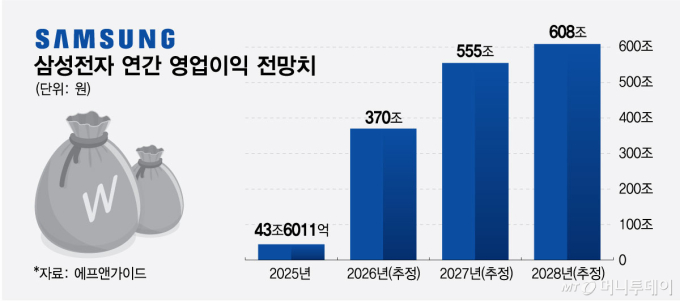
The scale of Samsung Electronics' performance bonus payments appears set to expand further. Securities firms project Samsung Electronics' annual operating profit at 55 trillion won next year and 608 trillion won in 2028. These figures already reflect the costs associated with paying special performance bonuses. Samsung Electronics includes performance bonus costs in its results through provisions, among other means.
Industry attention is also turning to the scale of executive performance bonuses. While the criteria for paying special performance bonuses to DS Division employees have been determined, the executive compensation structure has not yet been announced. The industry expects that executives will also receive substantial company stock compensation utilizing tools such as PSU (Performance-Linked Stock Compensation) and LTI (Long-Term Incentive).
In accordance with Commercial Act regulations requiring shareholder meeting approval for the disposal of company stock, Samsung Electronics will propose a special performance bonus payment plan at its regular shareholders' meeting in March next year. It plans to proceed with payments after going through related procedures, including board resolutions. The industry atmosphere suggests that the likelihood of this agenda item being rejected at the shareholders' meeting is low.
Samsung Electronics' semiconductor performance bonus provisions alone approach 3 trillion won… Growing "cost of the boom"
<- Shareholder meeting approval for company stock payment as a variable… Global memory industry also faces cost management challenges <
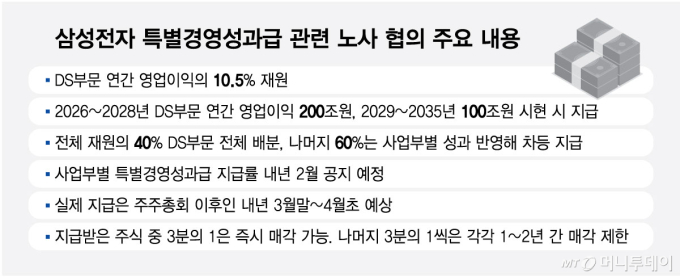
Samsung Electronics appears to have reflected nearly 3 trillion won in provisions through the third quarter this year to pay a "special management performance bonus" for its DS (Device Solutions) Division, which handles semiconductor business. This is a result of the bonus scale swelling as results surged on the back of a memory semiconductor (hereinafter referred to as memory) "super cycle (period of extreme boom)." The DS Division recorded cumulative operating profit of 143 trillion won in the first half alone, and is estimated to have generated over 100 trillion won in operating profit in the third quarter as well, projecting that it will far exceed the performance bonus payment criterion of "200 trillion won in annual operating profit."
According to relevant industry sources on the 12th, Samsung Electronics' labor and management previously agreed to pay a special management performance bonus using 10.5% of the DS Division's operating profit as the funding source. According to the detailed payment plan announced on the 7th, 40% of the total performance bonus fund will be distributed equally among DS Division executives and employees, while the remaining 60% will be paid differentially based on the performance of each business division. Calculated based on the securities industry's projection of 37 trillion won for the DS Division's annual operating profit, the estimated special management performance bonus per employee with an annual salary in the low 80 million won range is △approximately 750 million won for the memory division, △approximately 530 million won for common organizations, and △approximately 240 million won for foundry (semiconductor contract manufacturing) and system LSI.
The issue is that the performance bonus burden resulting from the overall strong performance of the DS Division also affects the profitability of individual business divisions. It is known that at a management issues briefing for executives and employees in June, the foundry division explained that the timing of its return to profitability could be delayed until 2028 due to the burden of performance bonus provisions. This is because the performance bonus fund is calculated based on the operating profit of the entire DS Division, but the related costs are reflected as labor costs for each business division.
Observations also emerge within Samsung Electronics that the foundry division has already improved its profitability to a level where it can return to profitability if performance bonus-related costs are excluded. Thus, independent of improvements in core business profitability, performance bonus provisions have become a variable determining the timing of an accounting-based return to profitability.
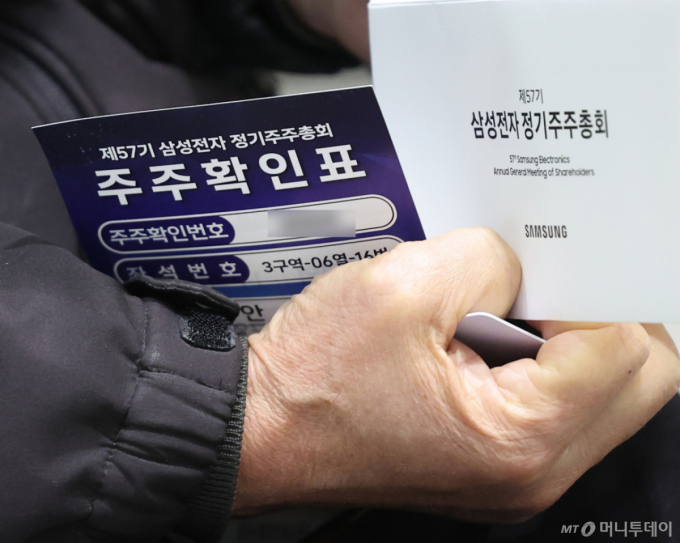
The hurdle of the shareholders' meeting (hereinafter referred to as the general meeting) remains. Under the Commercial Act revised in March this year, if a company pays its own stock (treasury stock) as compensation to executives and employees, it must prepare a plan for holding and disposing of treasury stock containing relevant details and obtain approval from the shareholders' meeting. If Samsung Electronics' treasury stock payment proposal is rejected at the shareholders' meeting, labor and management will likely need to renegotiate the payment method. In this process, there is also a possibility that the labor union may demand cash payments. Choe Seung-ho, Ji Bu (Chairman) of the Samsung Group Initial Enterprise Labor Union's Samsung Electronics branch, said in a phone interview with MoneyToday, "If it is rejected at the shareholders' meeting, we are considering demanding cash payment," adding, "However, I do not think the possibility of rejection is high."
Both inside and outside the industry place weight on the likelihood that the treasury stock payment proposal will pass the shareholders' meeting. The analysis is that if the proposal is rejected, the company's burden of cash outflow could increase, so shareholders have little reason to oppose treasury stock payments, which can be expected to raise corporate valuation through expanded investment. Jeong Heung-jun, Gyeong Yeong-hak-gwa (Prof.) at Seoul National University of Science and Technology, stated, "Since cash is a resource that can be utilized for technology development or M&A (mergers and acquisitions), treasury stock payment is more advantageous from the shareholders' perspective," adding, "The possibility of rejection at the shareholders' meeting is low."
<◆ Micron and SK Hynix also grappling with performance bonuses… Large-scale compensation becomes a 'new normal' <
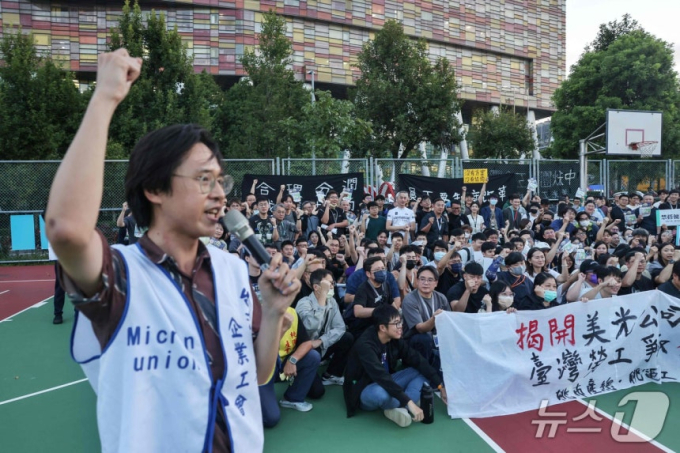
The cost burden from large-scale performance bonus payments is spreading beyond Samsung Electronics to the entire memory semiconductor industry. Micron announced during its earnings announcement conference call for the fourth quarter of fiscal year 2026 on the 30th of last month, "Additional costs of approximately $1 billion (approximately 1.3353 trillion won) are expected to occur next quarter for performance bonus compensation," and "(due to the burden of performance bonuses, etc.) the first quarter of fiscal year 2027 will be the bottom for gross profit." The gross profit margin forecast decreased from 87% in the fourth quarter of fiscal year 2026 to approximately 86.3% next quarter.
Internal backlash from executives and employees is also continuing. The union at Micron's Taoyuan factory in Taiwan has launched collective action, demanding the establishment of a performance bonus system linked to operating profit, similar to Korean semiconductor companies like Samsung Electronics and SK Hynix. The union is demanding the introduction of a permanent system that allocates 15% of operating profit as a resource for employee compensation. In a recent vote among members, 88.3% of all members voted in favor of a strike, securing the right to strike. The union plans to hold a large-scale rally in Taipei on the 19th (local time). However, whether and when an actual strike will begin has not yet been confirmed.
SK Hynix also adjusted its performance bonus payment method. SK Hynix's labor and management agreed last month to pay 50% of the Profit Sharing (PS) in cash and the remaining 50% in company stock. While maintaining the existing criteria of using 10% of operating profit as a performance bonus resource without setting a payment cap, they decided to pay part of the PS, which had been paid entirely in cash, in company stock. SK Hynix is also expected to reflect performance bonus provisions worth several trillion won ahead of its earnings release at the end of this month.
An industry official pointed out, "As the profit scale of memory semiconductor companies grows, large-scale performance bonuses are becoming a de facto permanent cost factor," adding, "From the companies' perspective, they must consider the burden of expanding compensation costs just as much as the increase in profits."

 in INDUSTRY


