

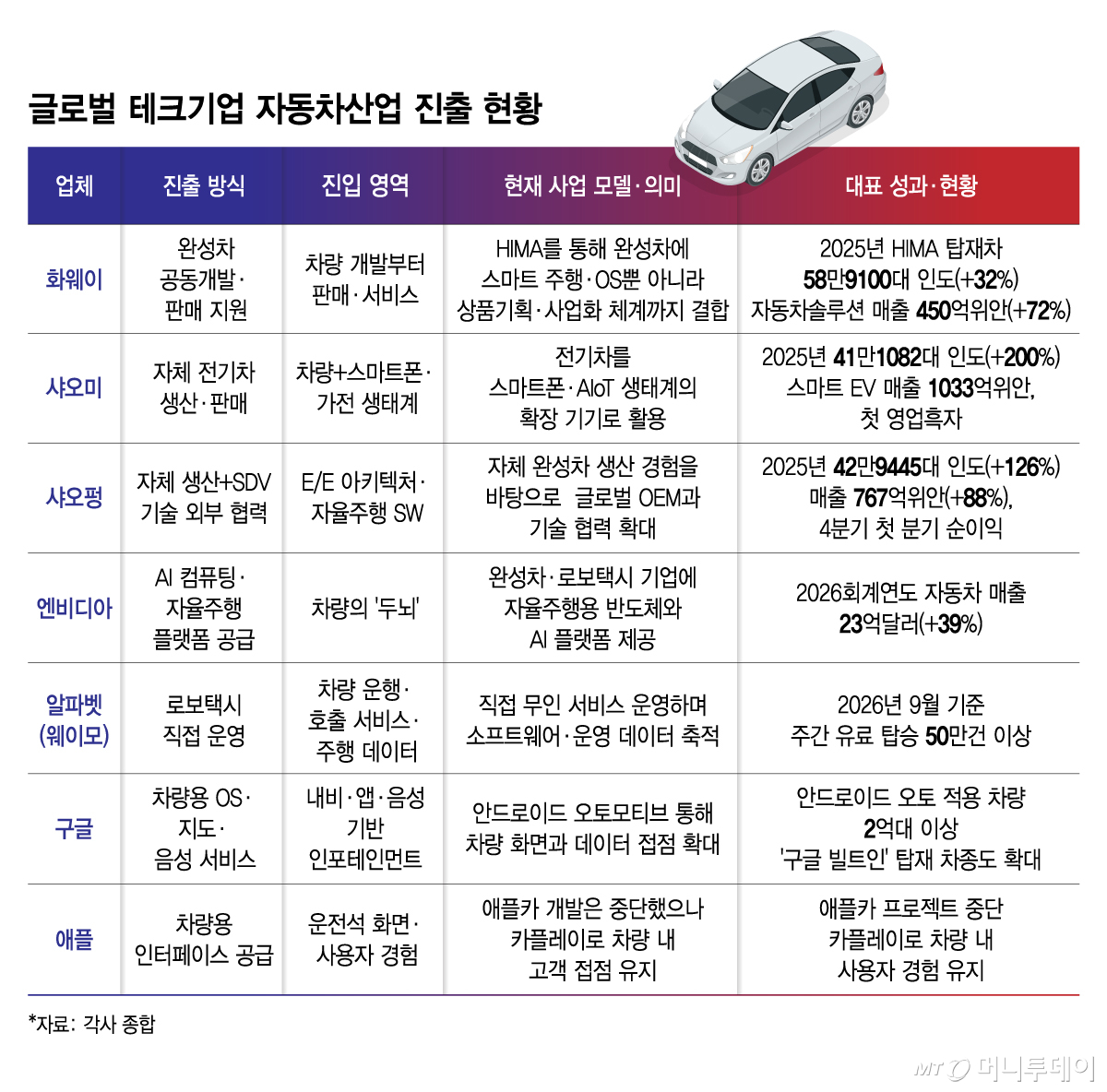
Global tech companies that once built smartphones and software solutions are now intensifying their competition to secure dominance over the "inside of the car," ranging from in-vehicle operating systems (OS) and autonomous driving artificial intelligence (AI) to infotainment and robotaxi services.
In this regard, the HMG Management Research Institute (hereinafter referred to as the Institute), a think tank within the Hyundai Motor Group, recently analyzed Xpeng's business strategy in an internal report titled "Xpeng Pushes External Sales of Software-Defined Vehicle (SDV) Technology."
The Institute focused on how Chinese electric vehicle manufacturers are expanding their software capabilities, accumulated through vehicle production, into external businesses.
Previously, the Institute released a report to the group internally titled "How Did Huawei Take Over China's Automotive Industry?—Sources of Competitiveness and Our Response," diagnosing that securing an SDV ecosystem within the vehicle could determine future competitiveness in the automotive industry.
The current report introduces how Xpeng is expanding external supply of SDV technology to secure new revenue sources. It analyzes that, based on its full-stack technical capabilities proven through collaboration with Volkswagen (VW) and its Yangsan capabilities, Xpeng is targeting the cooperation needs of global automakers whose transition to SDVs has been delayed.
The report also noted that if low-cost technology procurement by Chinese firms spreads, the technological gap between global automakers could narrow, making competition even fiercer.
Xpeng has independently developed in-vehicle OS, advanced driver assistance systems, and electronic/electrical architectures, applying them to vehicle sales. Last year, vehicle deliveries reached 429,445 units, a 126% increase from the previous year, while revenue rose 88% to 76.7 billion yuan. The company is using the Yangsan experience and driving data secured through direct car sales as the foundation for its technology business of selling to external automakers.
China's Huawei and Xiaomi are also entering the automotive market based on solutions closely tied to consumer life, such as smartphones and home appliances.
Huawei not only supplies autonomous driving assistance systems and in-vehicle OS to automakers but is also broadening customer touchpoints by integrating product planning, sales, and services. Xiaomi is focusing on selling its own electric vehicles that bundle a smartphone and home appliance ecosystem. Last year, Xiaomi's electric vehicle deliveries reached 411,082 units, a 200% increase.
The entry of U.S. tech companies into the automotive industry also aligns with this trend. Rather than manufacturing, they are focusing on entering through vehicle screens, brains, and operation services. Google has expanded in-vehicle touchpoints for maps, apps, and voice services by leveraging Android Auto and an in-vehicle Android OS.
Apple discontinued its Apple Car project in 2024 but is currently connecting iPhones to vehicle screens via CarPlay. Nvidia supplies autonomous driving AI semiconductors and platforms to automakers and robotaxi companies, generating $2.3 billion in revenue in the automotive sector last year. Alphabet's Waymo operates a paid driverless ride service with over 500,000 rides per week in the United States.
In this context, assessments indicate that as the scope of competition in the automotive industry expands beyond vehicle performance and manufacturing costs to software, services, and customer data, tech companies are emerging as both competitors and technology partners to automakers.

 in INDUSTRY
