

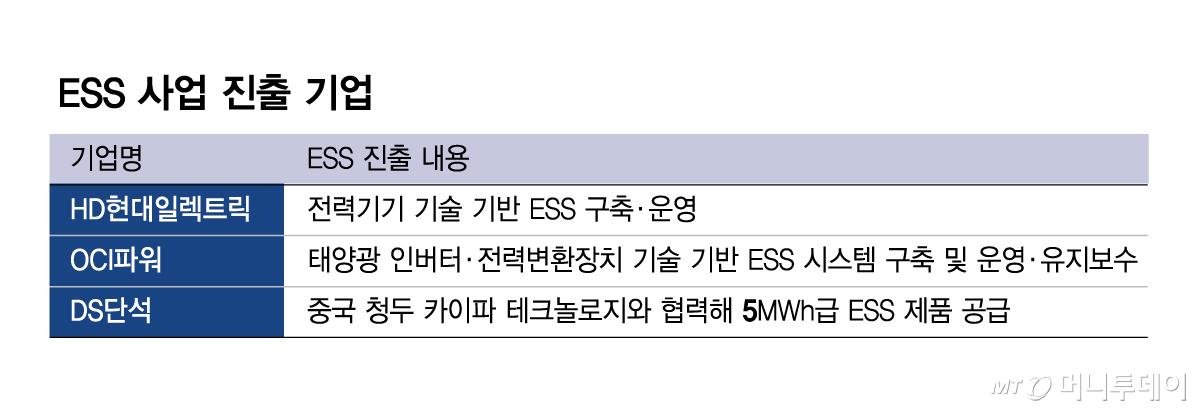
The competitive scope of the energy storage system (ESS) market is expanding from battery supply to power operations. Companies in power equipment, solar energy, and resource recycling are steadily entering the ESS market, which was once considered the exclusive domain of battery manufacturers, leveraging their existing business capabilities.
According to industry sources on the 14th, global new installations of battery storage systems reached 108 gigawatts (GW) last year, a 40% increase from the previous year. The International Energy Agency (IEA) analyzed that global energy storage capacity must be expanded to 1.5 terawatts (TW) to achieve the goal of tripling renewable energy installations by 2030.
As demand for storage systems grows to address the expansion of renewable energy and changes in power demand, companies based in the existing energy industry have also begun to turn their attention to the sector, alongside battery manufacturers. HD Hyundai Electric is expanding its ESS business based on the technological expertise accumulated in the power grid field, including power equipment and distribution equipment. The company has carried out various ESS construction projects since 2016 and established a local subsidiary in Texas, U.S., last year. In the same year, it secured an order for a 200 megawatt-hour (MWh) class ESS project worth approximately 140 billion won, fully launching its offensive into the North American market. Recently, it formed a consortium with renewable energy IT solution provider Enerdot to participate in AI-based distribution grid ESS projects and is also promoting the operation of virtual power plants (VPPs) utilizing grid management technology.
OCI Power is no exception. Based on its domestic research, development, and production capabilities, OCI Power supplies inverters for solar power generation and power conversion systems (PCS) for ESS. It is also expanding its scope to include EPC (engineering, procurement, and construction) and O&M (operation and maintenance) projects for solar power plants based on power conversion technology. The company is evaluated as strengthening its business capabilities across the entire renewable energy infrastructure, with power conversion technology as its core competitive advantage.
DS Dansok, a resource recycling and bioenergy company, is also concretizing its entry into the ESS market. Leveraging experience accumulated in its existing energy business, it recently began supplying 5 MWh class ESS products in cooperation with China's Chengdu Kaifa Technology. The company plans to expand its business scope from equipment supply to on-site application and operational support, and to broaden its operations into the power management sector by utilizing an energy management system (EMS) and other tools.
The background behind these companies' entry into the ESS market includes the fact that operational capabilities to utilize storage systems as actual power resources are important, in addition to installation. Beyond battery cell and system supply, technological and business capabilities in various fields such as power conversion systems (PCS), energy management systems (EMS), facility construction and maintenance, and power operations are required. The expansion of the domestic ESS market is also an opportunity factor. On the 22nd of last month, the government opened the third round of the central contract market for ESS, deciding to select operators for a total scale of 1,180 MW on land and in Jeju. This bidding scale exceeded the individual bid volumes of 563 MW in the first round and 565 MW in the second round by more than double each.
An industry official said, "In the ESS market, a company's competitiveness is no longer determined solely by battery manufacturing technology," adding, "It must also possess the capability to stably operate installed facilities and connect power resources dispersed across multiple regions as a single resource."

 in INDUSTRY
