

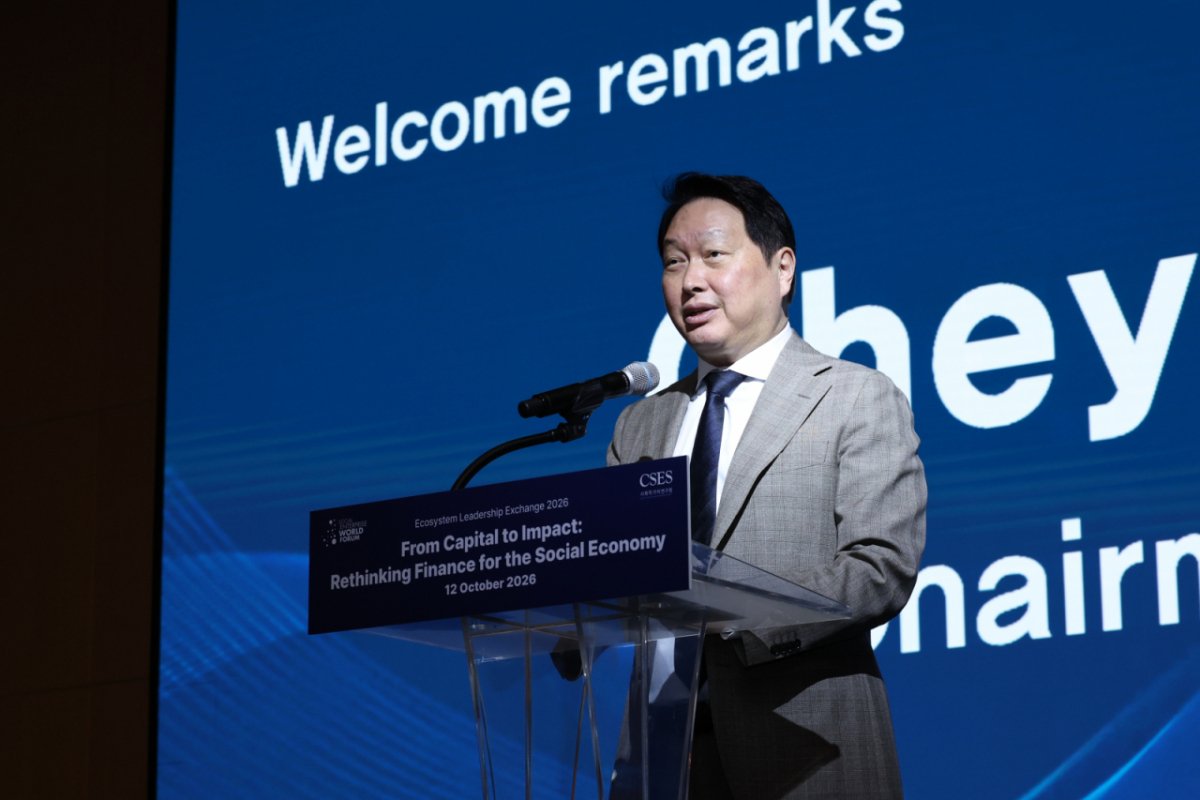
SK Group Chairman Chey Tae-won said, "To become an 'AI-native society,' we must all try creating AI and act proactively."
Chey made this remark while appearing as a lecturer on EBS's 'Great Lecture' on the 13th. Chey will lecture on EBS from the 12th to the upcoming 16th, under the theme of "AI and New Capitalism, and Youth." The topic of the second lecture, which aired that day, was "How to Create an AI-Native Society."
Chey emphasized that beyond the performance competition among AI models, individuals, organizations, cities, and nations must leverage their data to find practical solutions. He said, "Currently, AI is still an immature child, but over time it will develop into AGI (Artificial General Intelligence)," adding, "We need to consider how our country should respond."
He explained that as massive capital, power, semiconductors, and data centers are invested, we must secure speed and scale while also preparing for security, privacy, and the shocks resulting from rapid changes.
Chey noted, "The AI industry has a 'full-stack' structure extending from energy to semiconductors, infrastructure, foundation models, and applications," identifying applications as the most important among them. He stated that only by creating tangible value, such as boosting productivity and reducing costs, can we recover massive AI investments and proceed to reinvestment.
He also pointed out that the challenges facing Korea must be solved by itself. This is because the data accumulated by domestic organizations, cities, and citizens is a core resource for enhancing the accuracy of solutions. Chey explained, "What plays an important role here is the 'AI agent.' If we have one AI agent per citizen, they can gather our country's data and identify what problems exist."
Regarding privacy and security concerns arising from data utilization, he proposed technical solutions. He took the stance that rather than abandoning AI adoption due to risks, safety measures such as encryption should be advanced to address them.
He stated that the starting point toward an AI-native society does not need to be a grand national project. He said, "Even in organizations or clubs of 500 or 1,000 people, we can experiment with how to utilize AI, what information to input, and what to do," adding, "Even if AI is like a child, those who keep using it and continuously track its development will be at the forefront."
Ultimately, Chey analyzed that the core competency lies not in coding itself, but in the ability to identify the concerns of humans and communities and use AI to reduce the time and cost of solving them. He stated, "The effect of AI is ultimately about creating many problem-solvers for social issues," adding, "It is important how much and how quickly we solve the problems of our society."

 in INDUSTRY
