

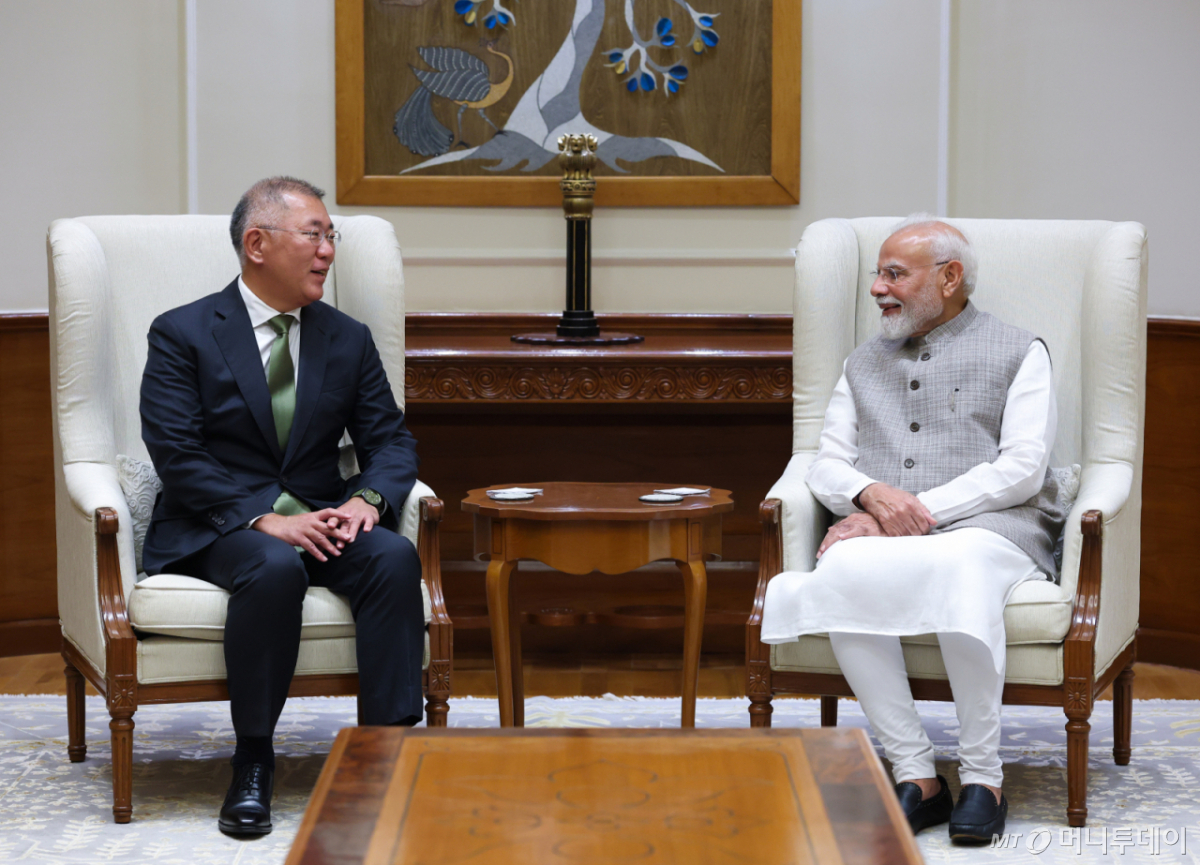
Hyundai Motor Group Chairman Eui-sun Lee met with Indian Prime Minister Narendra Modi and announced an investment plan exceeding 2 trillion won over the next seven years in India. This is interpreted as a strategic decision based on the high investment value of India, which has the world's largest population and is the third-largest automobile market globally, given its significant growth potential.
Chung Eui-sun: "Investment of $15.5 billion in India"
Chung held a separate meeting with Modi at the Indian Prime Minister's official residence in New Delhi, India, on Tuesday (local time).
Chung told Modi, "Since Hyundai Motor Group entered the Indian market in 1996, it has grown alongside India over the past 30 years," expressing gratitude for the Indian government's continued interest and support for the group. He then explained the current status of Hyundai Motor Group's business in India, as well as its medium- to long-term investment plans aimed at a new leap forward in the country.
Chung said, “Hyundai Motor Group has secured an annual production capacity of 1.4 million units through the operation of its Pune plant,” adding, “We will actively respond to the continued growth of India’s automotive market with stable production and expand exports to emerging markets.”
He emphasized that "India is a strategic country driving Hyundai Motor Group's future growth and expansion into emerging markets," adding, "We plan to invest approximately $15.5 billion (approximately 20.8 trillion won) over the next seven years starting this year."
Hyundai Motor Group will specifically pursue the construction of new factories, strengthening research and development (R&D) capabilities, enhancing local supply chain competitiveness, and developing future emerging technologies. The company aims to establish itself as a top-tier mobility enterprise in India by strengthening its local base and expanding business opportunities. To this end, it is also moving forward with establishing an investment-specialized subsidiary within India.
Chung also stated, “Hyundai Motor Group is actively fulfilling its various social responsibilities to become a brand loved by the Indian people, including supporting vulnerable members of society and fostering the growth of future generations.”
This marks the eighth meeting between Chung and Modi. The two have met on multiple occasions in the past, exchanging views on the development of India’s industrial sector and Hyundai Motor Group’s local business operations. In April, Chung visited India as part of an economic delegation and attended events including a lunch with Modi.
In 2024, following the listing of Hyundai Motor India Ltd. on the Indian stock market, Chung held individual talks with Modi. The two have also maintained communication through various opportunities, including Modi’s visit to South Korea in 2015, the Korea-India Business Summit, and India’s “MOVE Mobility Summit.”
Hyundai Motor Group Sees India as Its 'Future' ... Massive Investment
Hyundai Motor Group is making a large-scale investment in India, taking into account the country's high growth potential. India is a major global economy with a population of approximately 1.47 billion and boasts one of the highest economic growth rates in the world. In September, the Organisation for Economic Co-operation and Development (OECD) projected that India's economic growth rate would reach 7.1% this year.
The International Monetary Fund (IMF)'s outlook released in October also forecasted that India would grow by 7% each this year and next, posting the highest growth rate among major countries.
The growth of the automotive industry, which ranks third in the world after China and the United States, is also steep. The passenger car market, which accounts for more than 80 percent of India's entire automobile market, is projected to increase by nearly 15 percent from 4.57 million units last year to 5.25 million units this year.
India possesses a large domestic market, but tariffs on imported finished vehicles range from 70% to 110%, making the establishment of a local production base essential. Its geographic proximity to key emerging growth markets in the Middle East and Africa offers significant advantages as an export hub targeting the Global South region. Furthermore, low manufacturing costs provide a competitive edge, increasing its value as a global manufacturing and export hub.
Hyundai Motor Group has continuously expanded its local production base in India to align with the growth of the Indian market. The group currently operates Hyundai’s first and second plants in Chennai, Hyundai’s third plant in Pune, and a Kia plant in Anantapur.
Hyundai Motor Group sold a total of 852,164 vehicles in India last year, comprising 571,878 Hyundai cars and 280,286 Kia vehicles, securing a market share of 18.7% and solidifying its position as the second-largest automaker in the country.
Hyundai Motor Group is preparing for a new leap forward through a $15.5 billion investment, building on this business foundation.
In the R&D sector, the company will expand local infrastructure and secure top talent in India to enhance its capabilities. The goal is to strengthen business competitiveness by developing and supplying products and technologies optimized for Indian customers more rapidly.
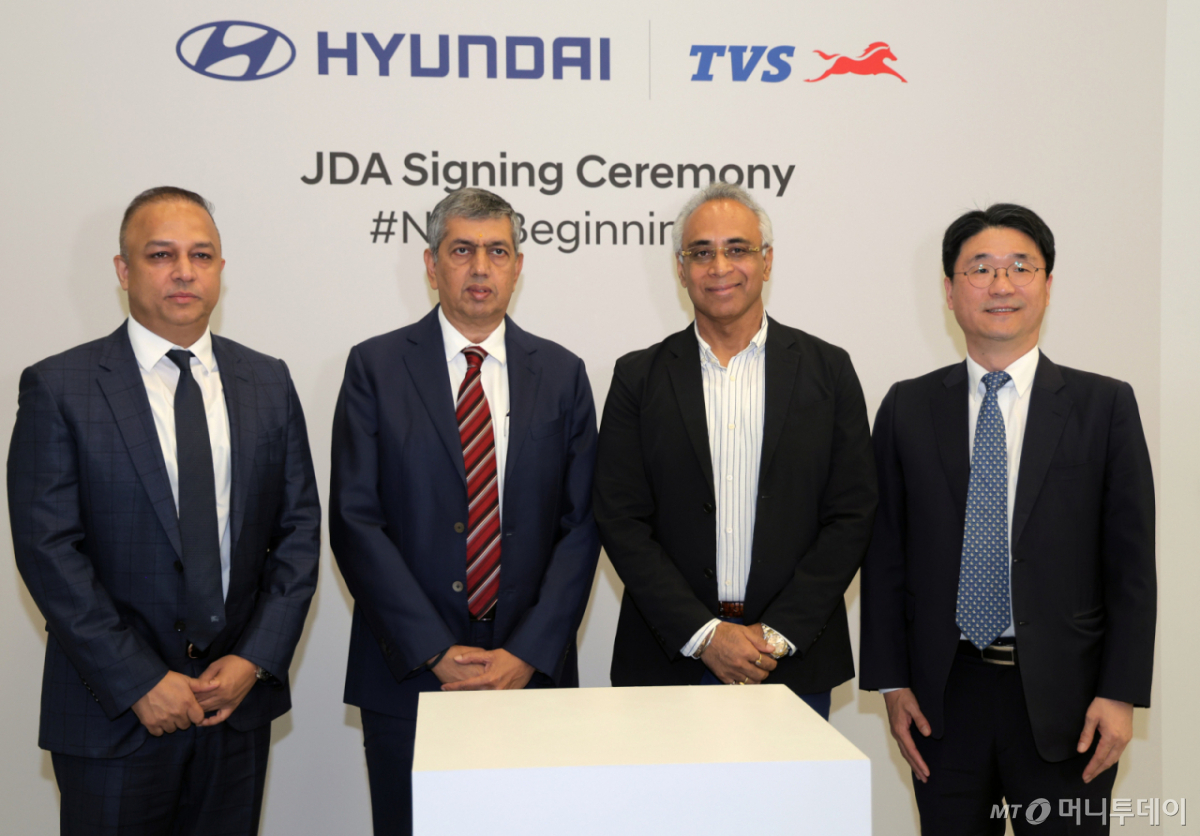
The group will also expand cooperation with local companies and startups in the fields of future mobility and emerging technologies. Hyundai Motor Group has completed the development of a prototype electric three-wheeler (i3W) through collaboration with India's TVS Motor Company, and is advancing the project with commercialization targeted for the end of 2027.
While expanding new mobility services, the company will also actively explore future business opportunities in areas such as auto finance, electric vehicle charging infrastructure, and end-of-life vehicle recycling.
Hyundai Motor is moving to establish a dedicated investment subsidiary in India to systematically and efficiently advance its medium- and long-term investments. The India-focused investment entity will be responsible for identifying, coordinating, and executing the group’s future investment initiatives.
It will serve as a platform that systematically coordinates and executes investments across R&D infrastructure, emerging technologies, and the broader industrial ecosystem, while also supporting the discovery and collaboration with high-quality local partners through strategic investments in local entities. Through these efforts, the group aims to enhance its responsiveness to changes in local policies and the industrial environment, further strengthening the foundation of its India operations in the long term.
Sincerity in Social Responsibility
Hyundai Motor Group is also continuing its corporate social responsibility activities to establish itself as a brand trusted and loved by the people of India.
A representative example is the "Samarth" campaign, which supports social participation and self-reliance for people with disabilities. Through the Samarth campaign, Hyundai Motor Group provides financial support and infrastructure to enable athletes with disabilities to focus on training, and also produces and distributes videos aimed at improving public awareness of disability issues.
Hyundai is also stepping up to support education for India's future generations. Hyundai Motor India plans to establish and operate HATS (Hyundai Academy for Technical Skills), a vocational technical school of global top-tier standard, in Chennai, Tamil Nadu. HATS will provide vocational technical training in key areas such as automobile production and maintenance, smart factories, construction, and industrial safety. The company aims to contribute to cultivating the technical talent that will drive the growth of India's manufacturing and advanced technology industries by training approximately 13,000 people annually.
Hyundai Motor, Kia, and Hyundai Mobis, among other major group companies, have consistently established social contribution funds. From 2016 to 2025, the cumulative social contribution funds raised by the major group companies in India reached approximately $110 million.
A Hyundai Motor official said, “We will continue to carry out sincere social contribution activities, including support for socially vulnerable groups and the cultivation of future generations.” The official added, “We plan to establish ourselves as a partner that contributes to India’s sustainable development and grows together with local communities.”

 in INDUSTRY

