

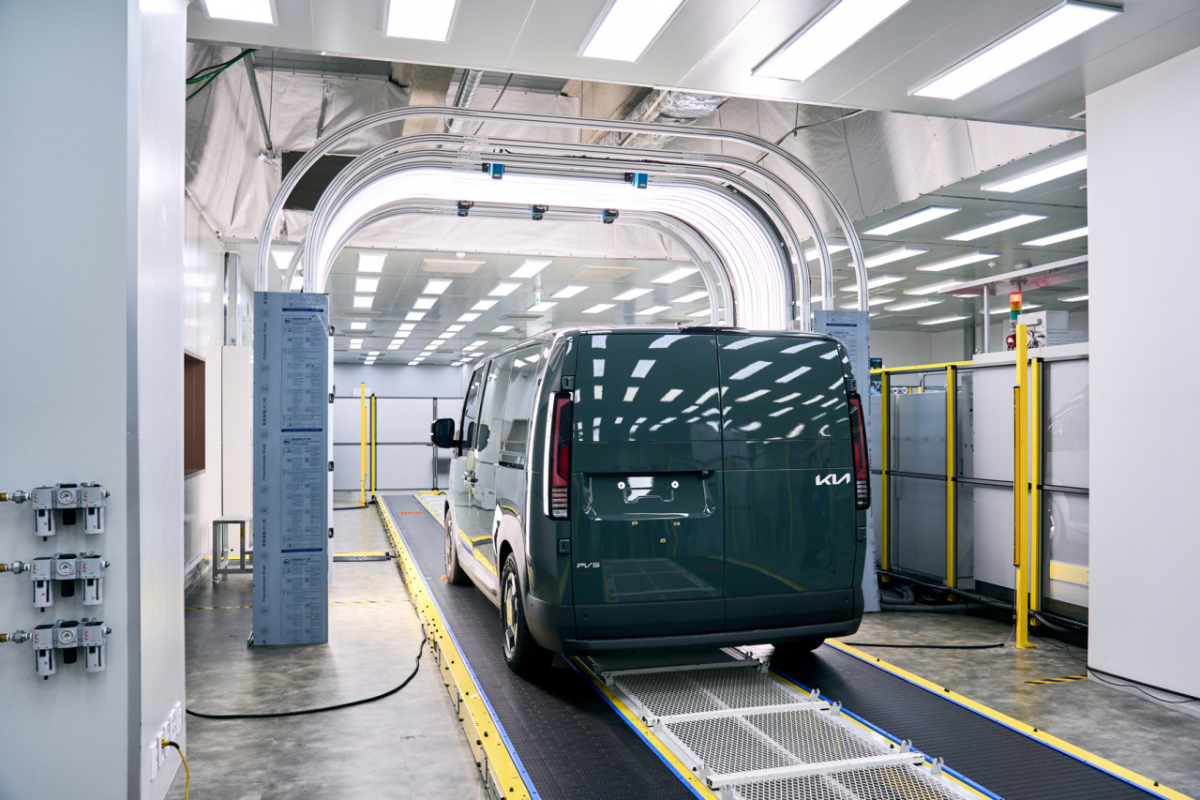
The exhibition hall at the Hyundai Motor and Kia Uiwang Research Institute in Uiwang, Gyeonggi Province, which was first revealed to media on the 16th. As a finished vehicle entered a tunnel-shaped device, an inspection began along the exterior of the body. The equipment is a 'tunnel-type exterior inspection vision (image recognition)' system that uses 3D simulation to determine whether there are defects in the vehicle's exterior. While this process has traditionally been handled by foreign-made systems, Hyundai Motor and Kia directly developed this equipment, from the optical system and algorithms to the hardware and software. This allows them to prevent defective vehicles from leaking out while also reducing equipment maintenance costs and investment costs for new models.
Hyundai Motor and Kia are replacing core plant equipment and software with in-house technology in this manner. Following the exterior inspection equipment, they plan to directly develop and standardize logistics robots and AI (artificial intelligence) that searches for and analyzes factory information, before sequentially applying them to plants both domestically and abroad.
According to industry sources on the 18th, Hyundai Motor and Kia will hold 'E-FOREST Tech Day 2026' from the 19th to the 21st to showcase core technologies for Software Defined Factory (SDF). E-FOREST is the smart factory brand of Hyundai Motor and Kia. At this year's tech day, which marks its seventh edition, over 200 new manufacturing technologies will be exhibited, including SDF-based technology, autonomy and automation, energy solutions, and future mobility. SDF is a production method that consolidates plant equipment and process data into a single system for management, improving equipment performance, quality, and productivity solely through software updates.
Hyundai Motor and Kia also directly manufacture logistics robots that transport parts within the factory. By setting standard specifications and developing the robot's hardware design and driving software in-house, they reduce manufacturing costs by approximately 30%. By combining LTO (lithium titanate oxide) batteries with good charging and discharging performance with lithium-ion batteries, they have reduced charging time from two hours to a maximum of about 12 minutes. Previously, robots had to be newly reviewed and manufactured for each logistics automation project, leading to increased costs and inconsistent quality.
The manufacturing-specialized AI 'E-FOREST Polaris,' which understands questions asked by workers and searches for and analyzes necessary information, began pilot operation at the Ulsan dedicated electric vehicle plant in September. It integrates and analyzes operational, quality, and equipment maintenance information scattered across various manufacturing systems, providing answers based on internal documents and expert know-how. Root cause analysis and corrective measures, which previously relied on worker experience, can be accumulated as data and standardized.
Technology to shorten the robot introduction period has also emerged. Currently, when introducing a robot for the first time, humans must manually input movements one by one. This technology automatically creates robot movement paths through simulation and uses 3D vision sensors to grasp the position and direction of the vehicle body and welding tools, correcting errors between virtual paths and actual robot movements. It can reduce the period and investment costs required to set up a new production line and prepare Yangsan. The goal is to complete development by June next year. High-difficulty assembly automation technology that allows robots to install door garnishes and weatherstrips (rubber parts that seal door gaps), which workers previously installed by hand, was also exhibited.
Hyundai Motor and Kia are using the Singapore Global Innovation Center (HMGICS) as a 'mother plant' for early verification of new technologies. Following this, they will sequentially expand this technology to existing global plants via the U.S. Georgia Metaplant (HMGMA) and the Ulsan dedicated electric vehicle plant. The company plans to advance its virtual-space-based autonomous manufacturing system at HMGICS by 2030, and to fully apply technologies for deploying humanoid robots and automating entire factories in future new plants from 2032 onward.
Choi Young-tae, Senior Executive Vice President and Head of the E-FOREST Center under the Manufacturing Solutions Division at Hyundai Motor and Kia, stated, "Previously, there were difficulties such as long development periods and dispersed investment and data because individual systems were developed and operated separately for each plant." He added, "To resolve this, we are transitioning from a structure centered on individual systems to a single standard manufacturing platform structure." He further noted, "The purpose of automation is not to reduce the number of people, but to create a manufacturing environment where people can focus on safer and more important tasks."

 in INDUSTRY
