

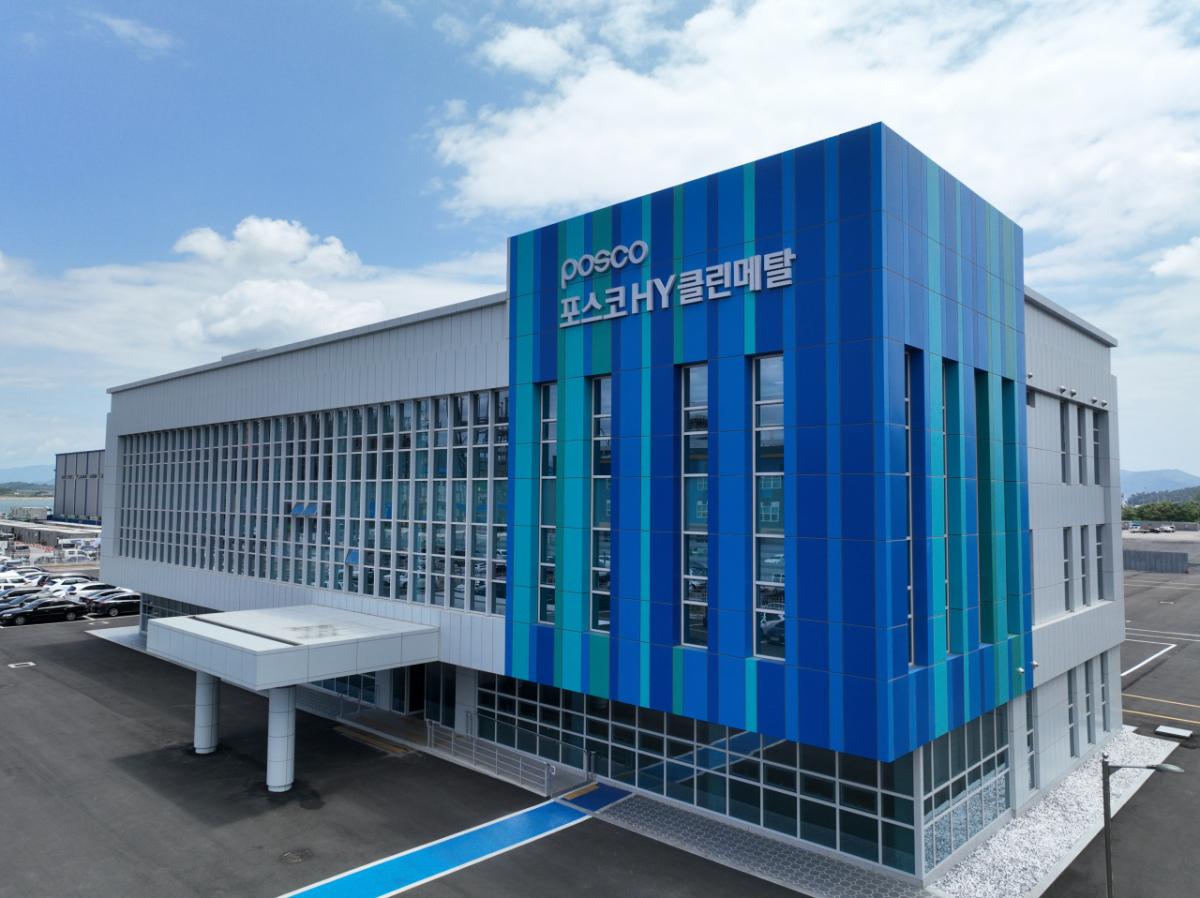
On Sept. 17, upon entering the large raw material warehouse inside the 19,000-pyeong-scale POSCOHY Clean Metal plant located in the Yulchon Industrial Complex in Gwangju, South Jeonnam Province, over 1,000 sacks (ton bags) containing black powder caught the eye. What was packed tightly inside these sacks was "black mass," made by crushing waste batteries and scrap generated during the battery manufacturing process.
Then, as one sack hooked onto a crane was lifted above the raw material inlet, the black powder poured out. Production equipment connected via piping began processing it. This is the first step in discarded batteries being reborn as critical minerals.
Black mass is a black powder containing critical minerals such as lithium, nickel, cobalt, and manganese. It can be used again as battery material after undergoing recycling processes, making it a key raw material for "urban mines." POSCOHY Clean Metal utilizes 12,000 tons of black mass annually to produce 2,500 tons of lithium carbonate, 12,000 tons of nickel sulfate, 3,800 tons of cobalt sulfate, and 2,000 tons of manganese sulfate.
The amount of recovered valuable metals is sufficient to produce over 60,000 electric vehicles. Kim Ho-young, Gyeong Yeong-gi-hoek (Head) at POSCOHY Clean Metal, emphasized, "The recovery rate for major valuable metals is over 90%, and the quality non-conformance rate is less than 0.1%, representing a global top level."
The importance of used battery recycling is growing increasingly significant in tandem with the restructuring of global supply chains. This is because movements to reduce dependence on Chinese critical minerals are spreading, and demand for recycled metals is increasing as tax credit requirements have been strengthened under U.S. Prohibited Foreign Institutional Investor (PFE) regulations.
This is why domestic companies such as Hyundai Motor Group, LG Energy Solution, Samsung SDI, and SK On are accelerating the establishment of a waste battery circular economy system.
As used batteries emerge as a new resource supply source, the Lisa Ecl market is also expected to grow. According to market research firm SNE Research, global used battery generation is projected to increase from 44 GWh (gigawatt-hours) in 2025 to 3,339 GWh by 2040.
This represents a surge of approximately 76 times over 15 years. The market size is also expected to reach approximately 230 trillion won by 2040. Lee Hang-gu, Special Professor at Seoul National University, stated, "It is a means not only for waste treatment but also for reducing overseas dependence on critical minerals, stabilizing supply chains, and securing cost competitiveness."

 in INDUSTRY
