

"Even if we recycle and sell lithium iron phosphate (LFP) batteries, it is not a situation where we can recover processing costs."
A battery industry official recently met with the reporter explained this as the reason why battery manufacturers are reluctant to readily enter the LFP recycling business. LFP batteries do not use high-priced metals such as nickel and cobalt in the initial production stage, allowing for lower raw material costs. However, when recycling waste batteries, the problem is that there are few valuable metals that can be recovered.
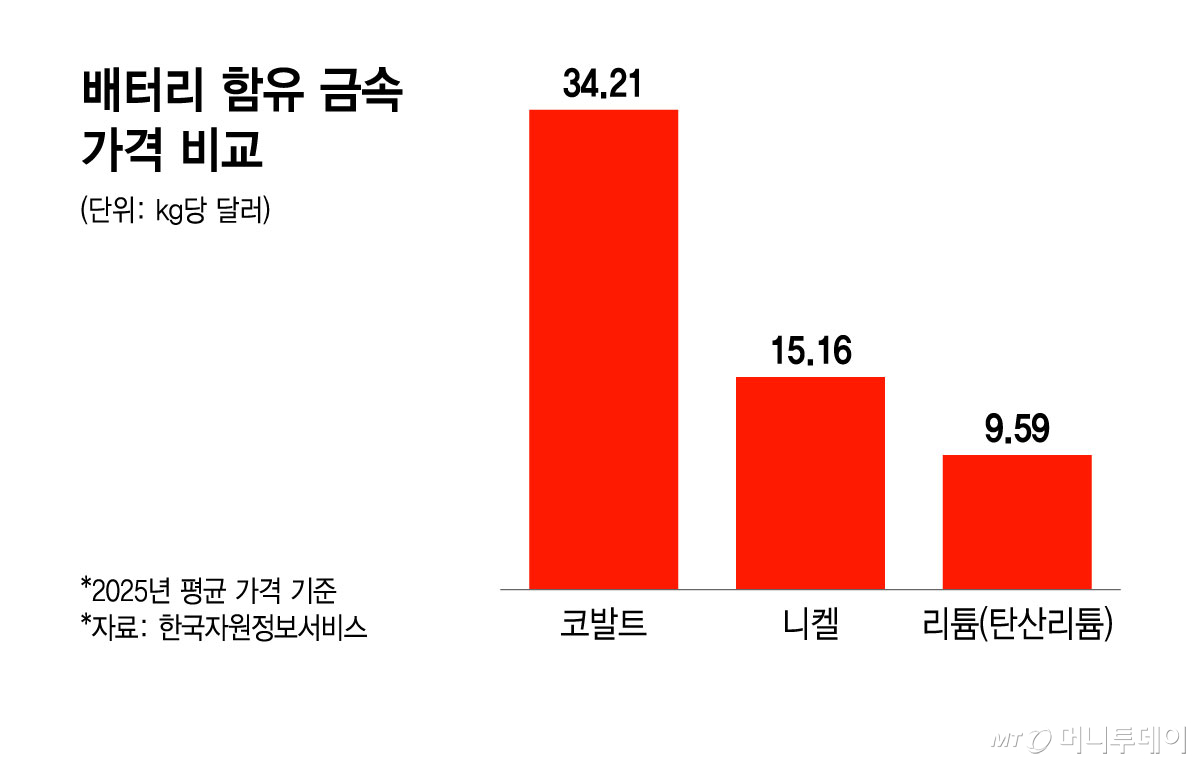
Price indicators clearly show the difference compared to NCM (ternary). According to the Korea Resource Information Service, the average price of lithium last year was $9.59 per kilogram. Iron, another main material used in LFP batteries, has a price of less than $1 per kilogram, so even if recovered and sold, its contribution to revenue is limited. In contrast, the average prices of cobalt and nickel last year were recorded at $34.21 and $15.2 per kilogram, respectively. Ternary batteries allow for the recovery of not only lithium but also nickel and cobalt, whereas LFP batteries are effectively sustained by revenue from lithium alone.
However, the adoption of LFP batteries is increasing rapidly. According to SNE Research, LFP accounted for more than 65% of the global electric vehicle battery cathode material market from January to August this year. LFP has also established itself as a key product in the energy storage system (ESS) market. Even if the profitability of the recycling business is low in the short term, it is structurally inevitable that the amount of waste batteries requiring processing will surge in the medium to long term.
Domestic companies are also accelerating related technology development in preparation for the future increase in demand for processing waste LFP batteries. POSCO Holdings is conducting separate technology development related to LFP recycling at its Future Strategy Research Institute. LG Energy Solution, which is strengthening its LFP cathode material business, is also focusing on securing recycling technology capabilities.
SK Innovation, the parent company of SK On, is promoting the development of technologies to reduce costs and environmental burdens in the recycling process. In fact, Busan water and wastewater are generated during the battery recycling process, which can increase processing costs. Accordingly, SK Innovation developed an eco-friendly process that selectively recovers lithium carbonate from LFP batteries using only water, carbon dioxide, and hydrogen peroxide. It is currently collaborating with domestic recycling companies to explore commercialization possibilities.
Chinese companies are also expanding their businesses into the recycling sector after securing a leading position in the LFP battery market. Chinese battery company BYD is promoting an LFP battery recycling business in cooperation with domestic and international companies. Brunp Lisa Recycling (Brunp Recycling), a subsidiary of CATL, is moving forward with waste LFP battery recycling and the expansion of large-scale processing facilities.
There are voices in the industry that institutional support is necessary to grow the LFP battery recycling market. This is from the perspective that securing stable sales channels through measures such as mandatory use of recycled metals can increase corporate investment incentives. It is also pointed out that discussion is needed on who will bear the processing costs of waste batteries with low economic viability. An industry official said, "If the adoption of LFP batteries becomes widespread, we cannot just leave them to be discarded, right?" and added, "We need to consider policy-wise who should bear the processing costs."

 in INDUSTRY
