


A survey found that seven out of ten young people currently seeking employment feel burdened by job preparation costs, spending an average of approximately 580,000 won per month. There was significant demand for support with "qualification and language test fees."
According to the "Survey on Job Preparation Costs Among Young Job Seekers" conducted by Monoresearch at the request of The Korea Economic Daily Association (The Korea Economic Daily (Hankyung) Association) on the 19th, targeting 1,000 respondents aged 19 to 34 nationwide who are currently seeking employment, the average monthly job preparation cost over the past three months was approximately 580,000 won.
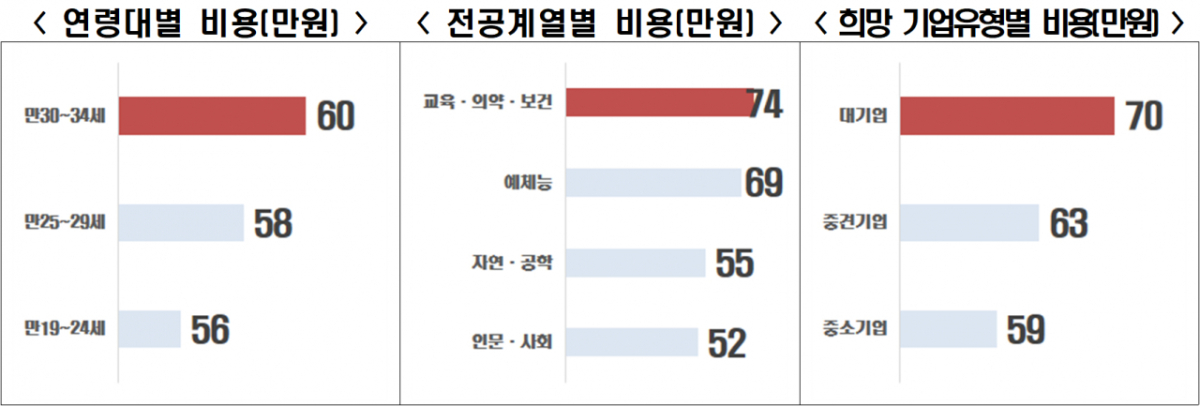
By age group, respondents aged 30 to 34 had the highest average monthly job preparation cost at approximately 600,000 won. This was followed by those aged 25 to 29 (580,000 won) and those aged 19 to 24 (560,000 won), indicating that spending increased with age. By field of study, respondents in education, medicine, and health fields had the highest cost at approximately 740,000 won. This was followed by arts and physical education (690,000 won), natural sciences and engineering (550,000 won), and humanities and social sciences (520,000 won). By desired company type, those hoping to work for large corporations had the highest average monthly cost at approximately 700,000 won, higher than those targeting mid-sized companies (630,000 won) and small and medium-sized enterprises (SMEs) (590,000 won).
Additionally, a trend was observed where the financial burden generally increased as the job preparation period lengthened. The average monthly preparation cost for young people who had been seeking employment for more than three years reached approximately 800,000 won, significantly higher than those who prepared for less than six months (560,000 won) or between six months and one year (520,000 won). When asked about the level of burden regarding job preparation costs, 69.3% of respondents answered that they felt "burdened," while only 7.3% responded that they did not feel "burdened."
The item with the largest share of expenditure was qualification and language test fees (30.7%). This was followed by education costs (22.6%), textbook and study material purchases (16.1%), transportation costs (12.4%), and space usage fees such as cafes and study cafes (7.3%).
Funding sources were identified as support from parents and family (32.8%), income from part-time jobs, etc. (29.5%), personal savings (27.3%), and government and local government subsidies (7.9%).
Respondents most frequently selected "support for qualification and language test fees" (25.9%) as a policy task to alleviate job preparation costs. Other responses included "housing cost support such as rent" (16.7%), "issuance of vouchers usable for overall job preparation" (16.1%), and "transportation cost support" (11.4%).
Lee Sang-ho, Gyeong Je-bon (Director) of The Korea Economic Daily (Hankyung) Association, stated, "Amid the continued difficulty in employment for young people, a significant number of young job seekers are feeling the financial burden during the job preparation process." He added, "It is necessary to strengthen support for language and qualification test fees, as well as education course fees, so that the economic burden on low-income youth can be alleviated."

 in INDUSTRY

