

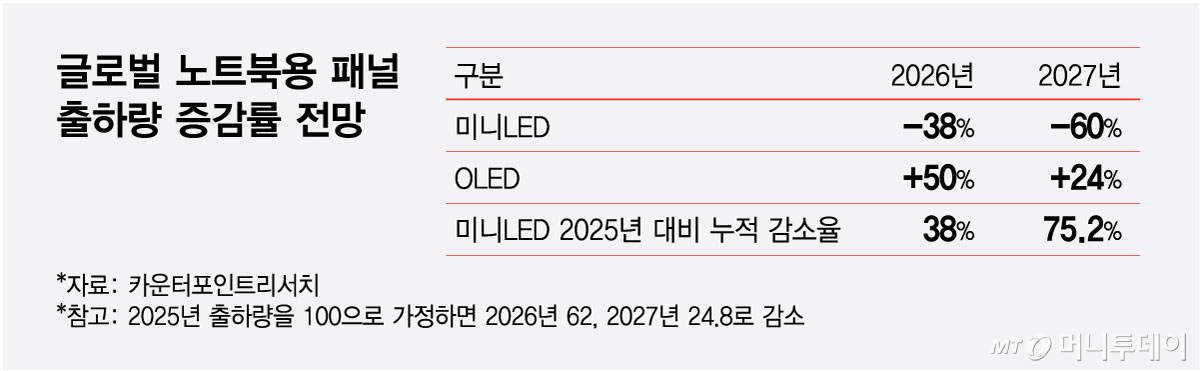
As the transition to OLED (organic light-emitting diode) accelerates in the premium laptop market, shipments of existing Mini-LED (light-emitting diode) panels are projected to plummet 75% over two years. With major manufacturers such as Apple expanding OLED adoption, expectations are growing for Samsung Display’s market lead, having proactively built an 8.6-generation production LINE. Attention is also turning to whether LG Display can secure competitiveness by leveraging next-generation process technology.
According to market research firm Counterpoint Research on the 20th, global Mini-LED panel shipments for laptops are expected to decline 38% this year compared to last year. A further 60% decrease is anticipated next year relative to this year. If estimates hold, 2027 shipments will amount to just 24.8% of the 2025 level. In contrast, OLED panel shipments for laptops are observed to increase by 50% this year and 24% next year. This stands in stark contrast to the overall laptop display shipment forecast of a 3% decline this year.
Differences in panel structure and manufacturing costs are driving these changes. Mini-LED enhances image quality by precisely controlling small light sources on the back of an LCD but requires a separate backlight. Conversely, OLED pixels emit their own light, making it advantageous for implementing thin panels. As OLED production efficiency improves, price burdens have decreased, leading to increased adoption by laptop manufacturers.
A representative case is Apple’s next-generation MacBook Pro. While Apple is expected to adopt OLED instead of the existing Mini-LED, observations suggest that Samsung Display will solely handle initial panel supply. If Samsung Display takes on initial supply, it can secure new demand arising from the OLED transition in premium laptops first.
Samsung Display began Yangsan in July at its 8.6-generation IT (information technology) OLED production LINE in Asan, Chungnam Province, where it invested 4.1 trillion won. By using larger substrates than the existing 6th generation, it can produce laptop panels with wider areas more efficiently. However, for improved production efficiency to translate into actual cost reduction, sufficient order volumes and stable yields must be supported. Securing Apple’s initial orders is important in establishing the demand base necessary to increase utilization rates of new production LINES and recover investment costs.
LG Display is pushing to expand supply based on its existing IT OLED business. If Samsung Display solely supplies initial orders for the next-generation MacBook Pro, LG Display’s initial benefits from Apple’s OLED transition will inevitably be limited. LG Display is developing FLiPP, a next-generation patterning technology that does not use fine metal masks (FMM), to reduce manufacturing costs. This strategy aims to reduce investment burdens by leveraging existing production infrastructure, but industry insiders note that since the Yangsan schedule has not yet been finalized, it will take time before cost reductions lead to new orders.
A display industry official stated, “The faster the OLED transition in the premium laptop market, the more important it becomes to secure stable customer order volumes in addition to production costs.” The official added, “Samsung Display has established proactive equipment investment and an initial supply base, but future competitive dynamics may vary depending on each company’s yield and actual speed of supply expansion.”

 in INDUSTRY
