

Domestic cathode material manufacturers are accelerating their efforts to capture the lithium iron phosphate (LFP) market for energy storage systems (ESS). POSCO Future M and LG Energy Solution’s competitor, L&F, are laying the groundwork to respond to rapidly growing domestic demand by expanding production capacity. In particular, they are strategizing to counter China’s low-price offensive and secure cost competitiveness by introducing new manufacturing processes.
According to battery industry sources on the 23rd, POSCO Future M recently converted one of four sintering lines for ternary (NCM) cathode materials at its Pohang plant in Gyeongsangbuk-do into an LFP cathode material production line. It plans to complete the conversion of the remaining three lines by May next year. In addition to Pohang, the company aims to utilize its production hub in Gwangyang, Jeollanam-do, to expand the share of LFP in total cathode material production from 2030 to 2035 to approximately one-third.
The industry views POSCO Future M’s potential LFP production capacity as larger than initially expected. Previously, it was estimated that converting equipment with a ternary cathode material production capacity of 10,000 tons for LFP use would yield approximately 15,000 tons. However, based on actual production results and a reassessment of conversion efficiency, industry observers predict that production could reach up to 20,000 tons. Applying this figure, Pohang’s ternary cathode material equipment of approximately 45,000 tons could be converted to produce up to 100,000 tons of LFP, while Gwangyang’s equipment of approximately 55,000 tons could be converted to a scale of up to 110,000 tons. The combined potential LFP production capacity of the two hubs would increase from the previously estimated approximately 150,000 tons to a maximum of 210,000 tons.
Not only POSCO Future M but also L&F is moving to expand its LFP production capacity. L&F Plus, an LFP-specialized subsidiary, plans to expand its current annual production capacity of approximately 30,000 tons to 60,000 tons by the first half of next year. Even after the completion of four production lines, the actual utilized area within the approximately 200,000 pyeong site in the Daegu National Industrial Complex is expected to be only about 60,000 pyeong, leaving room for further expansion. L&F Plus is also considering expanding its production capacity to a maximum of 120,000 tons through additional investment.
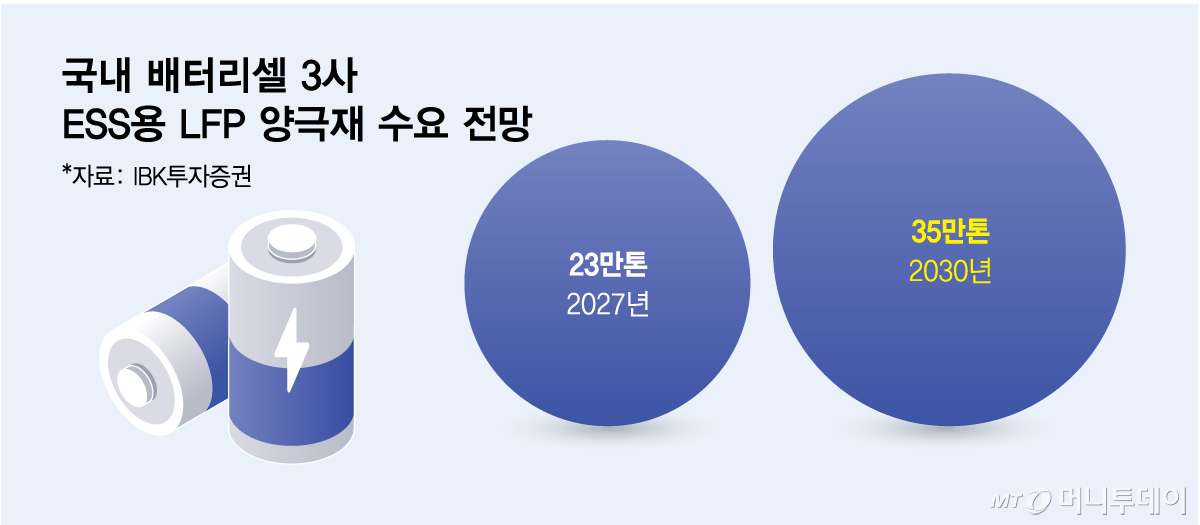
If domestic manufacturers’ production capacity expands as planned, the foundation for responding to the demand for LFP cathode materials for ESS from the three major domestic battery cell makers is expected to be strengthened. According to IBK Investment & Securities, the potential demand for LFP cathode materials for ESS from the three major domestic battery cell makers (LG Energy Solution, Samsung SDI, and SK On) is projected to increase from approximately 230,000 tons in 2027 to 350,000 tons in 2030. Combining the potential production capacities of POSCO Future M and L&F Plus yields a maximum of 330,000 tons, a scale approaching the projected demand for 2030. As cathode material manufacturers expand their domestic production base, this could serve as an opportunity to broaden the position of domestic products in the LFP cathode material market, which has been led by Chinese companies.
The key issue is price. Currently, the price of domestically produced LFP cathode materials is known to be approximately 30% to 40% higher than that of Chinese-made products. Considering that the benefits of the U.S. Advanced Manufacturing Production Tax Credit (AMPC) will end in 2032, it is necessary to establish a cost structure capable of competing with Chinese companies within the next five years. A precursor-free process, which skips the precursor manufacturing stage, is being discussed as a method to reduce costs. In the general cathode material manufacturing process, precursors are produced separately and then mixed with lithium raw materials for sintering. In contrast, the precursor-free process aims for process simplification and cost reduction by reducing this intermediate step. Both L&F and POSCO Future M are researching and developing related technologies. An industry official said, “How much the price gap with Chinese products can be narrowed through production capacity expansion and process innovation will determine the expansion of market share in the future LFP cathode material market.”

 in INDUSTRY
