

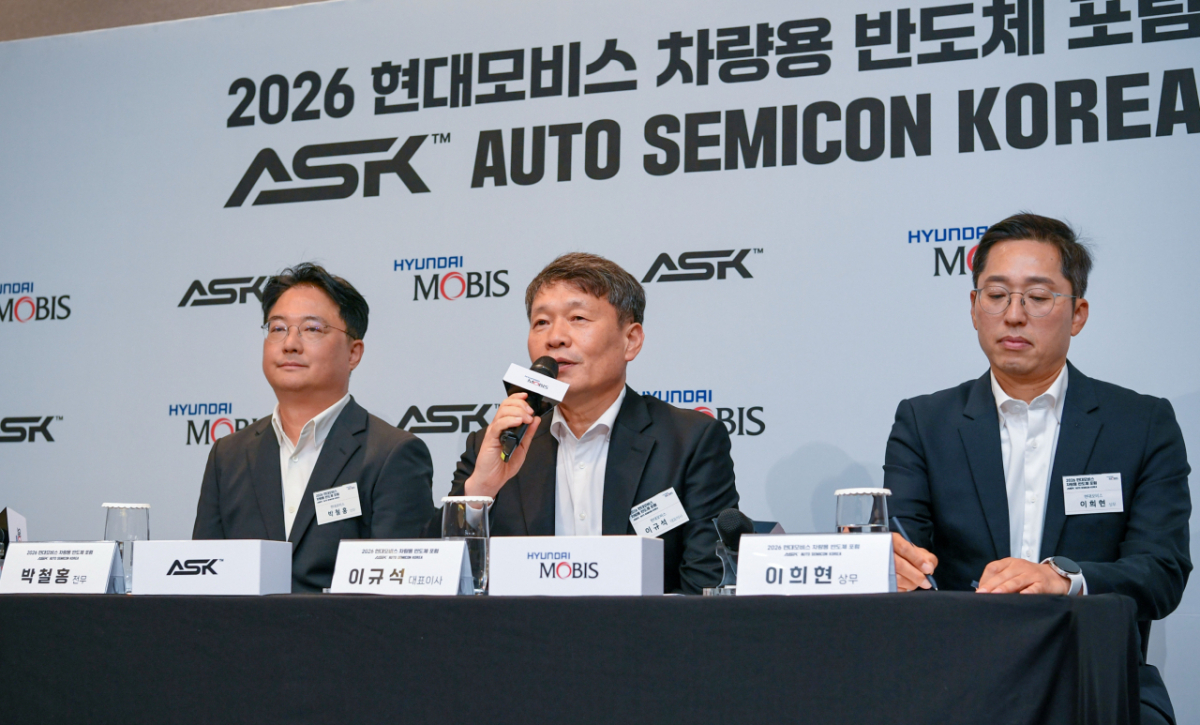
Hyundai Mobis is accelerating efforts to localize automotive semiconductors in partnership with South Korean chipmakers. CEO Lee Gyu-seok said the company aims to apply domestically developed chips to mass-produced vehicles as early as 2029 and will establish a collaborative framework spanning development, validation and mass production.
Lee made the remarks to reporters ahead of the second Automotive Semiconductor Forum, known as Auto Semicon Korea (ASK), held at the DoubleTree by Hilton Seoul Pangyo in Seongnam, Gyeonggi Province, on Wednesday.
"South Korea's automotive industry has approached the level of advanced economies, but the localization rate for automotive semiconductors remains quite low, at less than 5 percent," Lee said. "By connecting the capabilities of domestic semiconductor companies, we can build a collaborative model that enables the semiconductor sector to grow, as the automotive industry has."
Regarding when domestically developed chips could be used in vehicles, Lee said, "The earliest would be around 2029." He explained that this meant initial vehicle testing for the chips would begin next year.
"Such efforts are unlikely to make a significant contribution to Hyundai Mobis' revenue for the time being," he said. "But if we do not make these efforts and investments now, Hyundai Mobis and Hyundai Motor and Kia could face major difficulties in the future."
The event brought together around 90 participants, including Lee, Industry Minister Kim Jung-kwan, executives from major semiconductor companies such as Samsung Electronics, SK keyfoundry and LX Semicon, as well as government and academic representatives.
The number of participating companies and institutions rose to 53 this year from 27 last year. Since the inaugural ASK forum last year, Hyundai Mobis has identified 19 collaborative projects with domestic companies in the system semiconductor sector. Development has begun on 13 types of chips, and target vehicle models have been selected for nine of them.
"Hyundai Mobis will proactively outline the requirements and technology road maps for next-generation core semiconductors from the perspective of vehicle systems and control units," Lee said. "We will build an end-to-end collaboration structure in which we share responsibility from the early stages of development through validation and mass production."
The company also plans to prioritize domestic suppliers in its automotive semiconductor supply chain.
"If domestic suppliers are ready, prioritizing local fabs is the right policy," Lee said. "Overseas fabs should complement areas that domestic facilities cannot yet address. That is the right direction over the medium to long term."
Hyundai Mobis also disclosed progress in its partnerships with local semiconductor companies. LX Semicon is jointly developing an automotive Ethernet device for edge applications with Hyundai Mobis, targeting commercialization in 2028. Global Technology is preparing for mass production of an automotive LED driver chip developed jointly with Hyundai Mobis, while Magnachip has completed development of an insulated-gate bipolar transistor (IGBT) power semiconductor for hybrid vehicle inverters and is preparing for mass production.
During a panel discussion, participants identified high development costs and the burden of reliability testing as major obstacles to localizing automotive semiconductors.
SK keyfoundry said it plans to expand its pilot production programs and give higher priority to supplying domestic demand for automotive semiconductors.
The government is also stepping up support. The Ministry of Trade, Industry and Energy, Hyundai Motor, Hyundai Mobis and LG Electronics held a launch ceremony for a joint task force on automotive semiconductors, dubbed the Automotive Semiconductor One-Team TF, on Tuesday.
In congratulatory remarks, Industry Minister Kim said the government would develop more comprehensive support measures to ensure that Korean technologies in non-memory semiconductors can progress smoothly from development to commercialization.

 in INDUSTRY
