

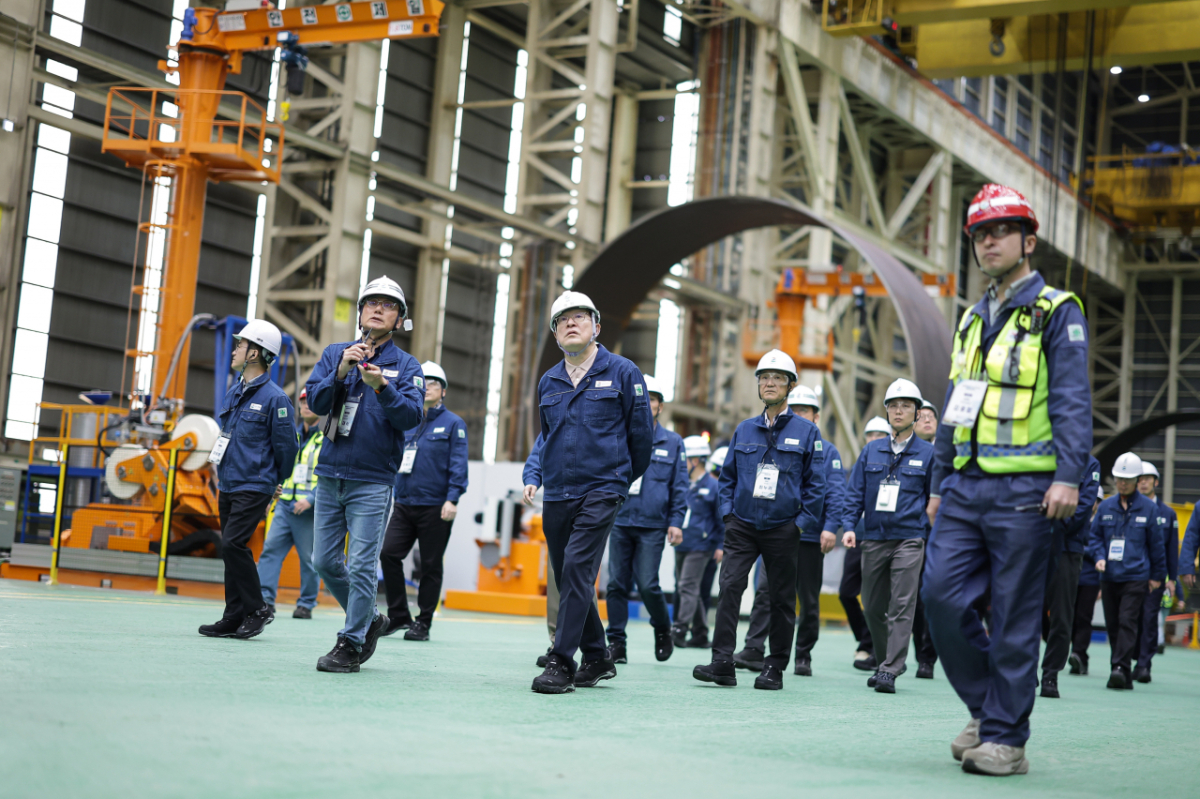
"This marks a turning point for us, as we move beyond simply expanding production facilities to become a company specializing in offshore wind foundations."
GS Entec CEO Heo Cheol-hong made the remarks at a completion ceremony for dedicated monopile production facilities held at the company's Yongjam plant in Ulsan on Oct. 26.
He said the company had grown by manufacturing equipment for refining and petrochemical plants, adding, "Building on that experience, we will strengthen our ability to produce monopiles of consistent quality for the offshore wind market and deliver them on schedule as promised to our customers."
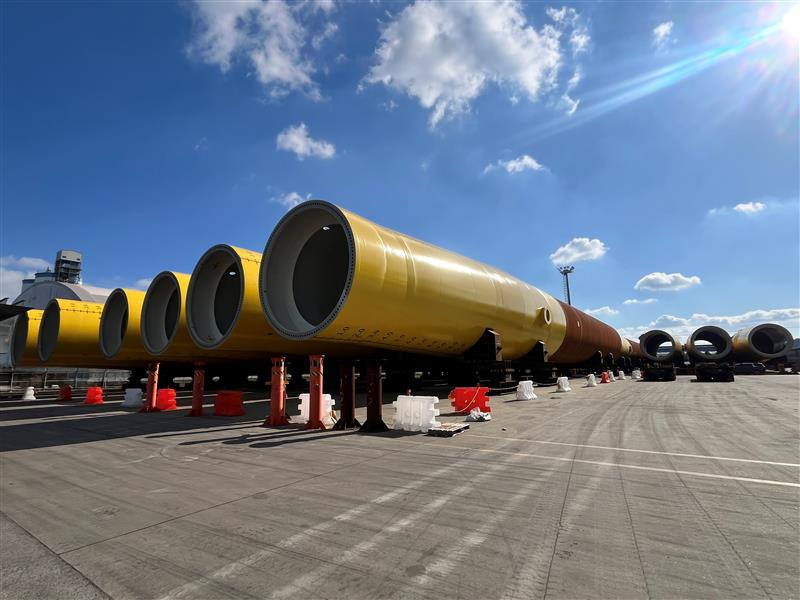
A monopile is a substructure that supports the tower and turbine of an offshore wind generator. It is widely used because it has a shorter manufacturing period and costs approximately 20-40% less than other methods such as floating structures, tripods, and jackets. GS Group Chairman Heo Tae-soo, Vice Chairman Hong Soon-gi, and other key group executives also attended the completion ceremony.
Chairman Heo said, "We have achieved a proactive business transition by leveraging the era's change of energy transition as a new business opportunity," adding, "The group will expand its business areas into future growth fields, including artificial intelligence (AI) data centers and renewable energy-related infrastructure."
GS Entec invested approximately 300 billion won over two years starting from October 2024 to build the monopile production line. With this expansion, annual production capacity increased by 3.75 times from 40,000 tons to 150,000 tons.
In particular, it has established Asia's first and largest single production system capable of manufacturing ultra-large monopiles for 15 MW (megawatt)-class wind turbines.
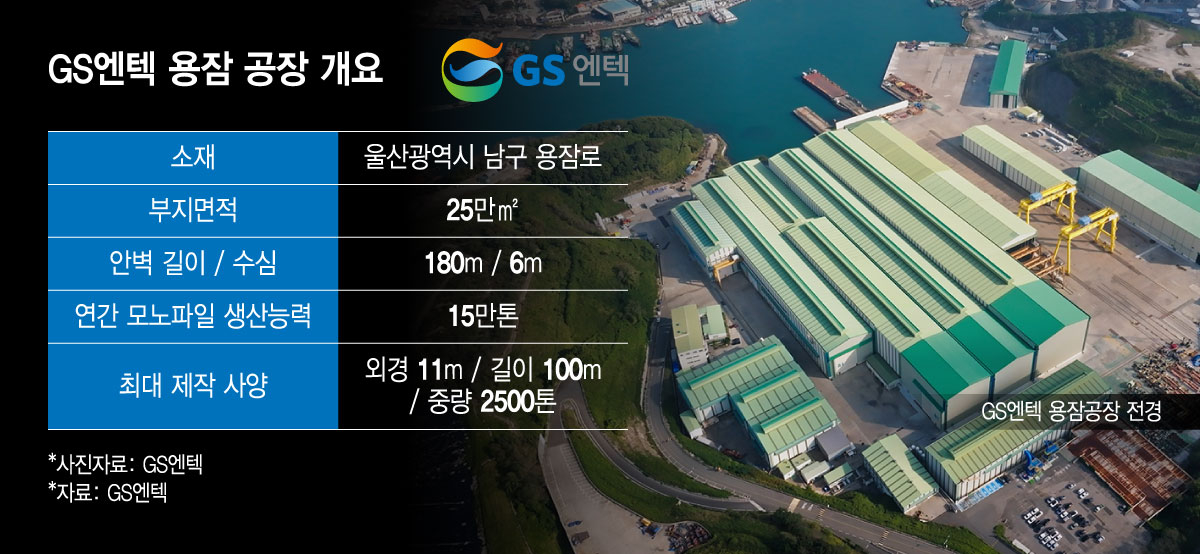
The process of manufacturing ultra-large monopiles was clearly visible at the Yongjam plant visited on this day. Massive equipment was located throughout the factory, from pre-treatment for refining large steel plates to bending them into cylindrical shapes and welding them together. At the end of the process, a 60-meter-long cylindrical monopile mockup displayed its grandeur. Connecting two of these structures results in the size of an ultra-large monopile actually installed at sea.
GS Entec, established in 1988, is a subsidiary of GS Global that has manufactured large chemical equipment. In response to the slowing growth of the chemical equipment market, it identified offshore wind power as a new growth engine and formed a strategic partnership with Sif, the world's number one monopile company based in the Netherlands, in 2023. Sif's technology was also applied to this automated equipment.
Results are following suit. After winning a contract to supply 64 monopiles worth approximately 200 billion won for the Yeonggwang Nakwol Offshore Wind Power project (365 MW) in South Jeolla and Gwangju in 2023, it signed a contract in September last year to supply 37 monopiles for the 540th MW Taean Offshore Wind Power project with Taean Wind Power Generation. Production is scheduled to begin in July next year, with delivery by August 2028.
GS Entec is aiming for additional orders in the domestic offshore wind power market, including Hanbit Offshore Wind Power and South Jeolla Offshore Wind Power Zones 2 and 3. The policy environment is also favorable. The government is transitioning from a developer-led development model to a system where the government leads site exploration and permits, marking the implementation of the Offshore Wind Power Special Act. It has also presented a total bidding volume of 55 GW (gigawatts) over the next 10 years.
Abroad, it has identified Japan as its first target market and is pursuing orders for one to two wind farms. The strategy is to selectively secure annual orders of 90,000 to 180,000 tons in South Korea and Japan from mid-2028 onwards to boost profitability and plant utilization rates. The annual revenue target is 360 billion to 400 billion won.
CEO Heo stated, "We are faithfully executing the projects we have secured and enhancing our manufacturing capabilities based on the experience and data accumulated during the production process," adding, "We will contribute to growing with partners and improving the competitiveness of the domestic offshore wind power industry while creating a new growth foundation for the group."

 in INDUSTRY


