

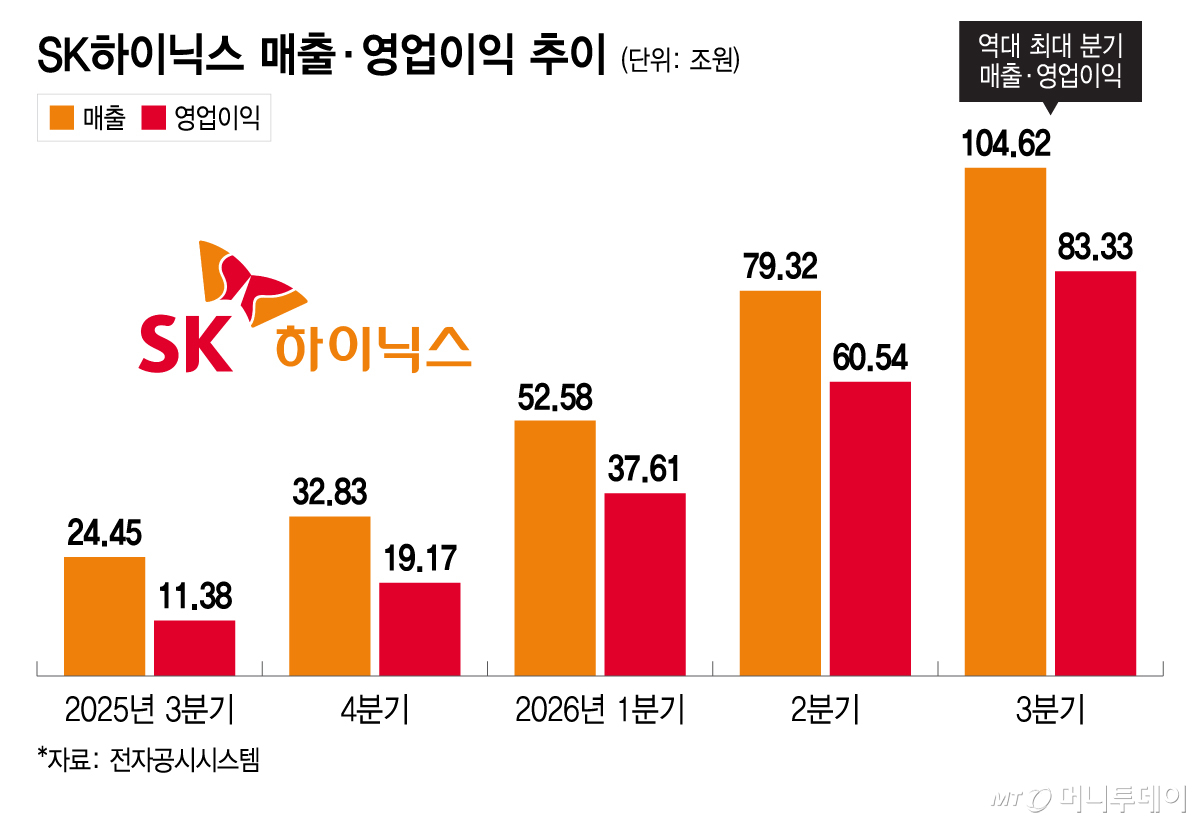
SK hynix has alleviated concerns about a peak in the memory semiconductor industry with an overwhelming 80% operating profit margin and solid demand outlook.
The company explained that the memory supply shortage will continue through 2030, and that DRAM and HBM (High Bandwidth Memory) volumes for the next three years are effectively sold out. Amid expectations of a long-term boom, coupled with shareholder returns on the scale of 100 trillion won, the stock price surged by more than 10% in a single day.
SK hynix said Wednesday that it recorded Q3 revenue of 104.6155 trillion won and an operating profit of 83.3338 trillion won this year. The operating profit margin reaches 80%.
This means that for every 1 million won worth of memory sold, 800,000 won remains as profit. Despite the unfavorable exchange rate environment of a strong won, profitability was boosted by rising product prices and expanded sales of high-value-added products.
The results were driven by rising DRAM prices and increased shipment volumes. Q3 DRAM shipments increased by approximately 10% compared to the previous quarter.
In particular, sales of server-based DDR5 (Double Data Rate 5) rose by more than 40%, and shipments of HBM4, which commands a higher price than existing products, have also begun in earnest.
With the strength in general DRAM prices combined with an increased share of HBM4, the DRAM average selling price (ASP) recorded a rise in the high 20% range compared to the previous quarter. SK hynix expects that in Q4 this year, HBM4 will surpass HBM3E in both shipment volume and revenue share, establishing itself as a key product.
NAND flash focused on profitability over sales volume. By shifting its sales composition toward high-value-added products such as enterprise SSDs (enterprise solid-state drives) based on 321-layer TLC (Triple-Level Cell), shipment volumes decreased slightly, but the ASP rose to the mid-20% range. Both DRAM and NAND supported strong results.
Market attention is focused on how long the AI memory boom will last. CFO Kim Woo-hyun predicted that "an environment where supply fails to meet demand will persist through 2030."
This diagnosis stems from the increasing technical difficulty of advanced processes and the long time required to build new production facilities, making it difficult for supply to catch up with rising demand.
The demand base is expanding. SK hynix analyzed that AI services are translating into actual revenue, and that the entities building infrastructure are expanding from a few big tech companies to general enterprises and nations. In the medium to long term, physical AI such as autonomous driving and robotics is also expected to increase memory demand.
Confidence in the results is also evident in customers' purchase plans. Park Jun-deok, head of DRAM marketing, said, "Combining the volumes already secured through LTAs (Long-Term Agreements) with demand currently under specific negotiation with customers, DRAM and HBM volumes through 2029 are effectively all sold out."
SK hynix has signed LTAs with 14 major customers, including large global cloud service providers (CSPs). The volumes secured through LTAs exceed 50% of total production capacity for next year and 2028. Discussions are underway to extend the contract period beyond the usual five years with some customers.
In the case of HBM, customer-requested volumes more than double the available supply, and negotiations on next year's HBM volumes and prices with major customers have been completed. The 12-layer HBM4 product is being shipped as planned, and to respond to surging demand, the company plans to expand production at its Cheongju M15X fab (factory) in Chungbuk Province to maximum levels by the end of the year.
The spread of AI inference presents new opportunities for NAND as well. As it becomes difficult to store all context information processed by AI in both HBM and DRAM, demand is growing to divide and store this data on SSDs for reuse. The AI memory boom that began with HBM is spreading to server DRAM and storage devices, thickening the foundation of results.
CEO Kwak No-jeong emphasized, "Customer trust built through technological competitiveness over time has led to long-term contracts, transforming our business structure into one equipped with medium-to-long-term demand visibility and revenue stability," adding, "We will carry forward memory competitiveness in HBM and other areas to next-generation products."
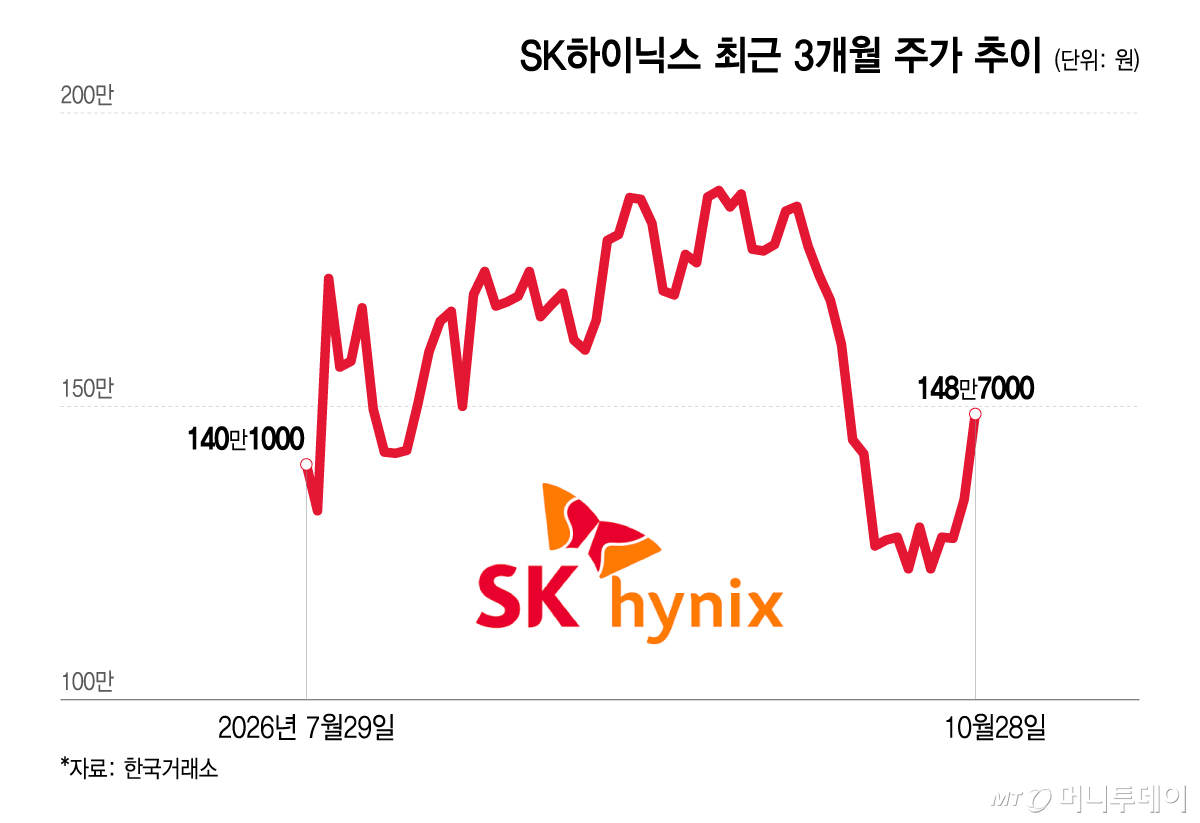
Following the announcement of medium-to-long-term performance outlooks and a shareholder return policy on the scale of 100 trillion won, SK hynix's stock price also surged. On this day, it closed at 1,487,000 won, up 146,000 won (10.89%) from the previous trading day. This marks a return to the 1.4 million won range for the first time in 10 trading days. Foreign investors turned to net buying after five trading days, purchasing 384.4 billion won worth of shares.
With increased medium-to-long-term profit visibility, concerns about peak-out (performance peak) that had weighed on the stock price appear to have eased. In addition, additional share buybacks are cited as a factor supporting the stock price from a supply and demand perspective. SK hynix disclosed its intention to purchase 20 trillion won worth of treasury shares over three months, starting from the 29th through January 28 next year.
Lee Kyung-min, head of the FICC Research Department at Daishin Securities, said, "Through SK hynix's strong results and expanded LTAs, we have reconfirmed a solid outlook for memory demand and performance growth."
Lee said that combined with the supply-demand buffer from large-scale shareholder returns, downside support and rebound momentum for the stock price will be strengthened.

 in INDUSTRY

