

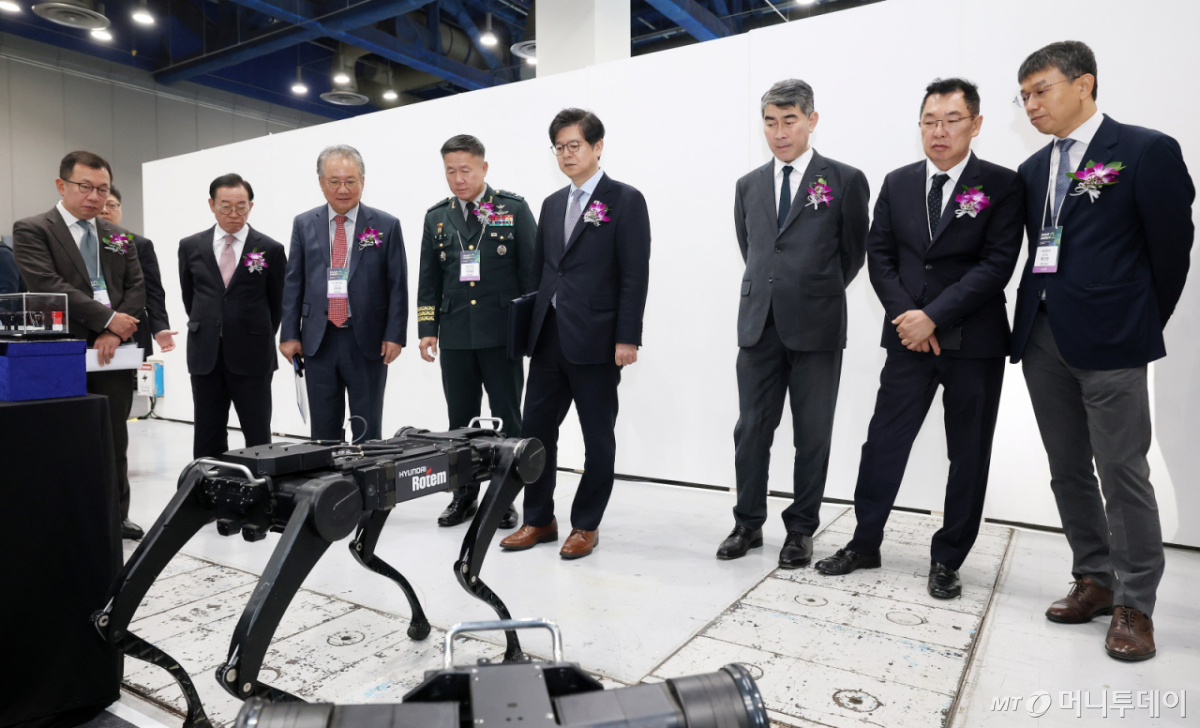
“Huh? It does push-ups too?”
Hyundai Rotem’s exhibition hall at “Smart Energy Plus (SEP) 2026,” held in Hall B of COEX in Samsung-dong, Seoul on the 28th. A robot with a black body and four legs ran back and forth across the exhibition floor, drawing the gaze of visitors. The motion of bending its legs to lower its body close to the ground and then lifting it back up resembled a person doing push-ups. It also demonstrated changing direction by moving its four legs in alternation. This was a demonstration site for a multi-legged walking robot designed to perform dangerous missions in place of soldiers on future battlefields.
The multi-legged walking robot unveiled by Hyundai Rotem at this exhibition is an unmanned ground operation robot platform developed with purely domestic technology. Because the joints of its four legs can be freely bent and extended, it can overcome slopes and stairs that are difficult for conventional wheeled robots to navigate. It was designed to perform missions in harsh environments such as areas with dense vegetation or mountainous terrain. The robot can freely climb stairs approximately 20 cm high. Equipped with daytime surround cameras and nighttime close-range cameras, it can also be used for surveillance and reconnaissance. Four units have already been deployed to the Army.
Hyundai Rotem is in charge of the software technology required for operating the robot. A Hyundai Rotem official met on site explained, “Research and development to advance autonomous driving technology is also underway, and we are currently developing algorithms internally.” The direction is to advance the technology beyond a robot simply operated by a person into an unmanned system that autonomously recognizes its surrounding environment and moves. In particular, the robot’s hardware was manufactured by domestic robotics specialist Rainbow Robotics. Without any separate mission equipment loaded, it can be operated for approximately four hours on a single charge, and the batteries are designed to be detachable from the left and right sides of the body to enhance convenience.
Another attraction at the exhibition hall is the hydrogen electric tram, a future urban transportation vehicle. Hyundai Rotem allowed visitors to enter the interior of the hydrogen electric tram using virtual reality (VR) equipment to examine the cabin structure and convenience facilities, and even experience the driver’s seat. It was set up so that visitors could indirectly experience the appearance of future hydrogen transportation vehicles without actually boarding a real vehicle.
The hydrogen electric tram operates using a HYBE-led power system that combines a hydrogen fuel cell with an electric battery. It is evaluated as excellent in terms of safety by applying a verified, reliable hydrogen fuel cell. Because it generates electricity directly inside the vehicle, unlike conventional electric trams, it does not require overhead power lines installed above the road. The advantage is that it can run through urban areas without separate overhead lines, thus not harming the city’s aesthetics.
Hyundai Rotem is also developing autonomous driving technology by integrating physical AI into its hydrogen electric tram. The Advanced Driver Assistance System (ADAS) for rail vehicles, which the company completed in-house this year, uses lidar and cameras to detect obstacles more than 100 m ahead. A Hyundai Rotem official said, “Through AI (artificial intelligence), it distinguishes between people and structures, judges the possibility of pedestrians entering the tracks, and alerts the driver to dangerous situations,” adding, “We will advance the technology for realizing a fully autonomous tram.”

 in INDUSTRY
