

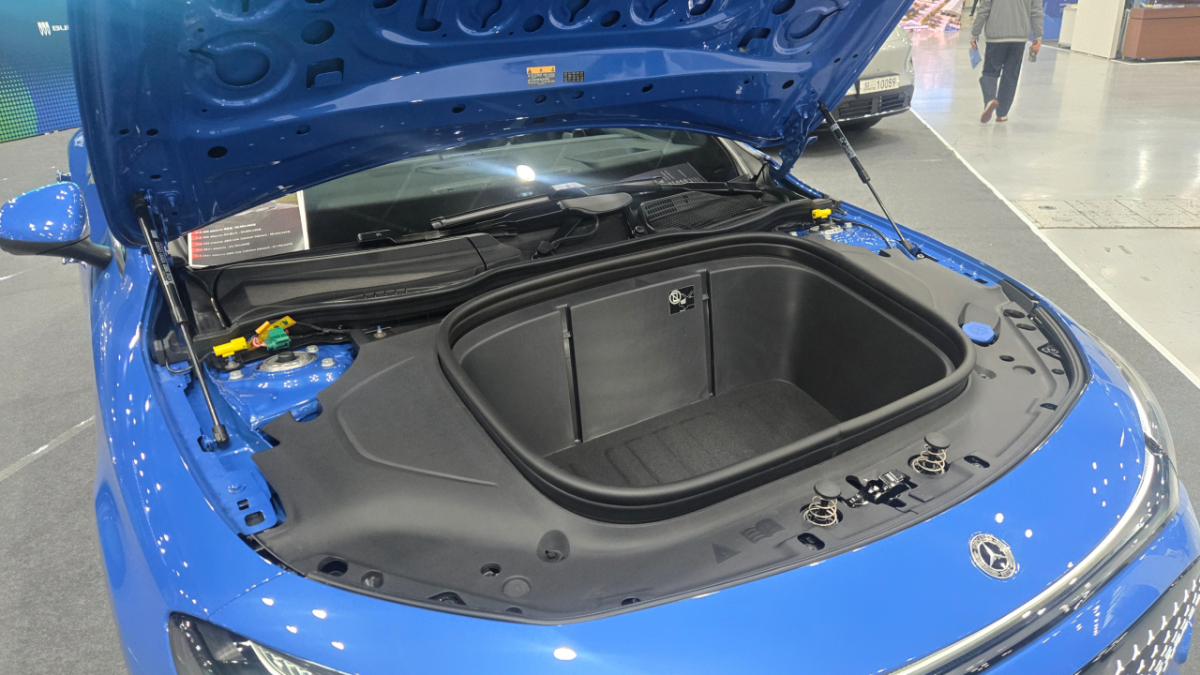
"There is a trunk in front of the car?"
The exhibition hall for "Smart Energy Plus (SEP) 2026," held on the 29th at Hall B of COEX in Samsung-dong, Seoul. As the front hood of Mercedes-Benz's new electric sedan, the "All-New Electric CLA 250+ electric AMG Line," swung wide open, curious questions arose among the visitors. Beneath the raised hood was not a complex engine or mechanical apparatus, but a deep black storage space. This is a "frunk" (front trunk), allowing luggage to be stored in the space where an engine would sit in an internal combustion engine vehicle.
The deeply recessed storage compartment appeared large enough to hold small bags or shoes. Visitors peered into the space they had previously assumed would house an engine, examining how electric vehicles have transformed automotive structure. A Mercedes-Benz official stated, "You can store sweaty clothes or shoes separately after exercise, and you can also load groceries on the way home from shopping," adding, "The space occupied by the engine in internal combustion engine vehicles has been converted into a storage area useful for daily life."
The changes to the new CLA do not stop inside the hood. Developed based on Mercedes-Benz's next-generation electric vehicle platform, this vehicle features the company's first application of an 800V high-voltage system. This improves charging performance compared to the existing 400V system, enabling the acquisition of power needed for long-distance driving in a short time. It can travel up to 400 km with approximately 15 minutes of charging, making fast charging speed one of its greatest advantages.
The process of connecting to a charger is also expected to change. Mercedes-Benz is preparing a "Plug & Charge" feature, aiming for introduction in the first quarter of next year. This method allows charging to occur without separate membership authentication or payment procedures once the charger is connected to the vehicle. The intent is to reduce the hassle of having to take out a charging card or go through authentication steps.
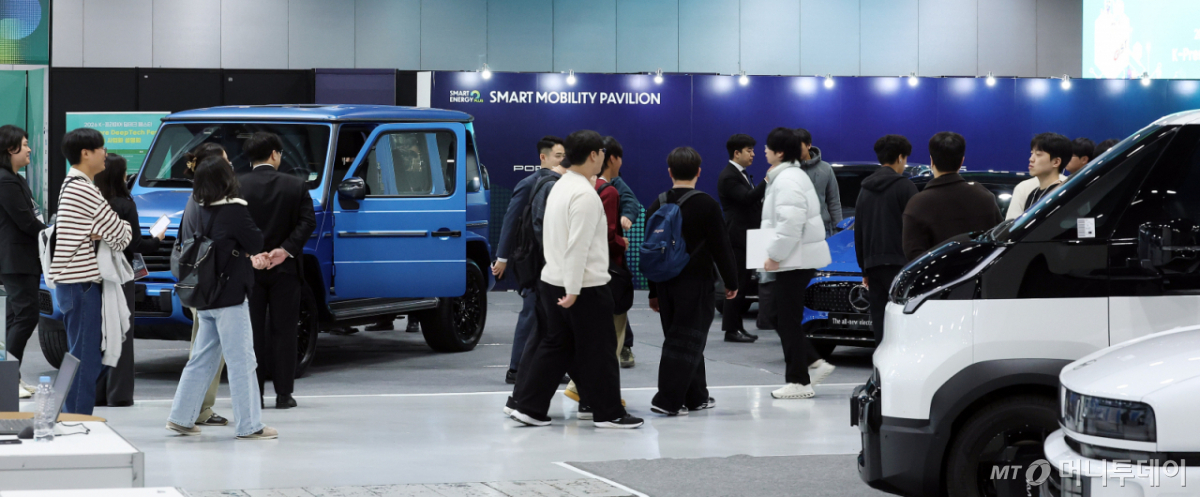
Just a few steps away, another scene unfolded. Visitors continued to line up to climb into the electric vehicle model of Mercedes-Benz's iconic off-roader, the "G-Class (Ji-ba-gen)," the "G 580 with EQ Technology." The vivid blue matte body, high and straight silhouette, and round headlamps combined to showcase the majestic build characteristic of the Ji-ba-gen. While the exterior is no different from existing internal combustion engine models, the power source moving the vehicle is an electric motor, not an engine. A line of visitors waiting to climb into the vehicle continued in front of the wide-open driver's door.
Visitors took turns sitting in the driver's seat, gripping the steering wheel, and pressing the display on the dashboard with their fingers to examine various functions. Family visitors were notably seen checking the interior space by sitting not only in the driver's seat but also in the rear seats, or taking photos while moving in and out of the vehicle. Although it was not a test drive on the road, the scene of sitting in the driver's seat to experience advanced convenience features resembled an auto show.
In particular, this vehicle maintains the distinctive design of the existing Ji-ba-gen while featuring four electric motors, one for each wheel. Unlike typical electric vehicles that drive wheels with one or two motors, it is designed to control driving force independently for each wheel. A representative technology utilizing this is "G-TURN," which rotates the vehicle body in place. By varying the rotation direction of the left and right wheels, the vehicle can be turned, a feature useful when changing direction on rough terrain. Since the Ji-ba-gen itself was created based on off-road driving, these characteristics are maintained even in the electric version.
The continued scarcity of the Ji-ba-gen is also a reason for drawing visitor interest. A Mercedes-Benz official stated, "The Ji-ba-gen is produced in Switzerland, taking longer to manufacture than general mass-produced cars, and production volumes are limited," adding, "Although it was released domestically in May last year, one must wait more than a year to purchase it currently."
Above all, Porsche's pure electric sports car, the "Taycan GTS," also caught visitors' eyes. Unlike the Mercedes-Benz Ji-ba-gen, visitors could not climb directly into the vehicle, but they could examine its low, sleek body and distinctive sports car design up close. The fact that even high-performance sports cars have joined the ranks of electrification demonstrated how diverse the appearance of future vehicles is becoming.
In addition, various eco-friendly vehicles from domestic and international automaker brands were on display. BMW showcased two electric SUVs, the "The New BMW iX3," while Audi presented the electric sedan "A6 e-tron." Polestar's "Polestar 4 Coupe" and Lexus's eighth-generation full-facelift model, the "All-New ES 350e," as well as Buick's plug-in hybrid (PHEV) "Electra E7," were also exhibited. Domestic brands included Hyundai Motor's hydrogen fuel cell vehicle "Nexo" and Kia's purpose-built vehicle (PBV) "PV5" and eco-friendly car "Niro." The exhibition was arranged to allow visitors to view the diverse forms of future means of transportation, ranging from luxury electric SUVs to sports sedans, hydrogen fuel cell vehicles, and logistics and passenger transport vehicles, all in one place.

 in INDUSTRY

